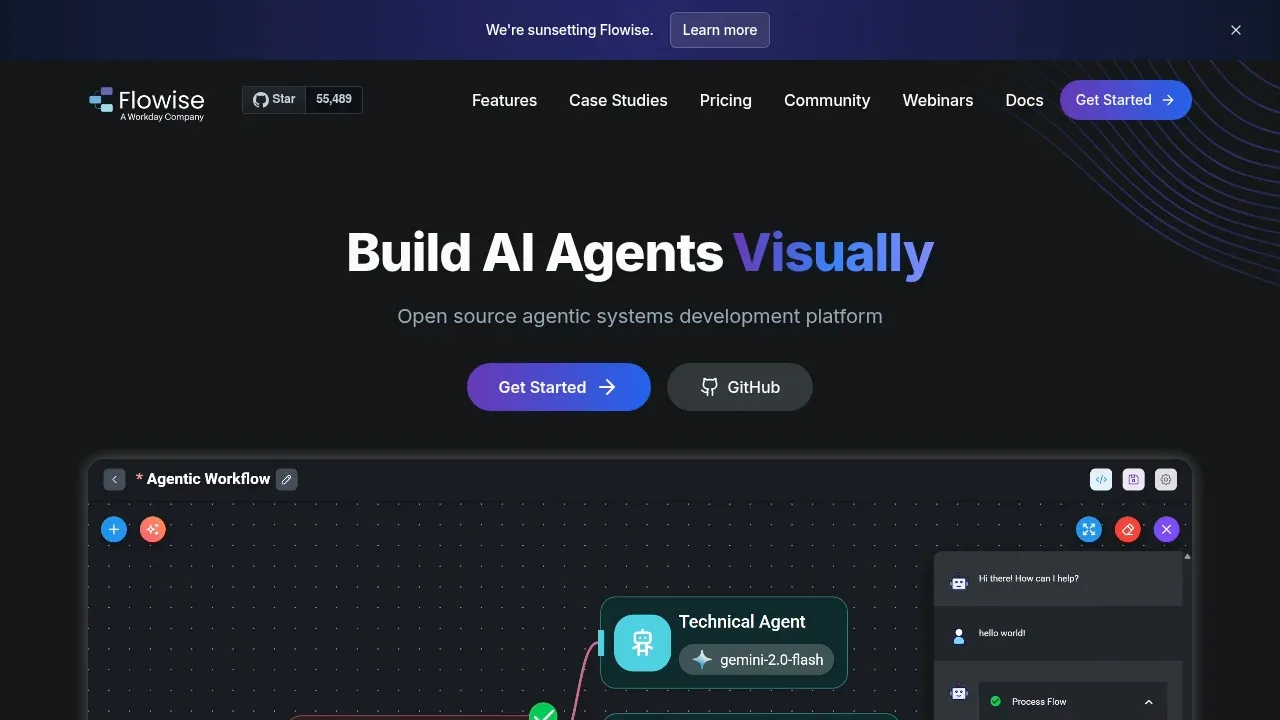
Flowise is a visual builder for AI agents and chatbots that can run locally or on your own server, including through Docker. It's for developers and teams building LLM applications with connected workflow blocks. The project is archived and no longer maintained.
Its editor covers both chat assistants and workflows that coordinate multiple agents. Chatflow builds single-agent assistants with tool calling and retrieval-augmented generation (RAG), so chatbots can draw on connected data sources. Agentflow distributes work across coordinated agents. Human review can sit inside the workflow, letting people check agent tasks as part of a feedback loop.
Flowise connects to LLMs, embedding services and vector databases. Its ecosystem includes LangChain and LlamaIndex, with integrations such as AWS Bedrock and Milvus. The visual approach suits teams that want to see how models, retrieval and tools connect while developing an application.
APIs, TypeScript and Python SDKs let developers connect those workflows to other applications. An embedded chat widget provides a way to put an assistant on a website. Execution traces help inspect agent behavior, and observability support includes Prometheus and OpenTelemetry.
The application supports on-premises deployment as well as cloud infrastructure. Cloud model integrations send requests to the chosen provider; hosting Flowise locally does not make those services local. Most code uses Apache 2.0, while the enterprise directory has a separate commercial license. For larger deployments, message queues and workers support horizontal scaling.
Claim this page with an email at flowiseai.com. Flowise gets the verified badge, and you can upgrade the listing to be featured on localhosted. Proud to be listed? Put our badge on your site.
Want more people to find Flowise?Promote it
Something wrong or outdated on this page?
157.6KUpdated 3 hours ago
Docker · Web#Code execution#MCP#OpenAI-compatible API
Dify is a source-available platform for teams building AI agents and apps on a visual canvas. Its Community Edition runs on your own server with Docker. Dify also offers a hosted cloud service, while Enterprise deployments can run in a VPC or on a self-hosted server. The Community Edition uses a custom Apache 2.0 derivative license.
155.4KUpdated 1 day agoMIT
macOS · Windows · Docker · Web#LLM tracing#MCP#Multi-agent workflows
12KUpdated 1 week agoApache-2.0
Docker · Web#Batch processing#Human approval#Multi-agent workflows
29.8KUpdated 1 day ago
Docker · Web#LLM tracing#MCP#Multi-user access
FastGPT is a self-hosted AI agent builder for teams that want assistants to answer questions using company documents and carry out business workflows. Its visual editor connects model calls, knowledge retrieval and tools into applications for customer support, internal knowledge search and document review. You can run the platform on your own server through Docker or use the vendor's hosted service.
22.9KUpdated 3 days agoGPL-3.0
Docker · Web#MCP#Multimodal input#RAG
18.3KUpdated 24 hours agoMIT
macOS · Windows · Linux · Docker · Web#Human approval#Hybrid search#llama.cpp backend
Langflow is a visual builder for developers creating AI agents and retrieval-augmented generation (RAG) applications. You can run it locally or on your own server, with Docker support and desktop apps for Windows and macOS. The open-source software uses the MIT license. A hosted cloud offering provides a separate deployment option.
Bisheng is an open source, self-hosted platform for teams building AI applications around business documents and processes. Its visual workflow editor combines automated tasks with human feedback, including intervention during multi-turn conversations. It's suited to document review, support ticket assistance and report generation that need more control than a single chatbot exchange.
MaxKB is a self-hosted AI agent platform for organizations building customer support bots, internal knowledge assistants and business automation. It combines answers grounded in company documents with workflows that can call functions and MCP tools. You can run it on your own server through Docker and use it through a browser.
DocsGPT is an MIT-licensed, open-source platform for teams that want AI search, assistants and agents over their own documents. It can run on your servers with local models, including fully air-gapped deployments where documents and questions stay inside your network. Answers include the source title and page number so readers can check the evidence.