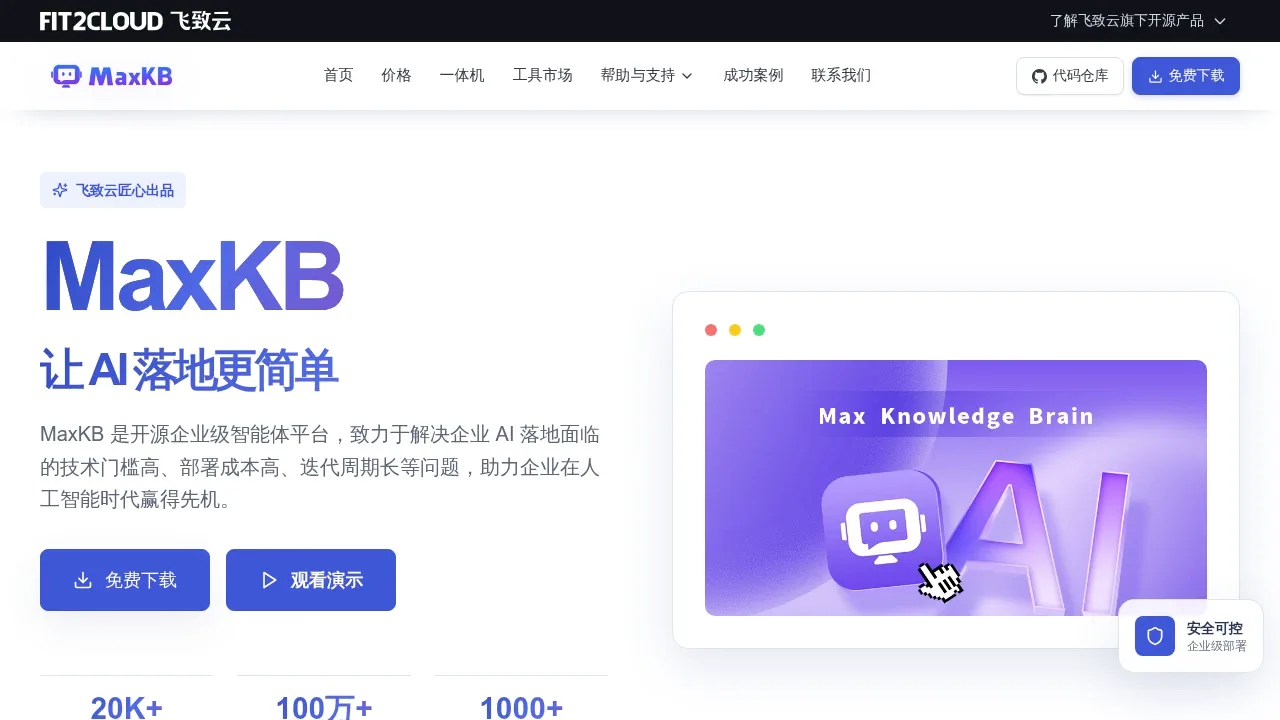
MaxKB is a self-hosted AI agent platform for organizations building customer support bots, internal knowledge assistants and business automation. It combines answers grounded in company documents with workflows that can call functions and MCP tools. You can run it on your own server through Docker and use it through a browser.
Its knowledge bases accept uploaded files in multiple formats and can collect online documents automatically. MaxKB prepares that material for retrieval so an assistant can draw on relevant passages when answering questions. This suits tasks such as explaining HR policies, finding technical guidance or answering service enquiries from a shared body of knowledge.
Workflows let teams build processes beyond document Q&A, including contract review and approval support. A function library and MCP tool access give agents ways to interact with other systems. The platform also supports text, image, audio and video input and output.
You choose the model backend. MaxKB supports privately deployed DeepSeek, Llama and Qwen models, as well as cloud services from OpenAI, Claude, Gemini and MiniMax. The platform runs on your server; choosing a cloud model sends model requests to that provider.
Teams can embed assistants in websites and connect them to WeCom, DingTalk or Feishu. An API lets existing business applications call its AI capabilities. MaxKB is open source under GPL-3.0, with a separate commercial edition.
Claim this page with an email at maxkb.cn. MaxKB gets the verified badge, and you can upgrade the listing to be featured on localhosted. Proud to be listed? Put our badge on your site.
Want more people to find MaxKB?Promote it
Something wrong or outdated on this page?
18.3KUpdated 24 hours agoMIT
macOS · Windows · Linux · Docker · Web#Human approval#Hybrid search#llama.cpp backend
DocsGPT is an MIT-licensed, open-source platform for teams that want AI search, assistants and agents over their own documents. It can run on your servers with local models, including fully air-gapped deployments where documents and questions stay inside your network. Answers include the source title and page number so readers can check the evidence.
29.8KUpdated 1 day ago
Docker · Web#LLM tracing#MCP#Multi-user access
FastGPT is a self-hosted AI agent builder for teams that want assistants to answer questions using company documents and carry out business workflows. Its visual editor connects model calls, knowledge retrieval and tools into applications for customer support, internal knowledge search and document review. You can run the platform on your own server through Docker or use the vendor's hosted service.
55.5KUpdated 2 months ago
Docker · Web#Human approval#LLM tracing#Multi-agent workflows
91.5KUpdated 7 hours agoApache-2.0
macOS · Windows · Linux · Docker#Hybrid search#MCP#Multi-agent workflows
157.6KUpdated 3 hours ago
Docker · Web#Code execution#MCP#OpenAI-compatible API
155.4KUpdated 1 day agoMIT
macOS · Windows · Docker · Web#LLM tracing#MCP#Multi-agent workflows
Flowise is a visual builder for AI agents and chatbots that can run locally or on your own server, including through Docker. It's for developers and teams building LLM applications with connected workflow blocks. The project is archived and no longer maintained.
RAGFlow is an Apache 2.0 licensed RAG engine for teams building AI agents that need to answer questions from their own documents. It can run on a self-hosted server through Docker on Windows, macOS or Linux. A separate hosted cloud service is available.
Dify is a source-available platform for teams building AI agents and apps on a visual canvas. Its Community Edition runs on your own server with Docker. Dify also offers a hosted cloud service, while Enterprise deployments can run in a VPC or on a self-hosted server. The Community Edition uses a custom Apache 2.0 derivative license.
Langflow is a visual builder for developers creating AI agents and retrieval-augmented generation (RAG) applications. You can run it locally or on your own server, with Docker support and desktop apps for Windows and macOS. The open-source software uses the MIT license. A hosted cloud offering provides a separate deployment option.