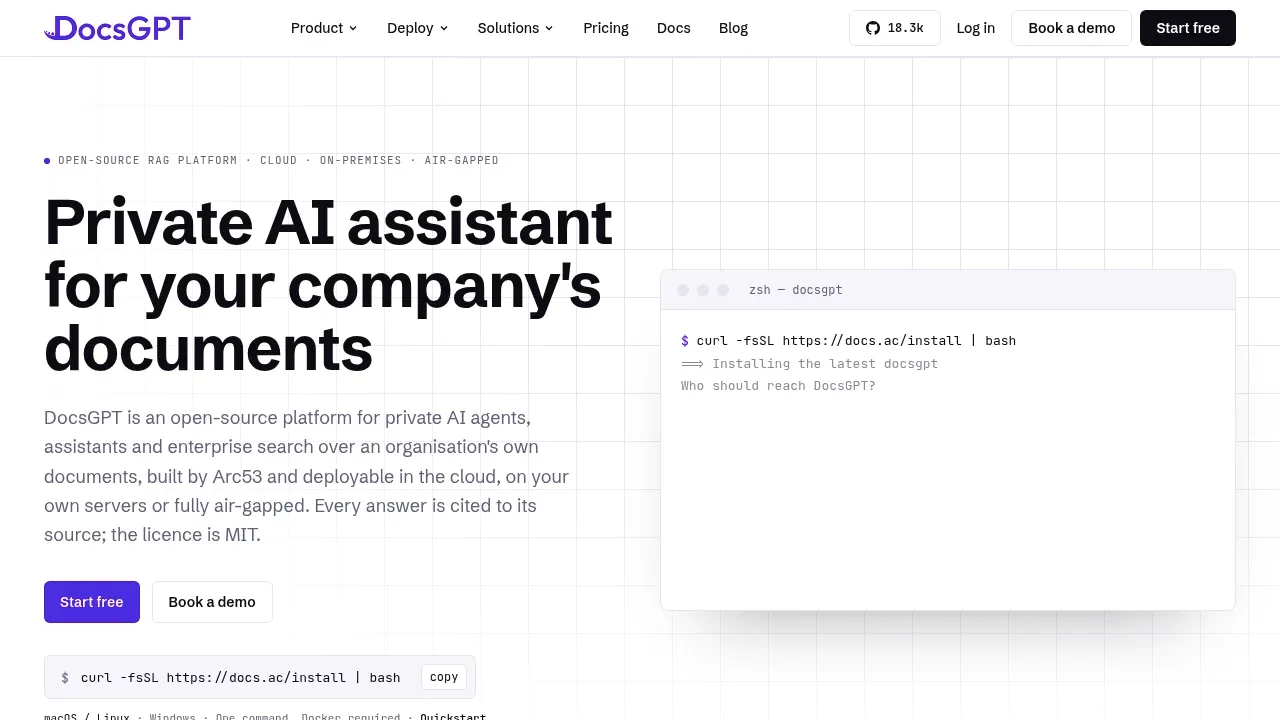
DocsGPT is an MIT-licensed, open-source platform for teams that want AI search, assistants and agents over their own documents. It can run on your servers with local models, including fully air-gapped deployments where documents and questions stay inside your network. Answers include the source title and page number so readers can check the evidence.
It reads PDFs, Office files, web content, images and audio. OCR makes scanned PDFs searchable, while audio transcription lets teams search meeting recordings and voice notes. Connectors bring in documents from Google Drive, SharePoint, Confluence and S3; it can also ingest websites and sitemaps.
Beyond answering questions, agents can conduct research and call tools through MCP or connected APIs. A visual workflow builder combines agents with conditions and code for document jobs, with execution history and human approval gates. Teams can embed chat in a website or connect assistants to Discord and Telegram.
Deployment determines where processing happens. Docker-based self-hosting works on macOS, Windows and Linux, with local inference through Ollama, vLLM or llama.cpp. Cloud model options include OpenAI, Google and Anthropic. A hybrid deployment keeps the platform on premises but sends model requests to a cloud provider; Arc53 also operates hosted and dedicated managed services.
For organisations with access and audit requirements, DocsGPT supports single sign-on, user provisioning and role-based permissions. Its append-only audit log records questions, answers and actions, and guardrails can flag, redact or block inputs and outputs.
Claim this page with an email at docsgpt.cloud. DocsGPT gets the verified badge, and you can upgrade the listing to be featured on localhosted. Proud to be listed? Put our badge on your site.
Want more people to find DocsGPT?Promote it
Something wrong or outdated on this page?
91.5KUpdated 7 hours agoApache-2.0
macOS · Windows · Linux · Docker#Hybrid search#MCP#Multi-agent workflows
RAGFlow is an Apache 2.0 licensed RAG engine for teams building AI agents that need to answer questions from their own documents. It can run on a self-hosted server through Docker on Windows, macOS or Linux. A separate hosted cloud service is available.
22.9KUpdated 3 days agoGPL-3.0
Docker · Web#MCP#Multimodal input#RAG
34.4KUpdated 2 months agoApache-2.0
macOS · Windows · Linux · Docker · Web#Batch processing#Human approval#MCP
20.1KUpdated 2 days agoMIT
macOS · Linux · Docker · Web#Code execution#llama.cpp backend#OpenAI-compatible API
155.4KUpdated 1 day agoMIT
macOS · Windows · Docker · Web#LLM tracing#MCP#Multi-agent workflows
12KUpdated 1 week agoApache-2.0
Docker · Web#Batch processing#Human approval#Multi-agent workflows
MaxKB is a self-hosted AI agent platform for organizations building customer support bots, internal knowledge assistants and business automation. It combines answers grounded in company documents with workflows that can call functions and MCP tools. You can run it on your own server through Docker and use it through a browser.
ChatDev is a self-hosted platform for building teams of AI agents through a visual workflow editor. It's for people who want agents to collaborate on research, data analysis or software projects without writing the orchestration code themselves. You define each agent's role and how information passes between them.
DB-GPT is a self-hosted AI data assistant for teams analyzing business data and developers building data applications. It turns plain-language requests into SQL queries and Python analysis, then produces charts, dashboards, or HTML reports. You can run it on macOS or Linux, with Docker deployment also supported.
Langflow is a visual builder for developers creating AI agents and retrieval-augmented generation (RAG) applications. You can run it locally or on your own server, with Docker support and desktop apps for Windows and macOS. The open-source software uses the MIT license. A hosted cloud offering provides a separate deployment option.
Bisheng is an open source, self-hosted platform for teams building AI applications around business documents and processes. Its visual workflow editor combines automated tasks with human feedback, including intervention during multi-turn conversations. It's suited to document review, support ticket assistance and report generation that need more control than a single chatbot exchange.