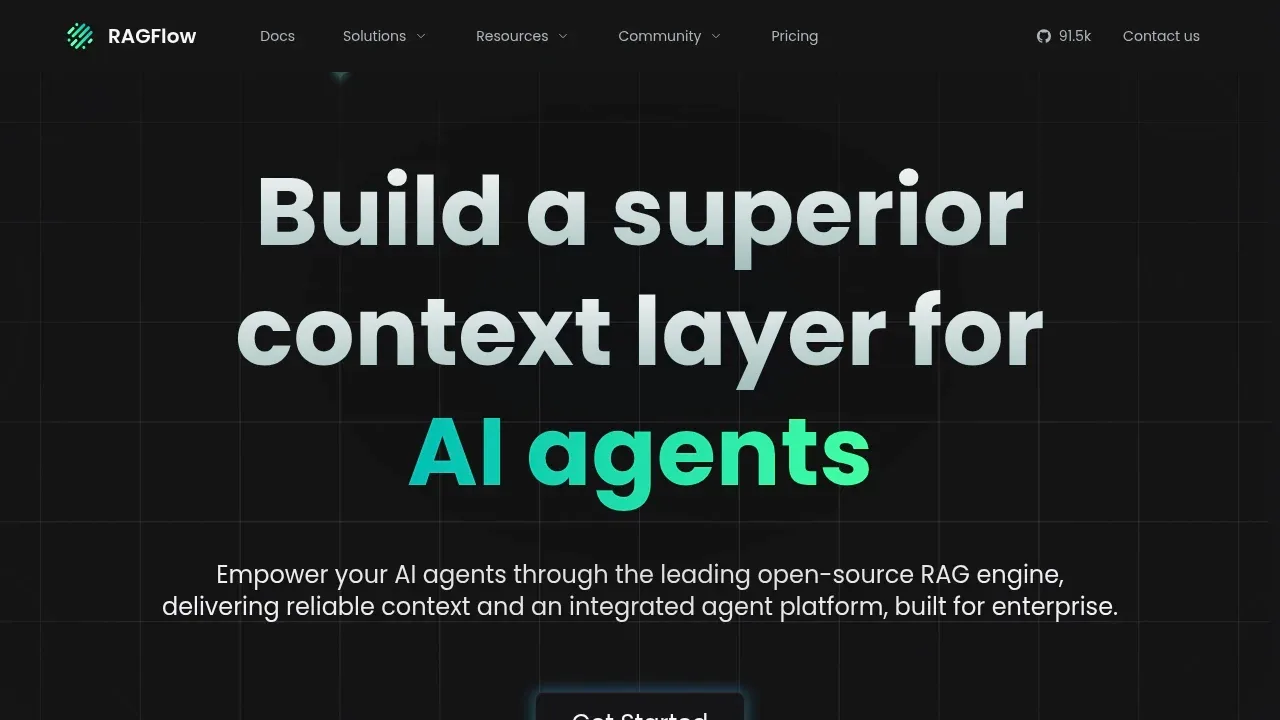
RAGFlow is an Apache 2.0 licensed RAG engine for teams building AI agents that need to answer questions from their own documents. It can run on a self-hosted server through Docker on Windows, macOS or Linux. A separate hosted cloud service is available.
Its ingestion pipeline handles Word files, slides, spreadsheets, images, scanned pages, structured data and web pages. It extracts content from complex layouts, including tables, then organizes it for retrieval. Teams can inspect and adjust how documents are split into searchable chunks, or compile document and dataset content into formats such as wikis, graphs and timelines.
Search combines vector retrieval, BM25 keyword matching, custom scoring and reranking. For complex questions, an agent can break a query into steps and retrieve more evidence before answering. Citations point back to the material used. Visual workflows bring retrieval, tools and MCP connections into the same agent platform, while configurable LLM, embedding and reranking models let teams choose their model providers.
The self-hosted deployment uses a Go service for its API, administration and document ingestion. Document layout analysis, OCR and table recognition run on the CPU. Resource needs depend on the document workload and the models you run.
Claim this page with an email at ragflow.io. RAGFlow gets the verified badge, and you can upgrade the listing to be featured on localhosted. Proud to be listed? Put our badge on your site.
Want more people to find RAGFlow?Promote it
Something wrong or outdated on this page?
18.3KUpdated 24 hours agoMIT
macOS · Windows · Linux · Docker · Web#Human approval#Hybrid search#llama.cpp backend
DocsGPT is an MIT-licensed, open-source platform for teams that want AI search, assistants and agents over their own documents. It can run on your servers with local models, including fully air-gapped deployments where documents and questions stay inside your network. Answers include the source title and page number so readers can check the evidence.
12KUpdated 1 week agoApache-2.0
Docker · Web#Batch processing#Human approval#Multi-agent workflows
22.9KUpdated 3 days agoGPL-3.0
Docker · Web#MCP#Multimodal input#RAG
155.4KUpdated 1 day agoMIT
macOS · Windows · Docker · Web#LLM tracing#MCP#Multi-agent workflows
39.9KUpdated 4 days agoMIT
macOS · Windows · Linux · Docker · Web#Knowledge graphs#LLM tracing#Multimodal input
20.1KUpdated 2 days agoMIT
macOS · Linux · Docker · Web#Code execution#llama.cpp backend#OpenAI-compatible API
Bisheng is an open source, self-hosted platform for teams building AI applications around business documents and processes. Its visual workflow editor combines automated tasks with human feedback, including intervention during multi-turn conversations. It's suited to document review, support ticket assistance and report generation that need more control than a single chatbot exchange.
MaxKB is a self-hosted AI agent platform for organizations building customer support bots, internal knowledge assistants and business automation. It combines answers grounded in company documents with workflows that can call functions and MCP tools. You can run it on your own server through Docker and use it through a browser.
Langflow is a visual builder for developers creating AI agents and retrieval-augmented generation (RAG) applications. You can run it locally or on your own server, with Docker support and desktop apps for Windows and macOS. The open-source software uses the MIT license. A hosted cloud offering provides a separate deployment option.
LightRAG combines knowledge graphs with vector search to answer questions across a document collection. It's a self-hosted Python framework for developers building document assistants, particularly where answers depend on relationships between facts in different files, such as legal or financial material.
DB-GPT is a self-hosted AI data assistant for teams analyzing business data and developers building data applications. It turns plain-language requests into SQL queries and Python analysis, then produces charts, dashboards, or HTML reports. You can run it on macOS or Linux, with Docker deployment also supported.