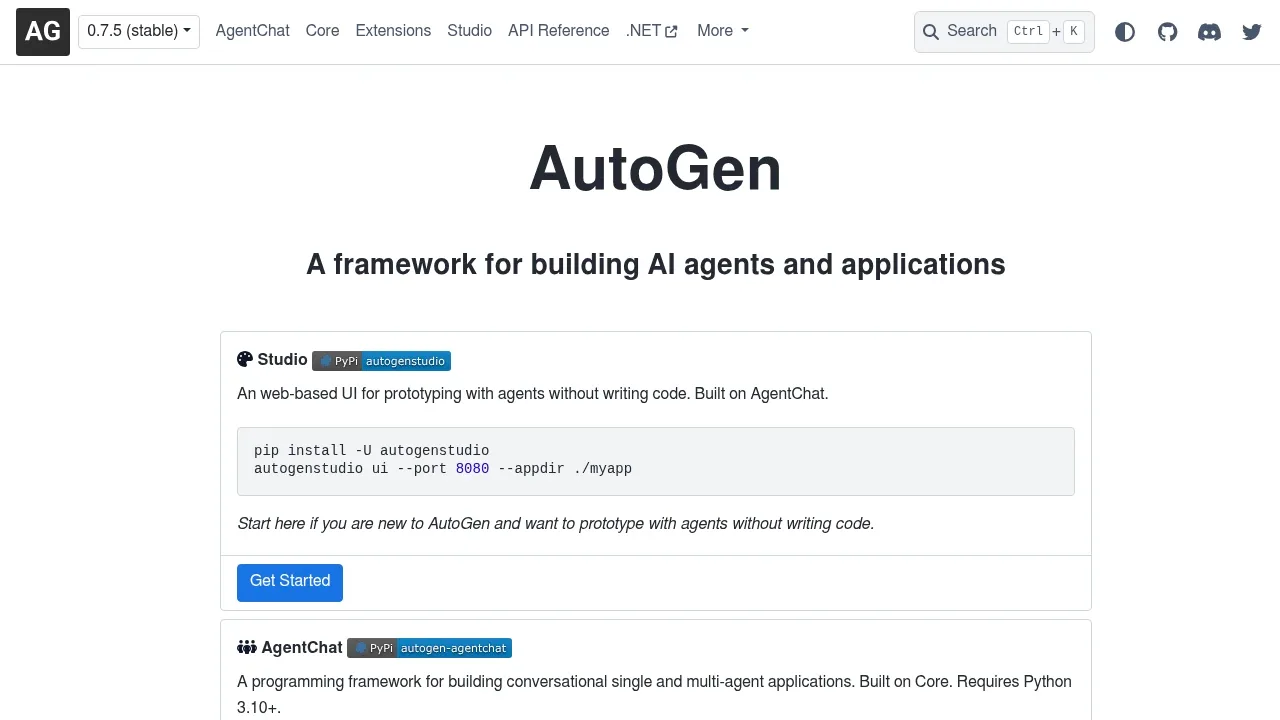
AutoGen is a framework for developers building AI agents that work together or alongside people. Its agent runtime can run locally or across distributed systems, while model integrations such as OpenAI and Azure OpenAI send requests to external services. It's community-managed and in maintenance mode, with no further features or enhancements planned.
The framework lets developers choose how much control they need. AgentChat provides a higher-level Python interface for conversational assistants, two-agent exchanges and group chats. Core handles event-driven workflows and message passing for more customized systems, including agents distributed across Python and .NET applications.
AutoGen Studio provides a browser-based interface for building and running multi-agent prototypes without writing code. It's a prototyping tool rather than a production application. Developers can use AutoGen Bench to evaluate agent performance.
Extensions connect agents to external tools and services. MCP support includes integrations such as Playwright for web browsing, while a Docker code executor runs model-generated code in containers. Developers can also create their own extensions. The documented OpenAI integration supports GPT-4o and requires an OpenAI account and API key, so that setup depends on a cloud service.
AutoGen requires Python 3.10 or later. Code is MIT licensed; documentation and other repository content use Creative Commons Attribution 4.0. Microsoft recommends Microsoft Agent Framework for new projects.
Claim this page and we'll verify you by hand. AutoGen gets the verified badge, and you can upgrade the listing to be featured on localhosted. Proud to be listed? Put our badge on your site.
Want more people to find AutoGen?Promote it
Something wrong or outdated on this page?
155.4KUpdated 1 day agoMIT
macOS · Windows · Docker · Web#LLM tracing#MCP#Multi-agent workflows
Langflow is a visual builder for developers creating AI agents and retrieval-augmented generation (RAG) applications. You can run it locally or on your own server, with Docker support and desktop apps for Windows and macOS. The open-source software uses the MIT license. A hosted cloud offering provides a separate deployment option.
55.5KUpdated 2 months ago
Docker · Web#Human approval#LLM tracing#Multi-agent workflows
42.4KUpdated 1 day agoApache-2.0
Docker · Web#Guardrails#Human approval#LLM tracing
3.1KUpdated 2 days agoApache-2.0
macOS · Windows · Linux · Web#Code execution#MCP#Multi-agent workflows
157.6KUpdated 3 hours ago
Docker · Web#Code execution#MCP#OpenAI-compatible API
2.9KUpdated 22 hours agoMIT
Web · VS Code#Code execution#Hugging Face integration#MCP
Flowise is a visual builder for AI agents and chatbots that can run locally or on your own server, including through Docker. It's for developers and teams building LLM applications with connected workflow blocks. The project is archived and no longer maintained.
Agno is a Python framework and runtime for developers building customer-facing or internal AI agents. You can run its agent platform locally with Docker, on your own servers or in your cloud. The open-source framework uses the Apache 2.0 license, and the platform keeps sessions, memory, knowledge and traces in your database.
BotSharp is a self-hosted framework for .NET developers building AI agents into business applications. Written in C#, it runs on Windows, Linux and macOS and is open source software under Apache 2.0. Its plugin design lets teams choose their model provider, storage and interface while keeping agent coordination in the same framework.
Dify is a source-available platform for teams building AI agents and apps on a visual canvas. Its Community Edition runs on your own server with Docker. Dify also offers a hosted cloud service, while Enterprise deployments can run in a VPC or on a self-hosted server. The Community Edition uses a custom Apache 2.0 derivative license.
Inspect AI is a Python framework for researchers and developers testing language models and AI agents. Developed by the UK AI Security Institute and Meridian Labs, it evaluates coding, reasoning, knowledge, behavior and multimodal understanding, including tasks where agents must take actions to succeed.