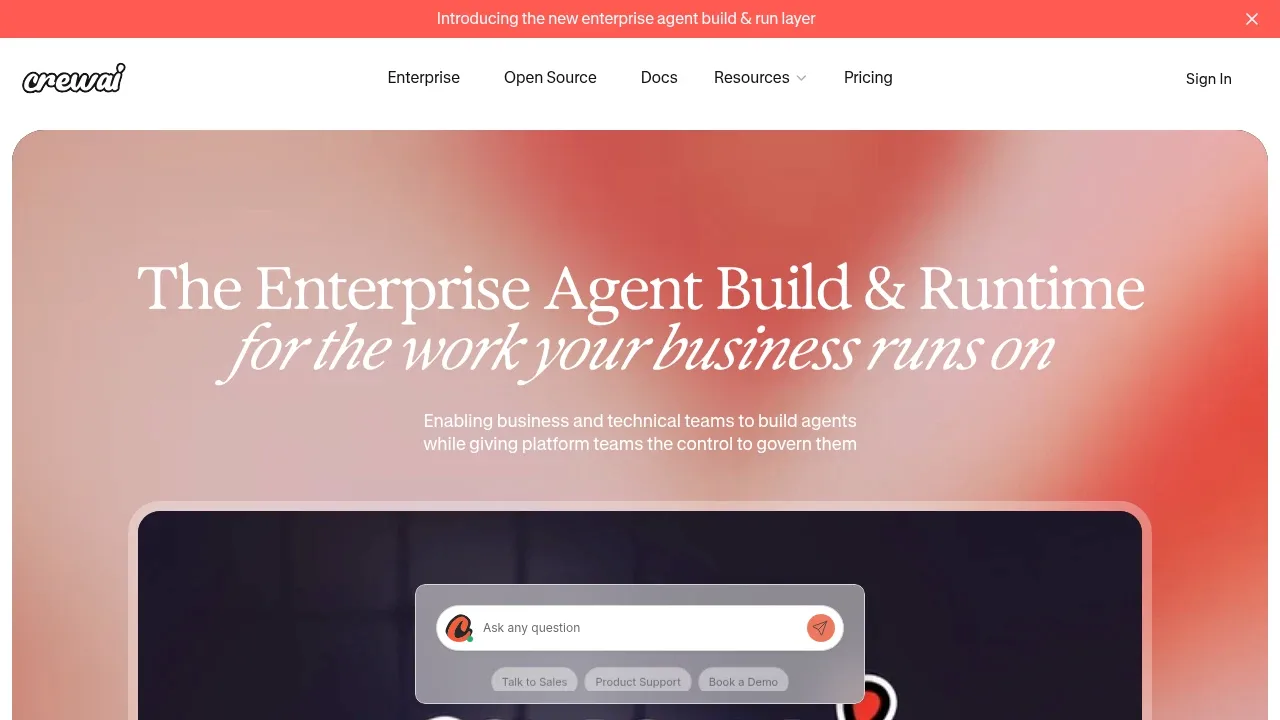
CrewAI is an open-source Python framework for developers building workflows with multiple AI agents on their own hardware or servers. It supports local models through Ollama and defaults to the OpenAI API for model requests. The framework uses the MIT license; a separate commercial platform provides managed deployment and governance, with on-premise and cloud options.
Its two main building blocks give you different levels of control. Crews group specialized agents with roles, goals, tools and assigned tasks. Flows put agent work inside event-driven workflows with state, branching and explicit business logic. You can combine both in one application, so autonomous decisions can sit alongside predictable steps and human review.
Agents can use memory and knowledge, return structured results, and save checkpoints. MCP and A2A support let them connect to tools and other agents. Python APIs give developers control over prompts and execution logic, while the commercial platform also has a visual builder that exports to Python.
For teams managing agents in production, the commercial control plane traces model and tool calls, tracks costs, and adds access controls, audit trails and approval gates. Runtime checks can redact personal data and enforce policies.
Model choice affects where requests go: Ollama supports local inference, while the OpenAI API sends model requests to OpenAI. The framework also collects anonymous usage telemetry, which you can disable. Enabling share_crew allows it to collect task descriptions and agent attributes.
Claim this page with an email at crewai.com. CrewAI gets the verified badge, and you can upgrade the listing to be featured on localhosted. Proud to be listed? Put our badge on your site.
Want more people to find CrewAI?Promote it
Something wrong or outdated on this page?
155.4KUpdated 1 day agoMIT
macOS · Windows · Docker · Web#LLM tracing#MCP#Multi-agent workflows
Langflow is a visual builder for developers creating AI agents and retrieval-augmented generation (RAG) applications. You can run it locally or on your own server, with Docker support and desktop apps for Windows and macOS. The open-source software uses the MIT license. A hosted cloud offering provides a separate deployment option.
55.5KUpdated 2 months ago
Docker · Web#Human approval#LLM tracing#Multi-agent workflows
42.5KUpdated 2 hours agoMIT
#Human approval#Multi-agent workflows#Persistent memory
34.4KUpdated 2 months agoApache-2.0
macOS · Windows · Linux · Docker · Web#Batch processing#Human approval#MCP
18.3KUpdated 24 hours agoMIT
macOS · Windows · Linux · Docker · Web#Human approval#Hybrid search#llama.cpp backend
28.4KUpdated 21 hours ago
Web#Human approval#LLM tracing#MCP
Flowise is a visual builder for AI agents and chatbots that can run locally or on your own server, including through Docker. It's for developers and teams building LLM applications with connected workflow blocks. The project is archived and no longer maintained.
LangGraph is a free, MIT-licensed Python framework for developers building AI agents that need to keep state and handle complex tasks. It gives teams control over how an agent moves between steps, where people can intervene, and what happens when a long-running task is interrupted.
ChatDev is a self-hosted platform for building teams of AI agents through a visual workflow editor. It's for people who want agents to collaborate on research, data analysis or software projects without writing the orchestration code themselves. You define each agent's role and how information passes between them.
DocsGPT is an MIT-licensed, open-source platform for teams that want AI search, assistants and agents over their own documents. It can run on your servers with local models, including fully air-gapped deployments where documents and questions stay inside your network. Answers include the source title and page number so readers can check the evidence.
Mastra is a TypeScript framework for developers building AI agents and applications on their own servers or inside existing web apps. Its server runs locally or as a standalone deployment; Mastra Cloud provides a hosted alternative. Model routing connects to providers such as OpenAI, Anthropic, and Gemini, so running the framework locally doesn't keep those model requests on your machine.