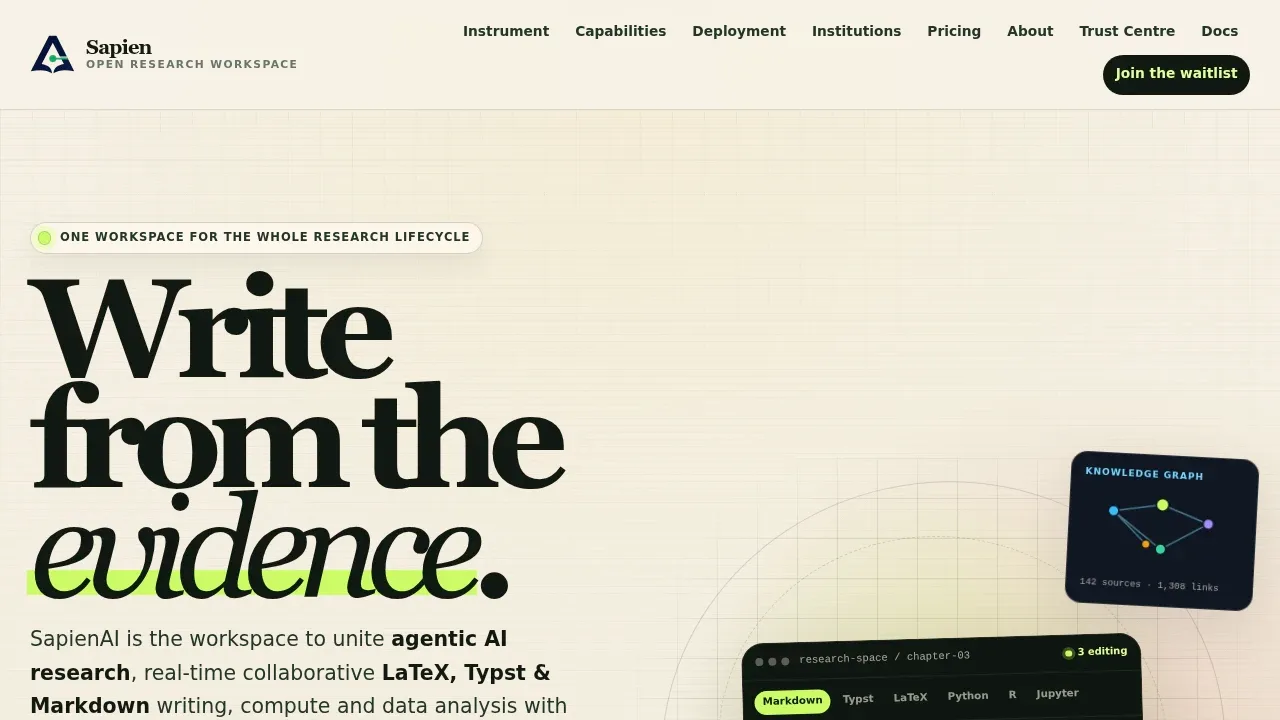
SapienAI is a self-hosted academic chatbot and writing workspace for researchers who want their sources, drafts and AI conversations in one place. It runs through Docker and connects to local models through Ollama or cloud models from OpenAI, Anthropic and Google.
Research spaces keep project documents, notes and sources alongside an editor that supports LaTeX, Typst and Markdown. You can choose how much AI assistance to use while writing. The AI can read uploaded material, summarize it and answer questions about its contents.
Semantic search covers chats and uploaded documents, with a Zotero connection for searching your reference library too. Integrated academic paper search gives responses supporting research evidence. For literature reviews, SapienAI can generate a review from uploaded sources and export it to Word or Excel. It also supports spoken conversations through realtime audio chat.
Messages, files and images stay in storage on your own device. Model choice is a separate privacy decision: Ollama provides a local model connection, while choosing a cloud provider sends the selected AI requests to that service. Cloud connections can use provider APIs directly or services such as Azure, AWS and Google Vertex.
Claim this page with an email at academicid.io. SapienAI gets the verified badge, and you can upgrade the listing to be featured on localhosted. Proud to be listed? Put our badge on your site.
Want more people to find SapienAI?Promote it
Something wrong or outdated on this page?
32.3KUpdated 1 day ago
Docker · Web · Browser Extension#MCP#Multi-user access#Ollama integration
Onyx is an AI search and chat platform for teams whose information is spread across workplace apps. It indexes company knowledge so employees can ask questions across sources and get answers grounded in relevant documents. Teams can deploy it in their own cloud or on bare metal, including an air-gapped environment.
1.3KUpdated 1 day agoMIT
Web#Agent Skills#Code execution#Human approval
37.6KUpdated 2 months agoAGPL-3.0
Web#RAG#Semantic search#Web search
11.9KUpdated 2 months agoAGPL-3.0
Web#Code execution#Multilingual#RAG
15.3KUpdated 2 weeks agoGPL-3.0
macOS · Windows · Linux · iOS · Android · Web#llama.cpp backend#LoRA#Multi-user access
77KUpdated 3 months agoAGPL-3.0
macOS · Windows · Linux · iOS · Android · Web#MCP#Multi-user access#RAG
Kady is a free, open-source AI research assistant for scientists who want to carry out analyses and review evidence on their own computer. You describe the task in plain language, and it can inspect files, write and run analysis code, search literature, and produce figures or reports. It uses the MIT license.
Khoj is an AI assistant for people who want to ask questions across their own files, research the web, and give recurring work to agents. You can self-host it on your computer or server, or use Khoj's cloud app. It's open source under the GNU AGPL v3.0 license.
Scira is an AI search engine for people who want answers backed by sources and control over the application they use for research. It has a hosted website, and you can self-host the open-source application under AGPL-3.0. Its live search relies on internet access and external services; self-hosting doesn't make that research offline.
ChuanhuChatGPT is a self-hosted web chat interface for people who want local models and cloud AI services in the same application. It runs on your computer or server and opens in a browser, with support for Windows, macOS and Linux. The Python application is open source under GPL-3.0.
AppFlowy is a self-hosted Notion alternative for teams that want project management, shared documents, and AI in an environment they control. Its self-hosted enterprise offering can run on premises, in your own cloud, or in an air-gapped environment. Self-hosted LLMs and embedding models let you keep AI processing and workspace data inside your infrastructure, with no vendor access to your instance.