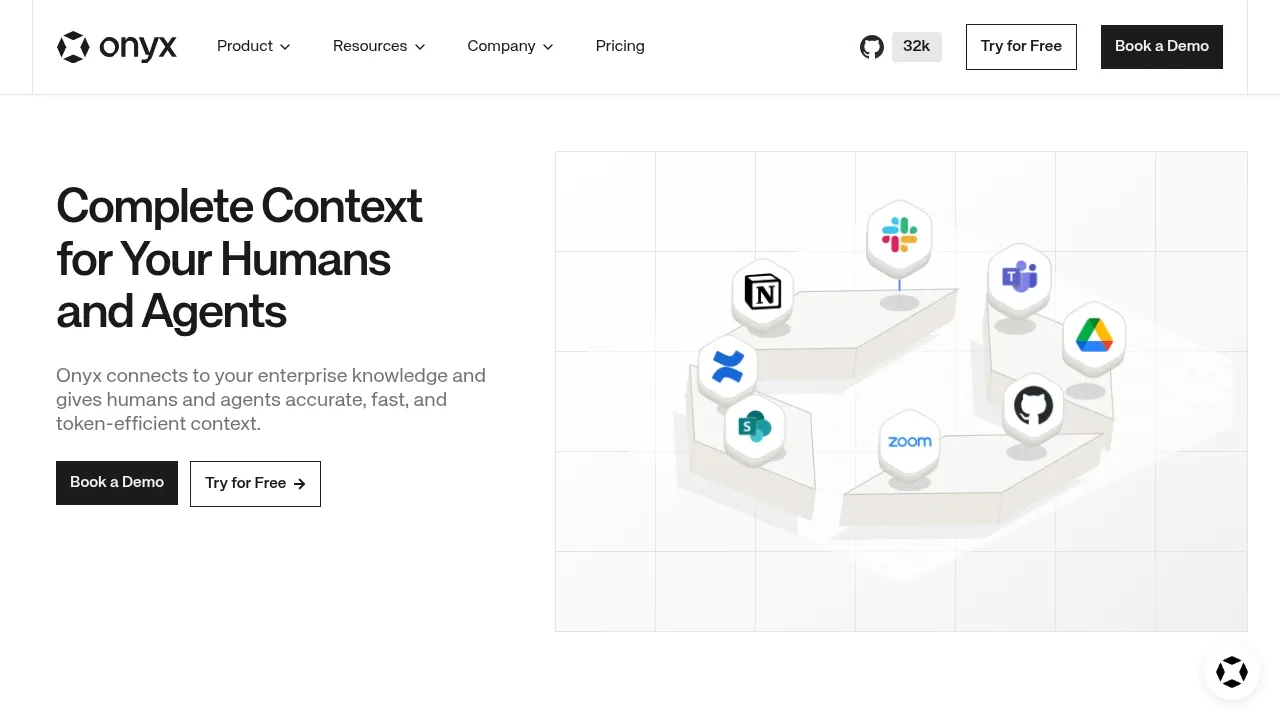
Onyx is an AI search and chat platform for teams whose information is spread across workplace apps. It indexes company knowledge so employees can ask questions across sources and get answers grounded in relevant documents. Teams can deploy it in their own cloud or on bare metal, including an air-gapped environment.
Search draws on indexed content from tools such as GitHub, Google Drive, Slack and Confluence. In the Enterprise Edition, Onyx can sync source permissions into its index and check them when someone asks a question, so an answer reflects what that person can access. Employees can use the web or desktop app, while teams can bring the same search into Slack. An MCP server gives coding assistants such as Claude Code and Codex access to company context under those permissions.
Onyx also supports custom AI agents with selected knowledge, instructions and actions. They can use web search and external applications, and the platform can produce reports and downloadable artifacts. For teams choosing their own models, Onyx works with local backends including Ollama, LiteLLM and vLLM, as well as providers such as Anthropic, OpenAI and Gemini. With local models, the document index, embeddings and model traffic can stay inside the team's infrastructure; using an external model provider sends model traffic outside that boundary.
The Community Edition is MIT-licensed and covers core search, chat, agents and actions. Self-hosted Enterprise adds source-permission sync, role controls and SSO. Onyx Cloud is available for teams that do not want to run the platform themselves.
Claim this page with an email at onyx.app. Onyx gets the verified badge, and you can upgrade the listing to be featured on localhosted. Proud to be listed? Put our badge on your site.
Want more people to find Onyx?Promote it
Something wrong or outdated on this page?
37.5KUpdated 2 months agoAGPL-3.0
Web#RAG#Semantic search#Web search
Khoj is an AI assistant for people who want to ask questions across their own files, research the web, and give recurring work to agents. You can self-host it on your computer or server, or use Khoj's cloud app. It's open source under the GNU AGPL v3.0 license.
38.7KUpdated 11 months agoApache-2.0
macOS · Windows · Linux · Docker · Web#Multimodal input#Ollama integration#OpenAI-compatible API
9.1KUpdated 21 hours agoMIT
macOS · Windows · Linux · Docker · Web#llama.cpp backend#MCP#Multi-user access
22.2KUpdated 1 month agoMIT
macOS · Windows · Linux · Docker · Web#Hugging Face integration#Hybrid search#Ollama integration
153.6KUpdated 1 week ago
Docker · Web#Code execution#Human approval#Hybrid search
11.9KUpdated 2 months agoAGPL-3.0
Web#Code execution#Multilingual#RAG
Langchain-Chatchat is a self-hosted application for asking questions about your own documents and using AI agents. It focuses on Chinese-language use and open models, with a fully offline setup that can keep documents and model processing on your hardware. Its code is open source under Apache 2.0.
Local Deep Research is a self-hosted AI research assistant for people who need cited answers drawn from academic papers, the web and their own documents. It can produce a quick summary or pursue a complex question through repeated searches, then assemble a structured report. It's open source under MIT.
localGPT is a self-hosted AI document chat app for people who want to question and summarise files on their own hardware. Its local Ollama setup keeps documents and conversations on your machine. Answers include source passages, so you can check what the model used.
Open WebUI gives individuals and teams a self-hosted place to chat with local LLMs and cloud models. It runs on your own computer or server, including through Docker, and can work entirely offline with local models.
Scira is an AI search engine for people who want answers backed by sources and control over the application they use for research. It has a hosted website, and you can self-host the open-source application under AGPL-3.0. Its live search relies on internet access and external services; self-hosting doesn't make that research offline.