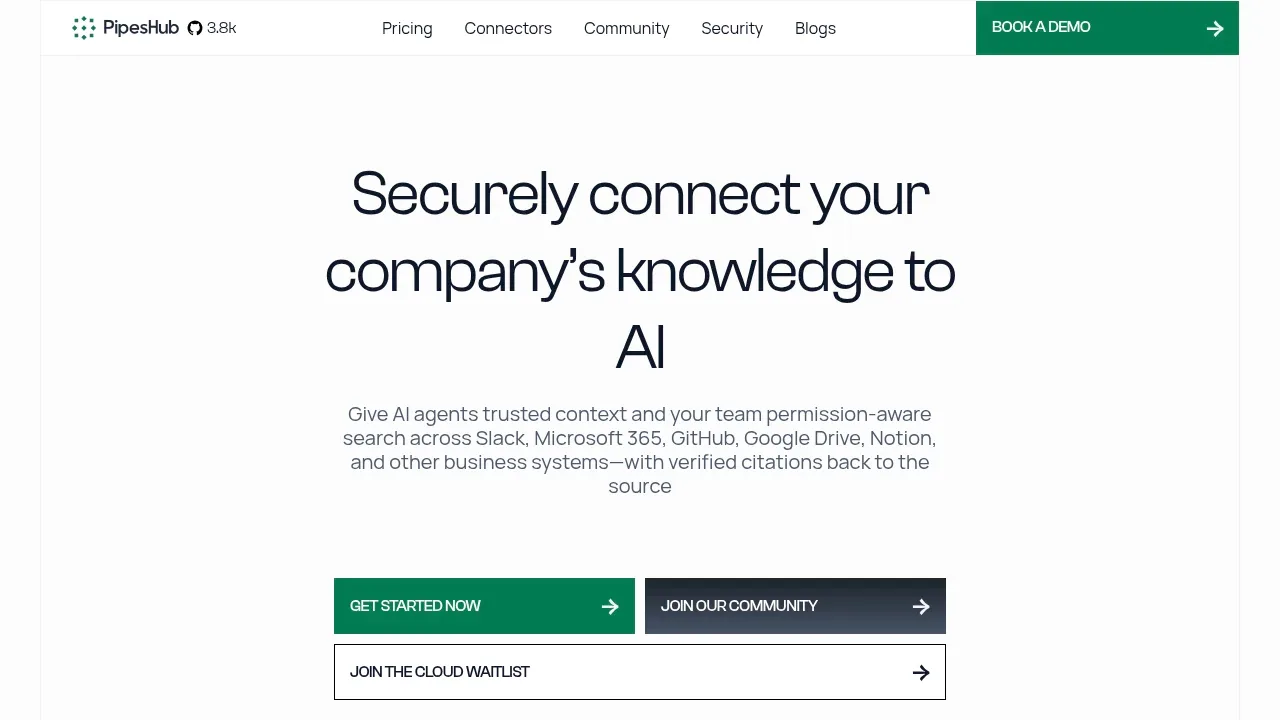
PipesHub is a self-hosted workplace AI platform for teams whose knowledge sits across business apps. It combines company-wide search, cited answers, and agents that can act on connected systems. It's an open source Glean alternative under the Apache 2.0 license, with Docker deployment on your own machine or server.
Search respects each document's original access rules. Someone who can't read a file in Google Drive can't retrieve it through PipesHub. Connectors include Slack, Microsoft 365, GitHub, Notion, and Salesforce. Its knowledge graph uses relationships between documents, entities, and metadata to retrieve context, while answers include page or paragraph references, source links, and highlighted evidence you can check.
You can run models locally through Ollama or use cloud providers such as OpenAI, Anthropic, Google, and Mistral with your own API keys. Local inference can stay on your infrastructure; choosing a cloud model sends inference requests to that provider. PipesHub also supports VPC, on-premise, and air-gapped deployments.
The visual agent builder supports department-specific assistants and workflows triggered by events or schedules. Agents can create Jira tickets from emails, send Slack alerts, or sync notes to Confluence. For developers, MCP exposes permission-filtered company context to clients such as Claude Code, Cursor, and Codex, with Python, TypeScript, and Go SDKs for custom applications. PipesHub also understands images, diagrams, and scanned files, supports voice interaction, and can generate reports, charts, and dashboards in a sandbox.
Claim this page with an email at pipeshub.com. PipesHub gets the verified badge, and you can upgrade the listing to be featured on localhosted. Proud to be listed? Put our badge on your site.
Want more people to find PipesHub?Promote it
Something wrong or outdated on this page?
32.3KUpdated 22 hours ago
Docker · Web · Browser Extension#MCP#Multi-user access#Ollama integration
Onyx is an AI search and chat platform for teams whose information is spread across workplace apps. It indexes company knowledge so employees can ask questions across sources and get answers grounded in relevant documents. Teams can deploy it in their own cloud or on bare metal, including an air-gapped environment.
18.3KUpdated 21 hours agoMIT
macOS · Windows · Linux · Docker · Web#Human approval#Hybrid search#llama.cpp backend
9.1KUpdated 22 hours agoMIT
macOS · Windows · Linux · Docker · Web#llama.cpp backend#MCP#Multi-user access
514Updated 1 month agoApache-2.0
Linux · Docker · Web#Knowledge graphs#MCP#Multi-user access
619Updated 5 days agoMIT
Docker · Web#Agent Skills#Hybrid search#Knowledge graphs
247Updated 2 days agoAGPL-3.0
macOS · Windows · Linux · Docker#Hybrid search#MCP#Multimodal input
DocsGPT is an MIT-licensed, open-source platform for teams that want AI search, assistants and agents over their own documents. It can run on your servers with local models, including fully air-gapped deployments where documents and questions stay inside your network. Answers include the source title and page number so readers can check the evidence.
Local Deep Research is a self-hosted AI research assistant for people who need cited answers drawn from academic papers, the web and their own documents. It can produce a quick summary or pursue a complex question through repeated searches, then assemble a structured report. It's open source under MIT.
RESTai is a self-hosted AI platform for developers and teams building document assistants, AI agents, and services other apps can call. Each project has its own model, prompts, and tools, with a browser dashboard for testing chats and tracking usage. It's open source under Apache 2.0 and runs on your own server, including through Docker or Kubernetes.
sage-wiki turns documents into linked articles and a knowledge graph that both people and AI agents can query. It's for personal research collections, shared team knowledge, and agents that need a lasting memory of what they've learned. The software is open source under the MIT license and runs as a Go binary or in Docker on your own machine or server. It supports local models through Ollama.
Marginalia is a local-first AI research agent for people whose research papers, notes and working documents are scattered across different formats. It checks relevant passages in the original files before writing answers with citations. Your library stays in readable folders by default.