
SLEAP
Open-source animal pose tracking software trains PyTorch models from labeled video, with a review GUI, CPU and CUDA support, and remote processing.
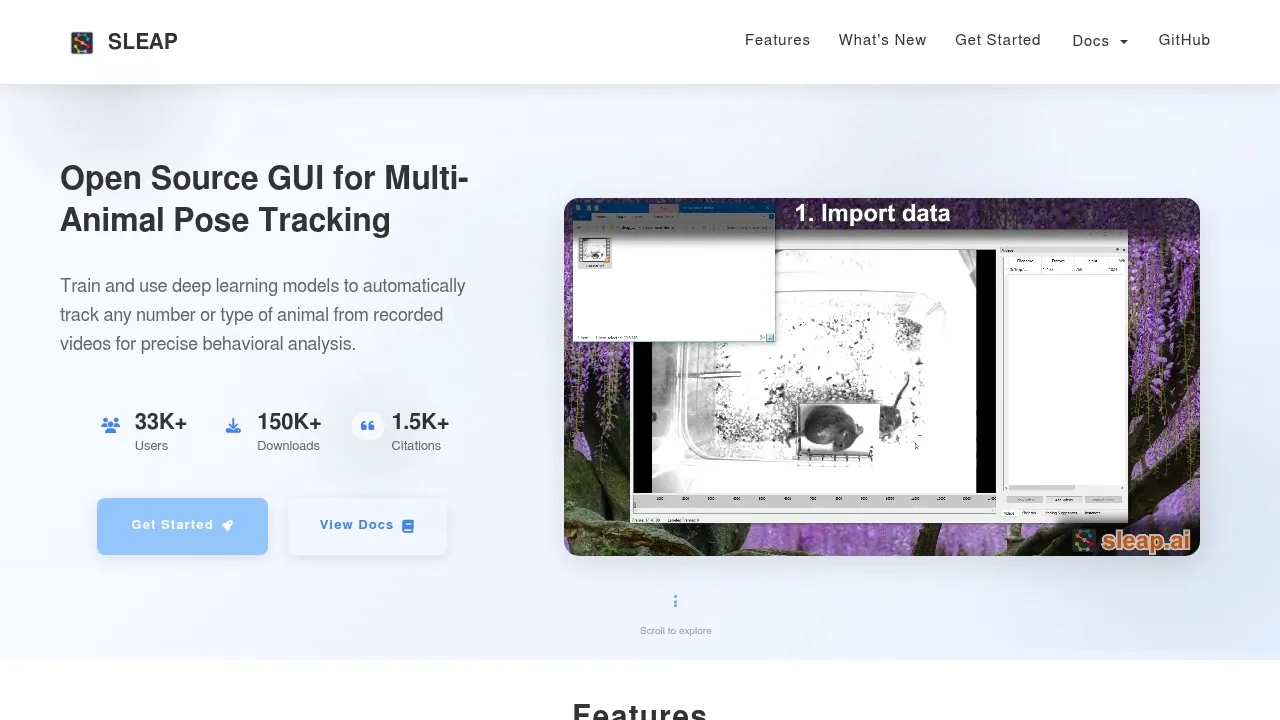
SLEAP helps behavioral researchers measure animal movement in recorded video. It trains models to estimate poses for single animals or groups, with human review during dataset creation and prediction checking.
- Labeling and proofreading. Use a purpose-built GUI to annotate examples, review model predictions, and correct labels through an active-learning workflow.
- Single and multi-animal tracking. Train models for different species using top-down or bottom-up pose estimation strategies.
- Custom models. Adapt neural network architectures to a research dataset and train from a small collection of labeled examples.
- Batch and real-time processing. Use the PyTorch backend for training and prediction, including batch video analysis and low-latency tracking.
- Research integrations. Build custom pipelines with the developer API or independent libraries: sleap-nn handles training and prediction, while sleap-io reads, writes, and converts .slp files.
SLEAP runs locally across operating systems and supports CPU-only use and CUDA GPUs. Training and prediction can also run remotely, allowing a computer without a GPU to use a separate server. sleap-nn supports server deployments without a graphical interface. The project is open source under the BSD 3-Clause Clear License.


