
DeepLabCut
Open-source pose estimation software runs on Windows, macOS and Linux, with custom training, pretrained animal models and CPU or GPU support.
DeepLabCut is an open-source toolbox for researchers who want to track animal movement and behavior on their own computers without attaching physical markers. It estimates the positions of visible features you choose, with support for animals, humans and objects rather than a fixed set of species or body parts.
The toolbox covers data labeling, project management, custom model training and pose estimation. Life scientists can work through a graphical interface, while computer vision researchers can use its Python API. The labeling interface uses napari, and custom models let researchers target the features relevant to their experiments.
For pretrained animal tracking, it includes SuperAnimal-Quadruped and SuperAnimal-TopViewMouse. SuperAnimal pretrained weights are restricted to non-commercial research use. Its model choices also include ResNet, HRNet and RTMPose backbones. PyTorch is the default engine; TensorFlow is an optional backend.
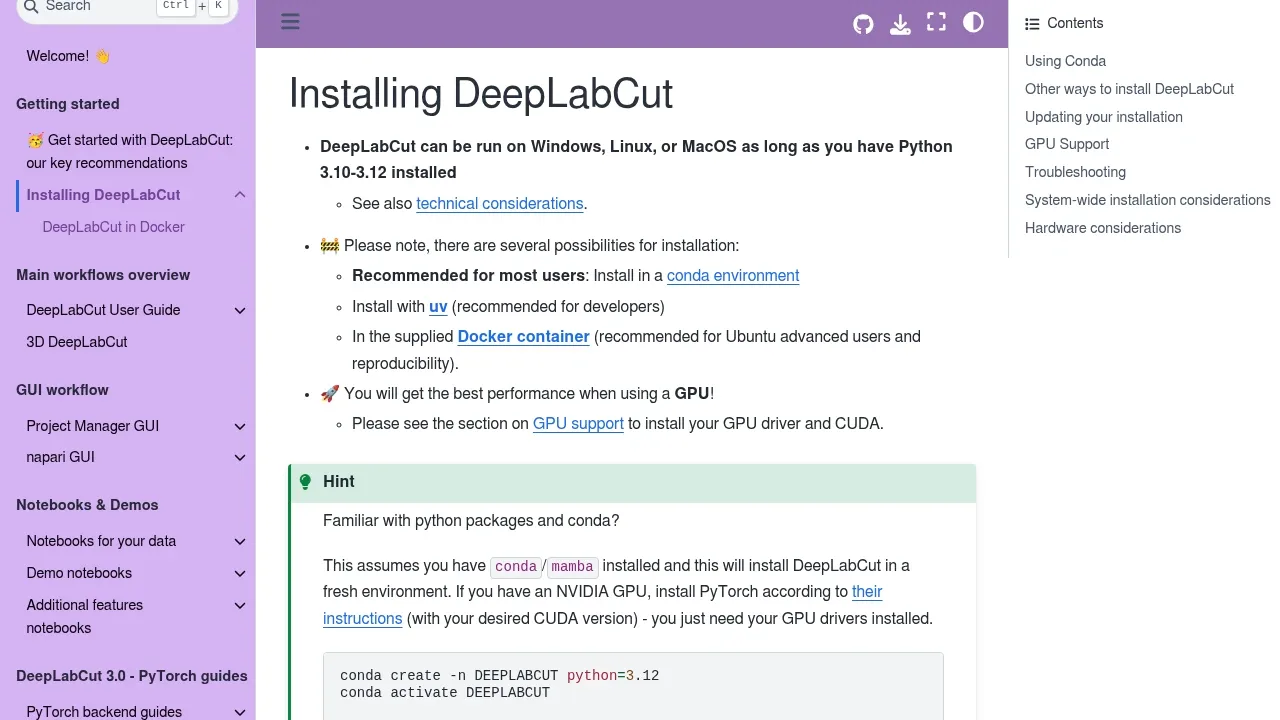
DeepLabCut runs locally on Windows, Linux and macOS, with Docker containers available for Linux. It can use a CPU, CUDA-compatible NVIDIA GPUs or Apple Silicon GPUs through PyTorch's Metal support. CPU training and evaluation are considerably slower, though labeling and project management don't require a GPU. An NVIDIA GPU with at least 8 GB of VRAM is recommended for computation.
Researchers can also use Google Colab or other cloud computing services for GPU work, which moves those computing steps off their own hardware. DeepLabCut uses the GNU Lesser General Public License v3.0. Models trained with footage from one camera may need retraining for footage from another.


