
Cellpose
Open-source cell segmentation software for Windows, Linux and macOS, with 3D support, a graphical editor and models you can train on your own images.
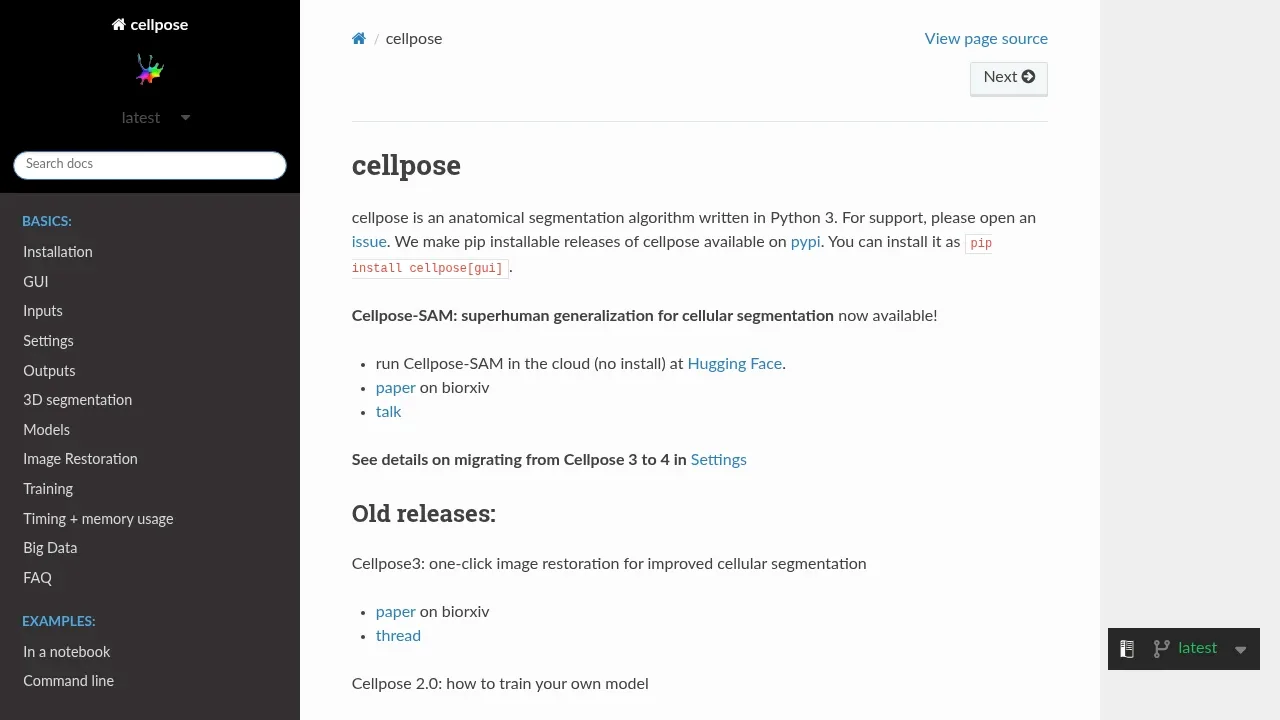
Cellpose is local AI software for biologists and microscopy researchers who need to identify individual cells and nuclei in images. It runs on Windows, Linux and macOS, with a graphical interface for automatic segmentation, manual annotation and correcting model results.
Cellpose-SAM handles both 2D images and 3D volumes. It can work with noisy, blurred or undersampled images, including inverted contrast, different channel orders and varying object sizes. Researchers can fine-tune models on their own labeled images and use human-in-the-loop training to adapt segmentation to their data.
The available models include Cellpose-SAM and the DINOv3-based cpdino and cpdino-vitb. The cpsam_v2 model reduces false masks in low-contrast regions. The interface accepts TIFF, PNG, JPEG and GIF images, including 3D TIFF stacks.
Local processing runs on your machine; pretrained models download on first use, so fetching them needs an internet connection. A separate hosted Cellpose-SAM website supports batch image processing through a free Hugging Face account. That service processes images online.
Cellpose uses Python and PyTorch. It requires at least 8 GB of RAM, while larger images and 3D volumes may need 16 to 32 GB. NVIDIA GPU acceleration is available on Windows and Linux.
The software is open source under the BSD 3-Clause license. Its models are trained on CC-BY-NC data, and the annotated Cellpose dataset also carries the CC-BY-NC license.


