
StarDist
Open-source microscopy segmentation software that runs locally on Windows, macOS and Linux, with models for fluorescent and H&E-stained nuclei.
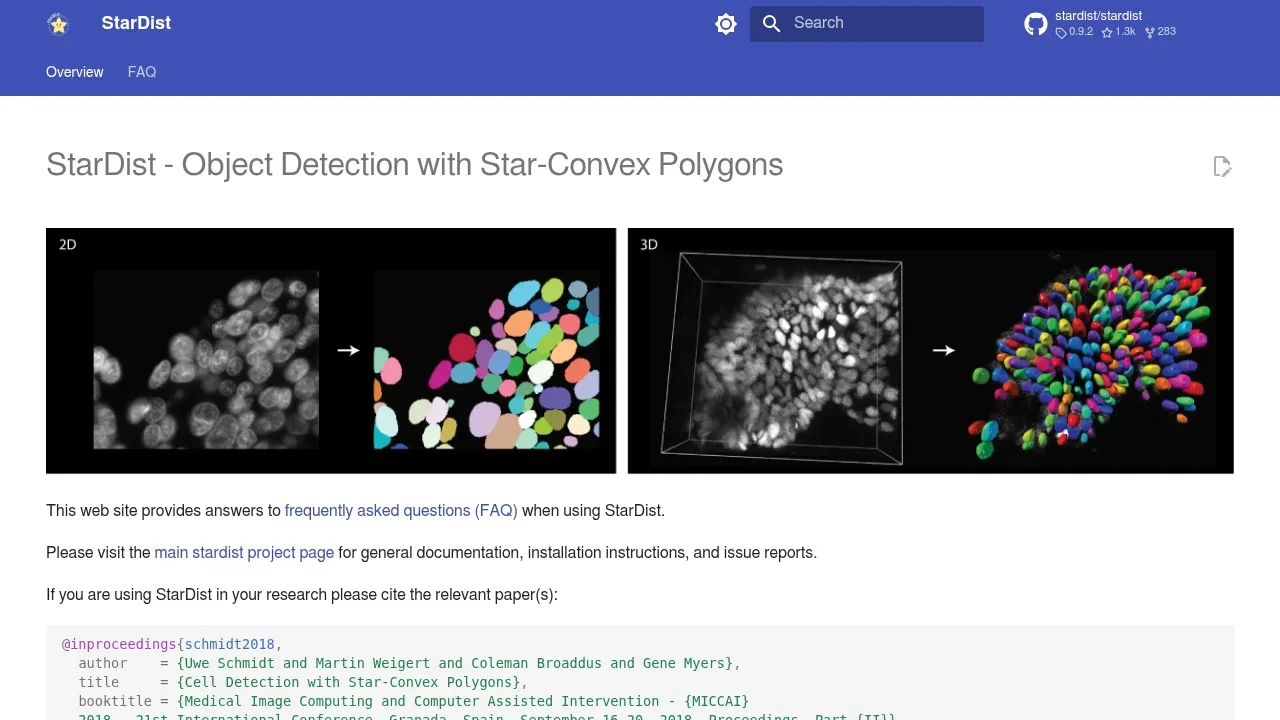
StarDist detects individual cells and nuclei in crowded 2D microscopy images and 3D volumes. It's for researchers and bioimage analysts who need separate outlines for closely packed objects. Its shape-based approach suits objects that can be represented by star-convex polygons in 2D or polyhedra in 3D.
The Python package runs locally on Linux, Windows and macOS and uses TensorFlow for deep learning. It's open source under the BSD-3-Clause license. GPU support is available through TensorFlow.
Pretrained 2D models cover fluorescent nuclei in single-channel images and H&E-stained nuclei in RGB brightfield images. Researchers can also train models on their own images, though training requires annotations that distinguish every cell or nucleus. Both 2D images and 3D volumes support custom training.
For people who prefer a visual application, the napari plugin handles 2D and 3D images through the Python package. ImageJ/Fiji can run pretrained models on 2D images and time series. QuPath has a separate StarDist 2D implementation, while Icy and KNIME integrations build on the Fiji plugin. LabKit and QuPath can provide annotations for training.
StarDist also includes tools for comparing predicted objects with reference annotations. These calculate precision, recall, F1 and panoptic quality across individual images or datasets, and can evaluate segmentation results produced by other methods.


