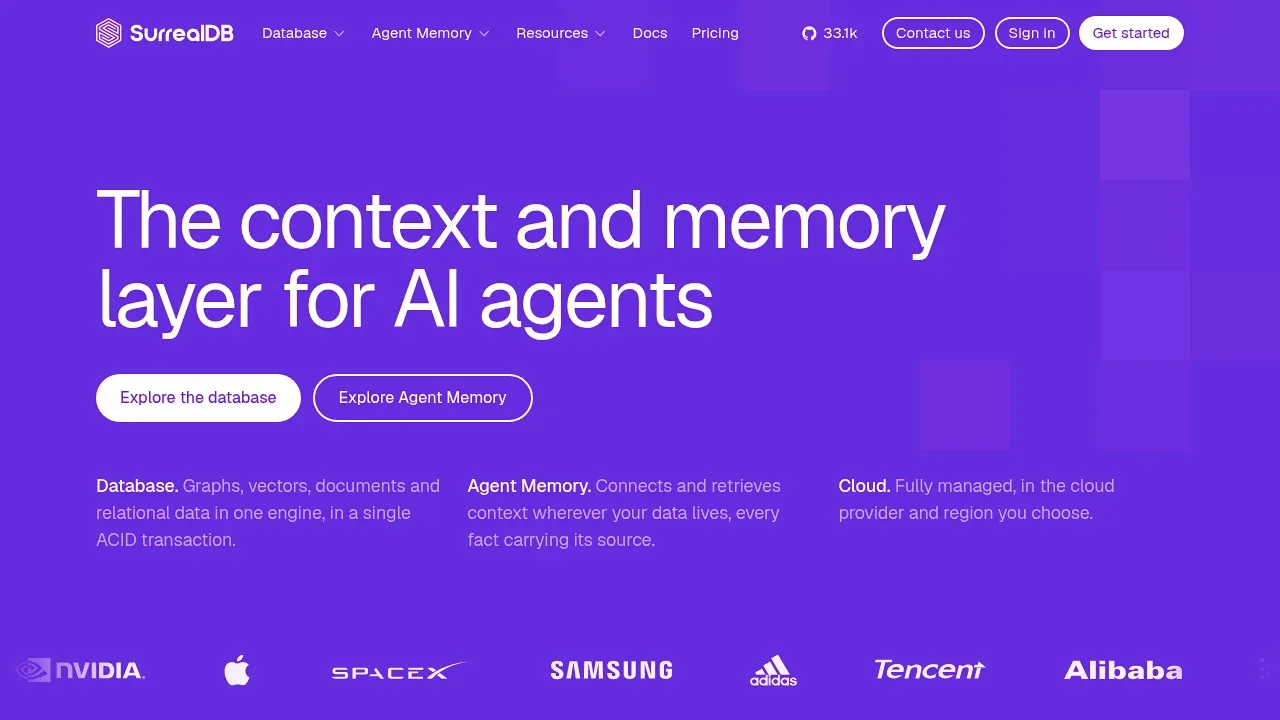
SurrealDB is a self-hosted database for developers building AI agents, knowledge graphs and applications that need several kinds of data together. It stores documents, relationships, vectors and time-series data in one engine, so an application's records and its AI retrieval layer can share the same database.
Its main distinction is how those data types work together. SurrealQL, its SQL-style query language, can combine graph traversal, vector similarity and full-text search in a single query. For GraphRAG applications, that means retrieving related entities alongside semantically relevant text without keeping separate graph and vector databases in sync. Queries can span data models within one ACID transaction.
SurrealDB includes authentication and permissions at the role, record and field level. These controls govern what each user, service or agent can read and change. Live queries and change streams send updates to connected clients as writes commit, supporting applications with shared, changing data.
Built in Rust, it can run on your own infrastructure, inside an application as an embedded database, or in a browser through WebAssembly. It also supports distributed clusters. SurrealDB Cloud is the separate managed hosting option, with a choice of cloud provider and region; self-hosted and embedded deployments use infrastructure you control.
The core database is source-available under the Business Source License 1.1. Offering SurrealDB itself as a managed service requires an agreement. Its SDKs and libraries use Apache 2.0 or MIT licenses.
Claim this page with an email at surrealdb.com. SurrealDB gets the verified badge, and you can upgrade the listing to be featured on localhosted. Proud to be listed? Put our badge on your site.
Want more people to find SurrealDB?Promote it
Something wrong or outdated on this page?
34.9KUpdated 4 weeks agoApache-2.0
Docker · Web#Agent Skills#Hybrid search#RAG
Qdrant is a self-hosted vector database for developers building semantic search, retrieval-augmented generation (RAG), recommendations and AI agent memory. It stores embeddings alongside JSON metadata, so applications can find similar content while restricting results by attributes such as location, text or numeric ranges. The Rust engine is open source under Apache 2.0 and runs locally in Docker or on your own servers.
8.2KUpdated 4 months agoApache-2.0
macOS · Windows · Linux · Web#Semantic search
sqlite-vec adds vector storage and similarity search to SQLite, so developers can keep embeddings alongside application data in a local database. It's for applications that need to find related items by vector distance without running a separate vector database server. The extension is small, written in C and has no dependencies.
59.4KUpdated 1 day ago
#Hybrid search#MCP#Multilingual
Meilisearch combines keyword search and AI retrieval in a search engine you can host on your own server. It's for developers building search into websites, applications, product catalogs, or internal data tools. Meilisearch Cloud provides a separate, fully managed hosted service.
13KUpdated 21 hours agoApache-2.0
Docker#Agent Skills#Hugging Face integration#Knowledge graphs
26.6KUpdated 6 days agoGPL-3.0
macOS · Linux · Docker#Hybrid search#Multimodal input#RAG
7.1KUpdated 1 day agoApache-2.0
Linux#Hybrid search#RAG#Semantic search
txtai is a Python framework for developers building search applications, chat with their data, and AI agents on their own hardware or servers. Its embeddings database combines sparse and dense vector search with graphs and relational data, so the same system can find related content and supply context to language models. It's open source under Apache 2.0.
Typesense combines typo-tolerant site search with vector and semantic search in a self-hosted engine. It's for developers building searchable apps, product catalogs or AI search over their own data. The C++ engine uses an in-memory architecture for low-latency results as users type.
Vespa is a self-hosted AI search platform for developers building search, RAG, and recommendation systems over large, changing datasets. It combines retrieval with machine-learned ranking, so an application can find candidate results and evaluate their relevance in the same platform. The code is open source under Apache 2.0. You can run it on your own servers or use the managed Vespa Cloud service, where applications run in the cloud.