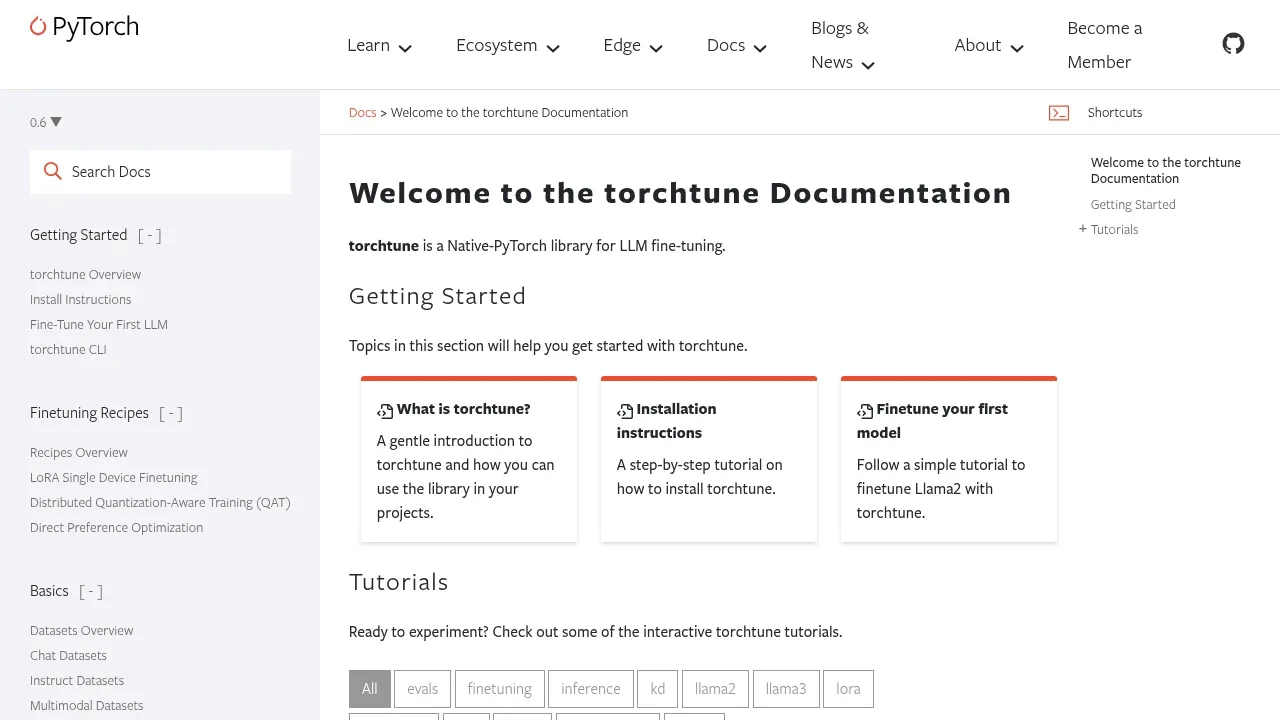
torchtune is a Python library for developers and researchers who want to adapt LLMs on their own GPU hardware using PyTorch. Its editable training recipes suit work that needs control over the training code and model implementations. The project is no longer actively maintained.
It supports full fine-tuning and memory-saving LoRA and QLoRA methods, with supervised training that can run on one device, multiple devices or multiple machines. NVIDIA hardware examples include the RTX 4090, A6000 and A100. Memory needs depend on the model and training method; QLoRA reduces them by quantizing the base model's weights.
Beyond supervised fine-tuning, torchtune includes knowledge distillation to train smaller models from larger ones, plus preference and reinforcement learning methods such as DPO, PPO and GRPO. Quantization-aware training prepares models for reduced-precision use. Evaluation, quantization and text generation recipes cover the stages after training, though each training method has different support for distributed execution.
Model implementations include Llama, Llama Vision, Gemma, Mistral, Microsoft Phi and Qwen. The library uses PyTorch APIs directly and exposes memory and speed optimizations, including activation checkpointing and compilation. It's open source under the BSD 3-Clause license, so developers can inspect and modify the training recipes and model code.
Claim this page with an email at pytorch.org. torchtune gets the verified badge, and you can upgrade the listing to be featured on localhosted. Proud to be listed? Put our badge on your site.
Want more people to find torchtune?Promote it
Something wrong or outdated on this page?
12.5KUpdated 2 days agoApache-2.0
Docker#Distributed execution#Hugging Face integration#LoRA
Axolotl is an open-source LLM fine-tuning framework for developers, researchers, and teams training models on their own data. It runs on local hardware or cloud infrastructure you control, including Docker and Kubernetes environments. The framework uses Apache 2.0, which permits commercial use.
15.8KUpdated 2 days agoApache-2.0
Web#Distributed execution#Hugging Face integration#LoRA
1.1KUpdated 2 years agoMIT
#Hugging Face integration#LoRA#Quantization
960Updated 7 months agoApache-2.0
#Hugging Face integration#LoRA#Quantization
13.7KUpdated 3 weeks agoApache-2.0
#Hugging Face integration#LoRA#Quantization
11.8KUpdated 4 days agoApache-2.0
Docker#Distributed execution#Hugging Face integration#LoRA
ms-swift is a Python framework for developers and researchers who want to train and deploy language or multimodal models on their own hardware. It brings fine-tuning, evaluation and model serving into one project, with support for Qwen3, DeepSeek-R1, Llama4 and Mistral, plus multimodal models such as Qwen3-VL and InternVL3.5. It's open source under Apache 2.0.
DataDreamer connects LLM prompting, synthetic data generation, and model training in one Python library. It's for researchers and developers who want to build datasets and use them to fine-tune or align models in reproducible workflows. The library is open source under the MIT license.
HQQ is a Python library that compresses language and vision models without needing a calibration dataset. It's for developers preparing models to run on their own hardware or servers, particularly when GPU memory limits the model they can use. The library is open source under Apache 2.0.
LitGPT is a Python toolkit for developers and researchers who want to train, adapt and serve language models on their own hardware or servers. Its model implementations are written directly, with little abstraction between you and the code, so you can inspect model behavior and modify it for research or custom applications. It's open source under Apache 2.0.
Ludwig is an open-source Python framework for developers and researchers who want to train custom AI models on their own hardware. A YAML file describes the model and training pipeline, while Ludwig handles preprocessing, training and evaluation. It uses the Apache 2.0 license. Install the Python package with the optional LLM dependencies for fine-tuning; current source requires Python 3.12 or later.