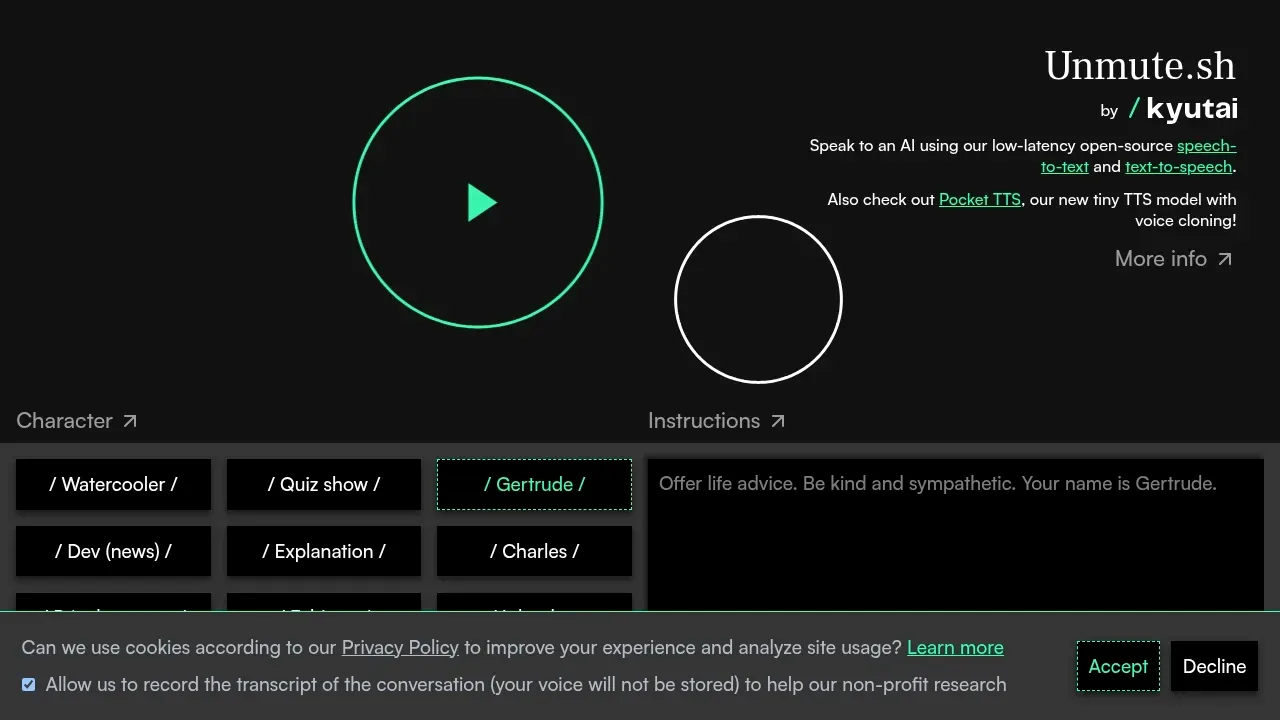
Unmute adds spoken conversation to text LLMs using Kyutai's speech recognition and speech synthesis models. It's for developers who want a self-hosted voice interface while keeping their choice of language model. The project uses the MIT license, and a hosted browser demo is available at Unmute.sh.
Both speech models prioritize low latency. Unmute transcribes your speech, passes the text to an LLM, and starts speaking the answer while the model is still generating it. This lets a text model participate in voice conversations without needing built-in audio support.
The backend works with OpenAI-compatible LLM servers, including vLLM and Ollama on your own hardware, or external services such as OpenRouter. The default Docker setup runs the speech services and vLLM locally, so conversation processing can stay on your machine. Choosing an external LLM sends the text exchange to that service; the hosted demo processes conversations on remote servers.
Self-hosting requires an x86_64 machine and a CUDA-capable GPU with at least 16 GB of VRAM. Unmute supports Docker and deployment without Docker. Spreading speech recognition, speech synthesis and the LLM across separate GPUs can reduce response latency compared with running them together on one GPU.
The browser interface includes character choices with distinct voices and prompts, plus subtitles for both sides of the conversation. Developers can customize the voices and character instructions.
Claim this page with an email at unmute.sh. Unmute gets the verified badge, and you can upgrade the listing to be featured on localhosted. Proud to be listed? Put our badge on your site.
Want more people to find Unmute?Promote it
Something wrong or outdated on this page?
1.6KUpdated 1 year agoMIT
Windows · Docker · Web#llama.cpp backend#LM Studio integration#Multimodal input
Amica is a locally runnable interface for talking with customizable 3D AI characters. It's for people who want an animated, voiced character as the face of their AI assistant, with a choice of local LLM backends or cloud services. The project builds on Pixiv's ChatVRM.
12KUpdated 12 months agoApache-2.0
macOS · Windows · Linux · Docker · Web#Code execution#llama.cpp backend#Multi-user access
7.1KUpdated 23 hours agoMIT
Docker · Web#LM Studio integration#Multimodal input#Ollama integration
14KUpdated 5 months ago
macOS · Windows · Linux · Web#GGUF#LM Studio integration#MCP
Open-LLM-VTuber is a local AI companion for people who want a character they can talk to, with a Live2D avatar that responds through speech and expressions. It runs on Windows, macOS and Linux through web and desktop clients. With local models for speech and language processing, it works fully offline and keeps conversations on your device. Cloud APIs are optional alternatives that send the corresponding processing to external services.
49.8KUpdated 23 hours agoMIT
macOS · Windows · Web#Ollama integration
voxta.aiAI Characters and Roleplay
Windows · Linux · Android · Web#Code execution#MCP#Multimodal input
h2oGPT is a self-hosted ChatGPT alternative for people who want to chat with local models and ask questions about their own documents. The project is archived and no longer maintained. It's open source under Apache 2.0, with support for Linux, macOS, Windows and Docker.
big-AGI is a browser-based AI workspace for researchers, developers and people who want to compare model answers before relying on them. Its Beam feature sends the same prompt to several models in parallel, without letting them see each other's replies. You can examine disagreements, then use Merge to combine the responses into a single answer with a preset or custom prompt.
AIRI is a self-hosted AI companion for people who want a virtual character they can talk to and play games with. Inspired by Neuro-sama, it combines real-time voice conversation with game integrations for Minecraft and Factorio. The project is in early development; Factorio support is a work in progress with a proof of concept. It's open source under the MIT license.
Voxta is an AI companion for people who want a character they can talk to, give work to or use in interactive stories. You choose its personality, voice and optional avatar. The proprietary local-server edition has a browser interface, and AI processing can run entirely on your hardware, through Voxta Cloud or across a mix of local and cloud services.