
Webcmd
Open source browser automation for AI agents that saves website knowledge locally and turns repeated tasks into reusable commands. Apache 2.0 licensed.
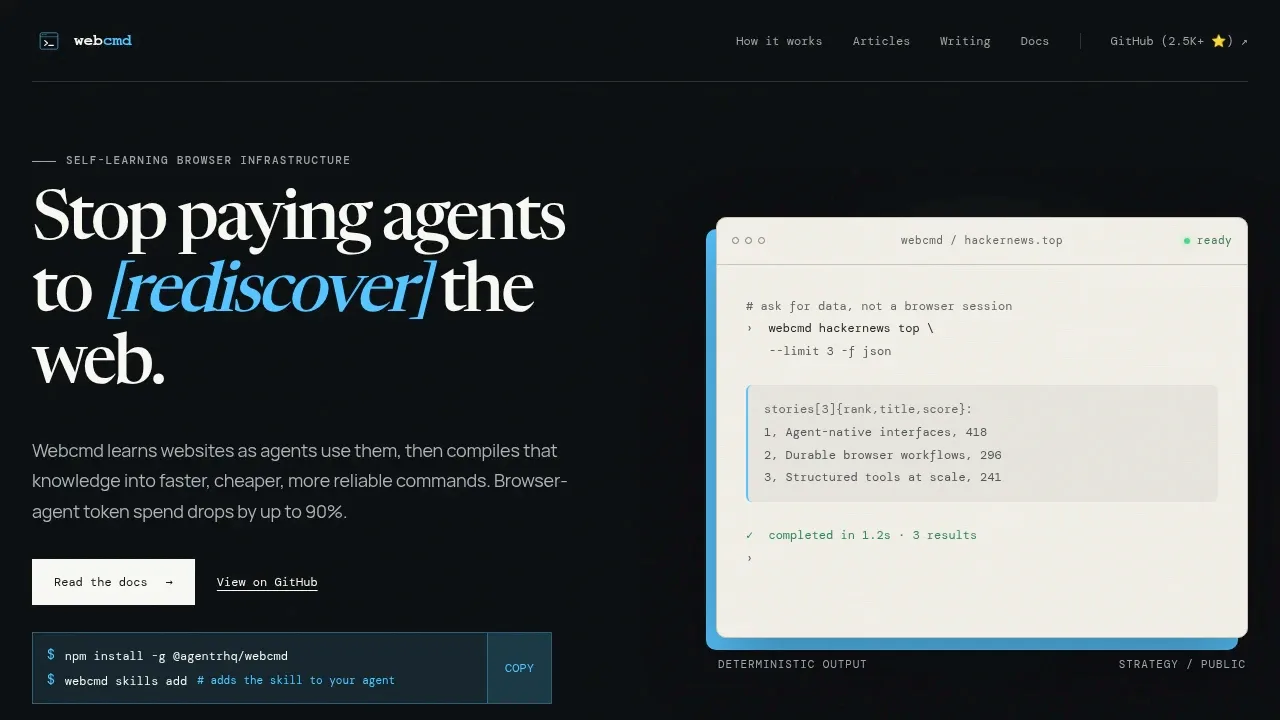
Webcmd is a local browser automation tool for developers building AI agents that repeatedly work with the same websites. It remembers what agents learn about a site and turns familiar tasks into reusable commands, reducing repeated page inspection and reasoning. It's open source under Apache 2.0.
Agents can use a real browser to inspect pages, click controls, enter text, extract information, and capture network requests. Webcmd retains observed pages, actions, workflows, APIs, and fallback paths in local sitemap memory. That context helps later agents work with a site without exploring it from scratch.
For recurring tasks, site adapters expose named inputs and structured results. Commands can use public endpoints, authenticated cookies, intercepted requests, the page interface, or a local tool, depending on the available path. Some commands can skip the browser entirely. Machine-readable results and errors help agents consume the output, while a command registry exposes what each command does and whether it needs a browser.
Webcmd works with Claude, Codex, and other agent harnesses. Its browser workflows cover sites such as PubMed, Hacker News, LinkedIn, and ChatGPT, including tasks that use logged-in profiles. It's written in TypeScript and requires Node.js.
Website learning stays local after initial access, which may use a Webcmd Cloud seed. The live browser remains the source of truth, and a memory failure doesn't block the task.


