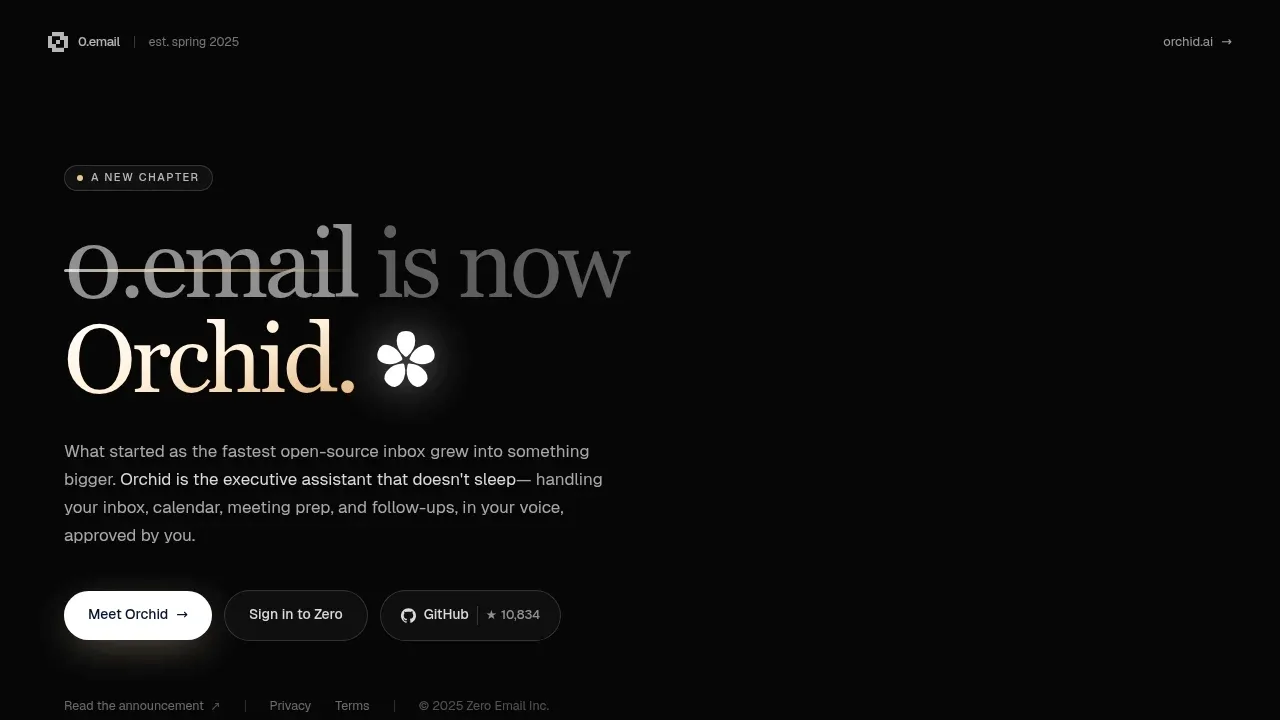
Zero is an open-source, self-hosted AI email app for people who want control over their inbox software while keeping accounts with providers such as Gmail and Outlook.
Zero brings connected email accounts into a unified inbox and uses AI agents and LLMs for email assistance. You can customize its interface and features, and its emphasis on extensibility makes it relevant to developers who want to adapt an email app or add integrations. The MIT license permits modification and reuse.
Self-hosting applies to the email app; connected providers still handle data under their own privacy policies. Zero states that it doesn't track, collect, or sell user data, but that doesn't extend to those external services. Its email sync storage uses Durable Objects and an R2 bucket, so running the app yourself shouldn't be read as a promise that all email data stays on your machine.
The app uses a TypeScript and React frontend with a Node.js backend and PostgreSQL. Gmail connections use Google OAuth. Deployment requires provider OAuth setup, configured services and model-service credentials for the AI workflows.
Claim this page with an email at 0.email. Zero (0.email) gets the verified badge, and you can upgrade the listing to be featured on localhosted. Proud to be listed? Put our badge on your site.
Want more people to find Zero (0.email)?Promote it
Something wrong or outdated on this page?
73.1KUpdated 1 day ago
iOS · Android · Docker · Web#Multi-user access
AFFiNE is a local-first knowledge workspace for individuals and teams who want documents and visual planning in the same place. It combines a block editor, an edgeless whiteboard and databases, making it an alternative to Notion and Miro for team wikis, project plans and connected notes.
77KUpdated 3 months agoAGPL-3.0
macOS · Windows · Linux · iOS · Android · Web#MCP#Multi-user access#RAG
12.4KUpdated 22 hours ago
iOS · Android · Docker · Web#Batch processing
Inbox Zero is an AI email assistant you can self-host with Docker or use as a hosted service. It's for people handling busy Gmail, Google Workspace, or Microsoft Outlook inboxes who want help sorting mail and preparing replies. It works alongside your existing email client.
11.9KUpdated 4 days agoAGPL-3.0
macOS · Windows · Linux · Android · Docker · Web#GGUF#Hugging Face integration#llama.cpp backend
752Updated 9 months agoAGPL-3.0
Web#llama.cpp backend#OpenAI-compatible API#Persistent memory
1.1KUpdated 7 months agoAGPL-3.0
Web · Browser Extension#Multilingual#Multimodal input#Ollama integration
AppFlowy is a self-hosted Notion alternative for teams that want project management, shared documents, and AI in an environment they control. Its self-hosted enterprise offering can run on premises, in your own cloud, or in an air-gapped environment. Self-hosted LLMs and embedding models let you keep AI processing and workspace data inside your infrastructure, with no vendor access to your instance.
KoboldCpp pairs local model inference with a browser interface built for chat, creative writing and roleplay. A fork of llama.cpp, it bundles KoboldAI Lite with tools for keeping character details and story context alongside your conversations. It's open source under AGPL-3.0.
Mikupad is a browser-based LLM frontend packaged as a single HTML file, for writers and people who want control over generated text. It connects to a model backend of your choice and supports both direct text continuation and chat with instruct models. It's open source under AGPL-3.0.
NativeMind brings a local AI assistant into Chrome for people who want help with webpages, documents, and writing without sending that content to a cloud model. The browser extension connects to Ollama on your machine, keeping prompts and AI processing on-device. It requires no account and uses the AGPL-3.0 open-source license.