
AI Infra Guard
Self-hosted AI red teaming platform for agents, MCP servers and LLMs. Runs with Docker on Linux, macOS and Windows; free under Apache 2.0.
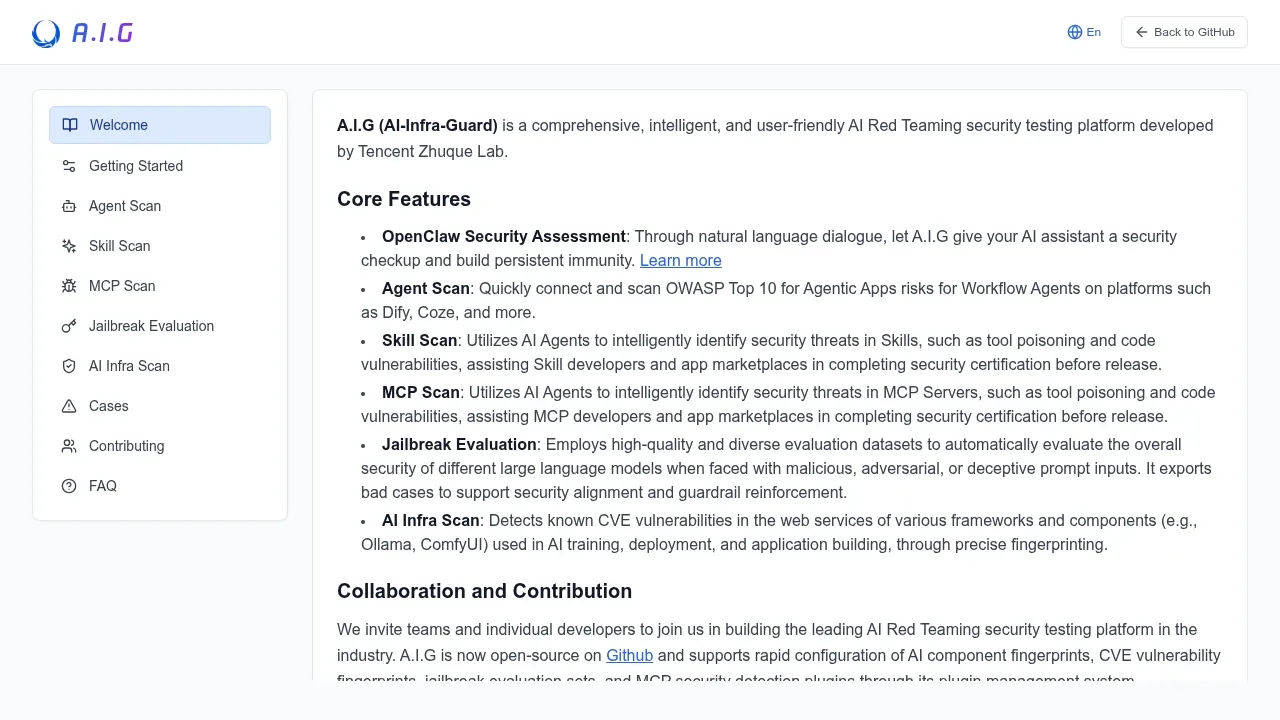
AI Infra Guard is a self-hosted AI security testing platform from Tencent Zhuque Lab for developers and security teams checking agent workflows, model behavior and the services behind AI applications. It brings infrastructure vulnerability scans and tests for malicious prompts into one web interface. The software is free and open source under Apache 2.0.
Its scans cover several parts of an AI deployment:
- Agent workflow testing checks OWASP Top 10 for Agentic Apps risks on platforms including Dify and Coze.
- MCP server and agent skill audits examine source code or remote URLs for tool poisoning, code vulnerabilities and other security risks. Skill audits also cover memory poisoning, unauthorized access and insecure dependencies, and can fit into CI/CD pipelines.
- Infrastructure scans identify AI components and check their web services for known CVEs, including Ollama, ComfyUI, vLLM, n8n and Triton Inference Server.
- Jailbreak evaluations test LLM responses to adversarial and deceptive prompts, compare results across models and export failed cases for guardrail work.
OpenClaw users can request assessments through chat. These checks cover insecure settings, risky skills, known vulnerabilities and privacy leakage. A separate model and API relay checker provides model fingerprinting and relay auditing.
The self-hosted service runs through Docker on Linux, macOS and Windows, with at least 4 GB of RAM and 10 GB of disk space. An online offering runs separately from your own deployment. The local web interface supports English and Chinese, tracks scan progress, and provides an API for integration. Plugins extend component fingerprints, vulnerability checks and evaluation datasets.


