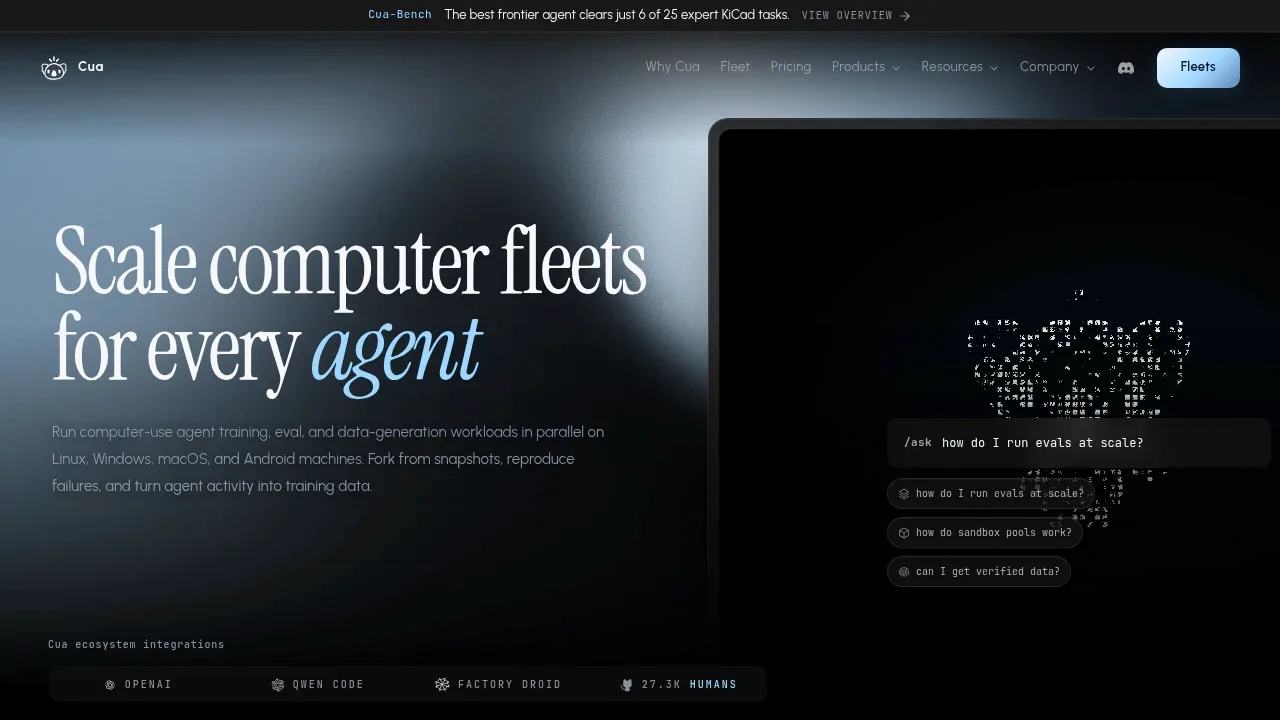
Cua gives AI agents access to computers they can inspect and operate, with tools for desktop automation, local virtual machines, and hosted fleets. It's for developers building agents that work across native apps and browsers, or evaluating how well those agents complete computer tasks. You bring the agent and model.
Cua Driver connects agents to macOS, Windows, and Linux through MCP, a CLI, or SDKs. It works with Claude Code, Codex, Cursor, and OpenClaw. Where the app and platform support it, agents can interact in the background without moving your pointer or taking focus. An agent can combine code, APIs, and graphical interfaces within one task.
For work on your own hardware, Lume creates and manages local macOS and Linux VMs on Apple Silicon using Apple's Virtualization.Framework. Cua Fleets provides isolated cloud desktops, with fleet support spanning Linux, Windows, macOS, and Android. Local sandboxes and hosted Fleets share a Sandbox SDK for running commands, capturing screenshots, and interacting with apps, though their runtime requirements differ. Fleets runs in the cloud; Lume's VMs run locally.
Cua Bench lets developers build tasks, evaluate agents, and export action trajectories for training. Its simulated tasks can run without a VM, Docker, or a model API key. The open-source repository uses the MIT license.
Claim this page with an email at trycua.com. Cua gets the verified badge, and you can upgrade the listing to be featured on localhosted. Proud to be listed? Put our badge on your site.
Want more people to find Cua?Promote it
Something wrong or outdated on this page?
42.4KUpdated 1 day agoApache-2.0
Docker · Web#Guardrails#Human approval#LLM tracing
Agno is a Python framework and runtime for developers building customer-facing or internal AI agents. You can run its agent platform locally with Docker, on your own servers or in your cloud. The open-source framework uses the Apache 2.0 license, and the platform keeps sessions, memory, knowledge and traces in your database.
7.2KUpdated 23 hours ago
Docker#Guardrails#LLM tracing#Tool calling
37.7KUpdated 2 days agoApache-2.0
macOS · Windows · Linux · Docker#Code execution#LM Studio integration#MCP
4.4KUpdated 19 hours agoMIT
macOS · Windows · Linux · Web · JetBrains#Agent Client Protocol#Code execution#Git integration
9.4KUpdated 1 day agoApache-2.0
macOS · Windows · Linux · iOS · Android · Web#Batch processing#LLM tracing#Structured output
3.1KUpdated 1 day agoMIT
macOS · Windows · Linux · Docker#GGUF#Hugging Face integration#llama.cpp backend
NeMo Guardrails is an open-source Python toolkit for developers who need control over how an AI assistant responds and uses tools. It runs within your application or as a self-hosted server, including in Docker. The library uses the Apache 2.0 license.
Playwright MCP lets AI agents control a browser by reading structured page information rather than interpreting screenshots. It's for developers building browser automation, exploratory tests or agent workflows that need to keep a browser session open across repeated actions. The server runs locally on macOS, Windows and Linux, or as a self-hosted service.
gptme is a self-hosted AI agent that works directly in your terminal, with access to your files and installed tools. It's for developers who want a coding assistant in their own environment, and people who want an agent for data analysis or other knowledge work. The software is free under the MIT license and doesn't require a gptme account.
BAML is a programming language for developers building AI agents, with typed model calls and local tracing built into the language. It runs standalone on macOS, Linux and Windows, or alongside an existing application. The language is open source under Apache 2.0, and works offline.
RamaLama runs and serves AI models on your own hardware using OCI containers. It's aimed at developers who want local chat or a self-hosted inference API with a container workflow they can also use in production. The project uses the MIT license.