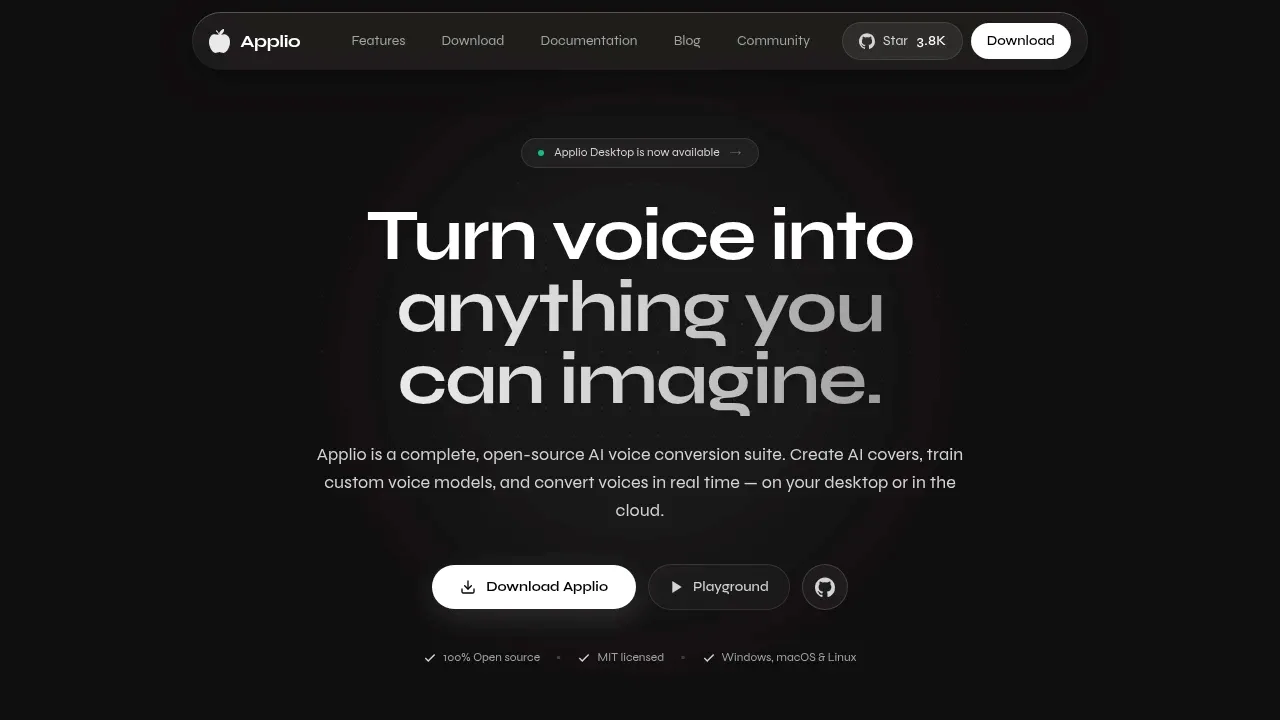
Applio is a local AI voice conversion suite for musicians making AI covers, streamers changing their voice live, and creators working with speech. It converts recordings or microphone input into another voice using community models or models you train yourself. Its software uses the MIT license.
The software runs on Windows, macOS and Linux, with a standalone desktop app and a Gradio interface you use in your browser. Local use doesn't require an account, and Applio collects no telemetry. Audio processing and model training run on your machine. For cloud use, it also offers a playground and Google Colab access.
Voice conversion includes pitch adjustment, audio cleaning and upscaling, plus batch processing for multiple files. Live conversion uses low-latency inference for singing, streams and calls. Text-to-speech lets you generate spoken audio and pass it through a voice model, so you can work from written material as well as recordings.
Custom model training starts with your own audio dataset and includes preparation, feature extraction, training and export. An audio analyzer checks dataset quality before training. If you want to combine voices, the voice blender merges multiple models and lets you control each model's contribution. Plugins support further customization, and the MIT license permits modification and redistribution for personal, research and commercial work. The project now focuses on security patches, dependency updates and occasional feature improvements, with less frequent releases.
Claim this page with an email at applio.org. Applio gets the verified badge, and you can upgrade the listing to be featured on localhosted. Proud to be listed? Put our badge on your site.
Want more people to find Applio?Promote it
Something wrong or outdated on this page?
2.4KUpdated 2 years agoAGPL-3.0
macOS · Windows · Linux · Docker · Web#Hugging Face integration
AllTalk TTS generates speech on your own computer. The project recommends v2 for most users; the saved documentation below describes v1, built on Coqui TTS and XTTSv2 models. It's for people adding voices to AI conversations or producing spoken audio from longer texts. It runs as a standalone application or alongside Text-generation-webui, with support for Windows, Linux and macOS.
62.2KUpdated 1 month agoMIT
macOS · Windows · Linux · Docker · Web#Hugging Face integration#Multilingual#Voice activity detection
2.3KUpdated 4 months agoMPL-2.0
macOS · Windows · Linux · Docker#Multilingual#Streaming inference#Voice cloning
15.3KUpdated 1 week agoMIT
Docker · Web#Multilingual#Voice cloning
6.4KUpdated 3 years agoMIT
Windows#Hugging Face integration#Multilingual#Voice cloning
StyleTTS 2 is an open-source text-to-speech model for developers and speech researchers who want to generate expressive speech on their own hardware. It can choose a speaking style from the text without a reference recording, while its multispeaker model uses reference audio to reproduce a speaker's voice and delivery. The Python code uses PyTorch and carries the MIT license.
6.3KUpdated 10 months agoApache-2.0
#Hugging Face integration#llama.cpp backend#LoRA
GPT-SoVITS is a local text-to-speech and voice cloning tool. It can generate speech from a short reference recording or fine-tune a model for a custom voice. The source code uses the MIT license.
XTTS v2 generates speech from text using a reference voice recording or a preset speaker. It runs locally through Coqui TTS and suits developers building speech into apps, as well as researchers who want to fine-tune a speech model on their own hardware.
F5-TTS is a local text-to-speech system that uses a reference recording to generate new speech in that voice without training a separate model for each speaker. It's for developers, speech researchers, and creators who want to generate voices on their own hardware. Its Python code uses MIT, while pretrained models use the noncommercial CC-BY-NC license.
Orpheus TTS is an open-source text-to-speech system for developers building voice applications or adapting speech models to their own recordings. It runs locally and uses a Llama backbone to generate speech with control over emotion and intonation. The code uses the Apache 2.0 license.