ElevenLabs alternatives for TTS and voice cloning
Compare Chatterbox TTS Server, TTS WebUI and GPT-SoVITS for self-hosted speech, voice cloning, audiobook narration and dubbing.
ElevenLabs turns text into speech and offers voice cloning, dubbing and sound effects in a cloud platform. You might need a narrator for a book, a voice for an app or translated dialogue for a video. Those are different jobs, and a replacement can focus on the one you actually need.
Chatterbox TTS Server and TTS WebUI are ElevenLabs alternatives for speech generation on your own computer or server. GPT-SoVITS focuses on voice cloning, while ebook2audiobook handles longer narration with chapters. For video dubbing, look at pyVideoTrans. The tools below use different speech models, so language support and voice options vary.

Self-hosted text-to-speech server runs Chatterbox models on CPU or GPU, with voice cloning and an OpenAI-compatible API.
Chatterbox TTS Server is the nearest match for everyday text-to-speech: built-in voices, voice cloning from a WAV or MP3 clip, and long texts split and joined into one file for narration. It runs on your own computer or server with a browser interface.
It speaks English with emotion control and other languages through Chatterbox Multilingual, and offers an OpenAI-compatible API for apps. It runs on NVIDIA, AMD, Apple Silicon or a CPU.

A browser-based AI voice cloning studio combines Qwen3-TTS, VibeVoice and other speech engines with voice design, conversion and custom voice training.

Local text-to-speech and voice cloning software generates multilingual speech from short recordings, with a web interface and an MIT license.
GPT-SoVITS is for voice cloning. It generates speech from a short reference recording or fine-tunes a model on a custom voice, in English, Japanese, Korean, Cantonese and Chinese, including a language other than the recording's.
The browser interface includes tools to clean and split training audio.

A self-hosted text-to-speech and music generation interface with audio editing tools, model extensions and an optional OpenAI-compatible speech API.
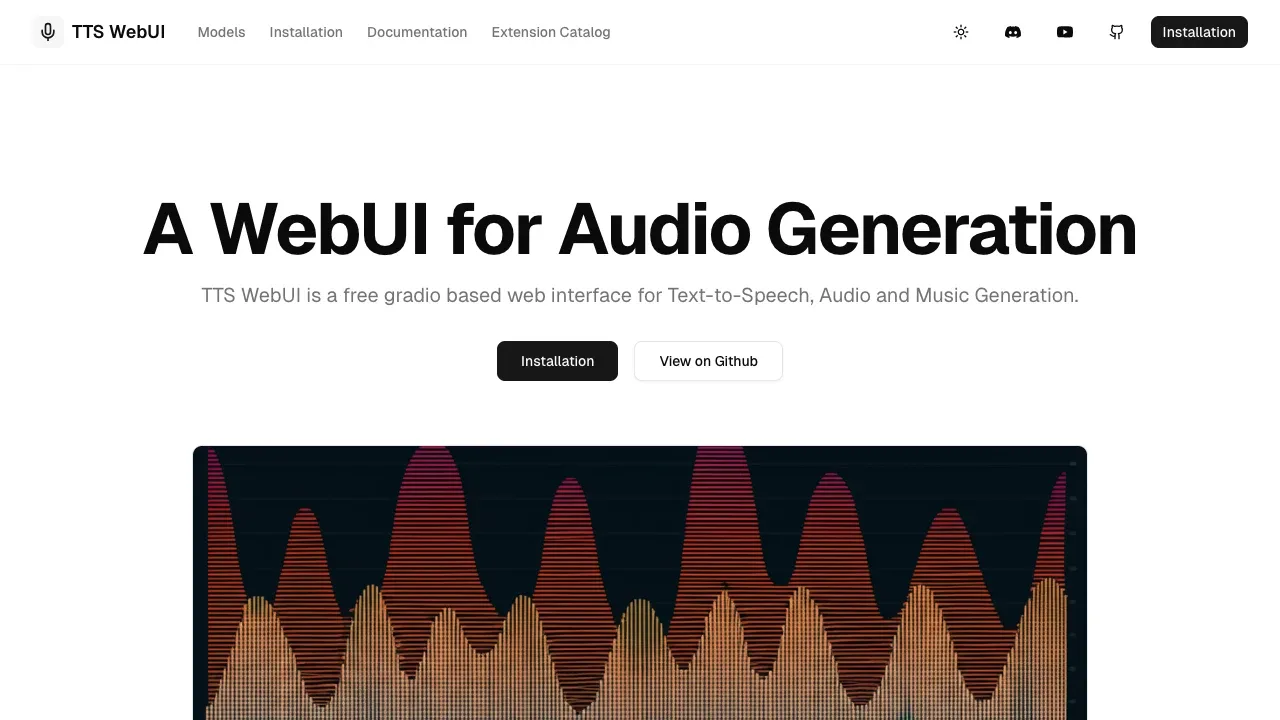
TTS WebUI gathers many local speech models in one browser interface: Bark, Tortoise and StyleTTS2 by default, with Kokoro, XTTSv2, CosyVoice and others as extensions. It also covers voice conversion with RVC, transcription with Whisper, and music generation.
Its OpenAI-compatible speech API connects it to Open WebUI and SillyTavern. Model weights have their own licenses.

Self-hosted text-to-speech software runs models such as ChatTTS, CosyVoice and Qwen3-TTS through a web UI or API, with optional MiniMax Cloud TTS.

Local text-to-speech software that clones a voice from one recording and supports multilingual speech with emotion and pronunciation controls.

Open-source text-to-speech desktop app for Windows and Linux with offline narration, voice cloning and optional cloud speech APIs.
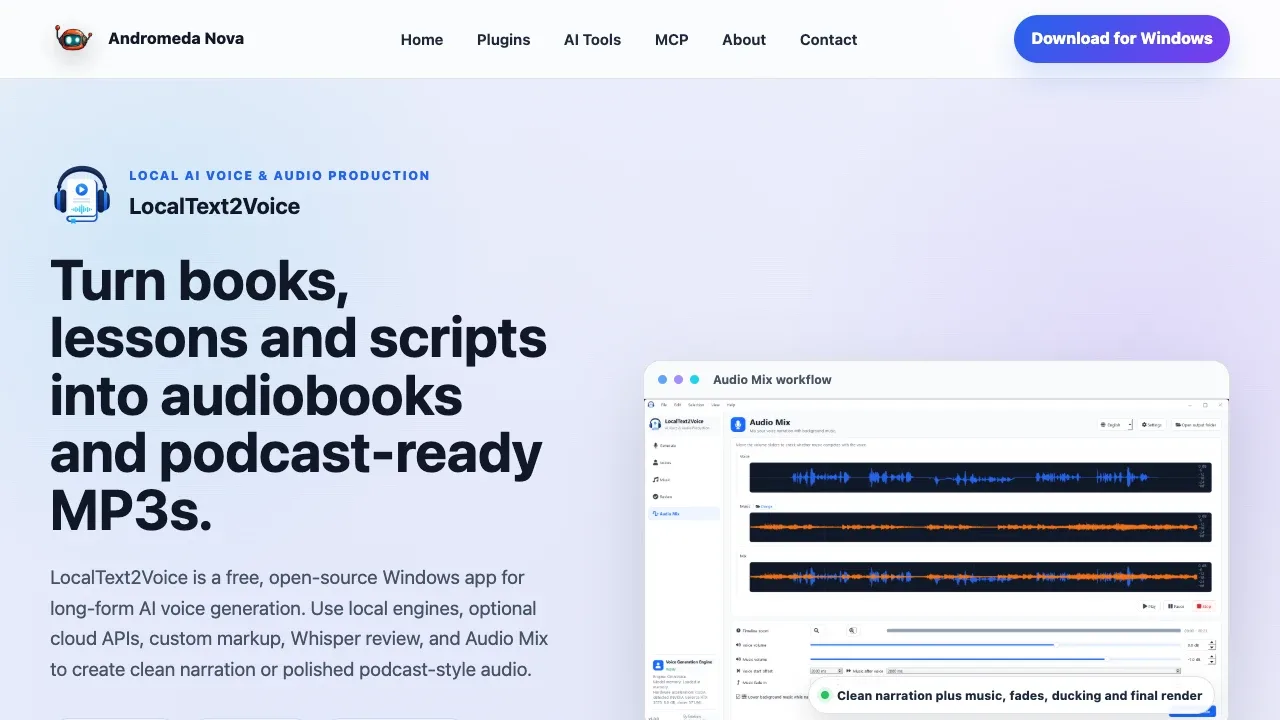

A local AI audiobook generator uses Qwen3-TTS for multiple voices, connects to local or cloud LLMs, and exports MP3 or chaptered M4B.

A local AI dubbing and voice cloning app with Whisper transcription and a browser interface that requires internet access.

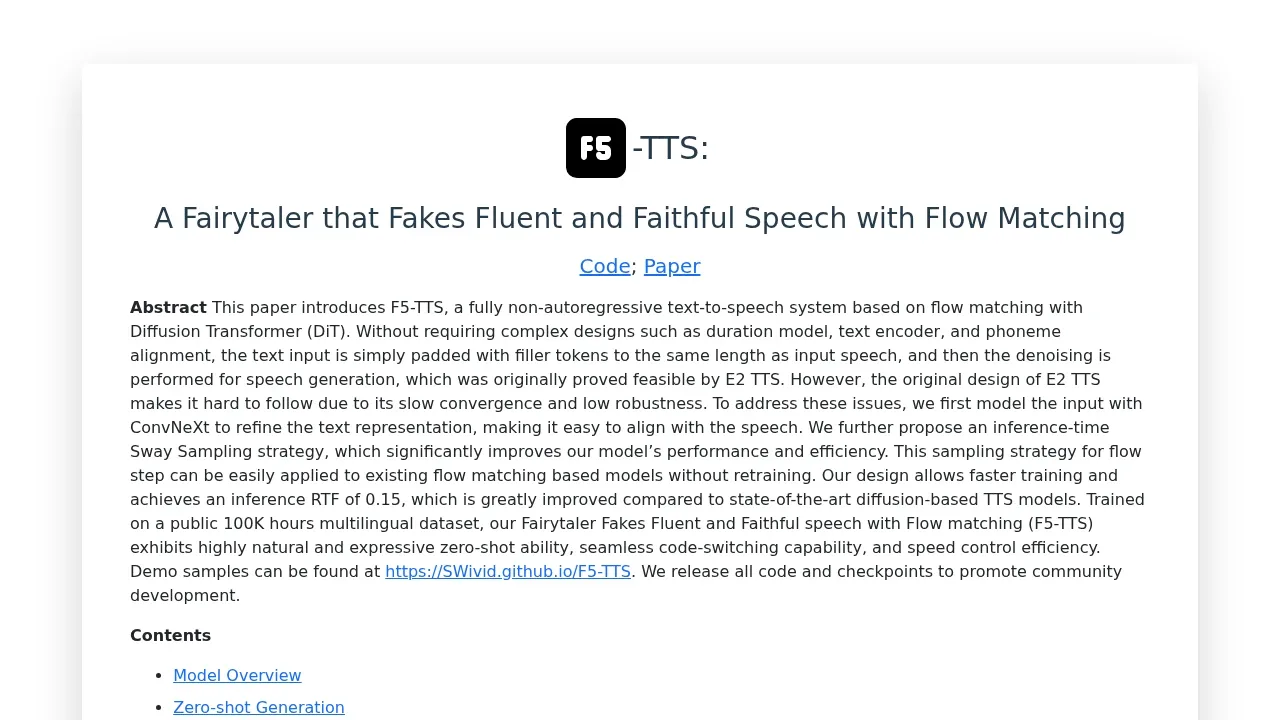
A local text-to-speech system supports multi-speaker generation and NVIDIA GPUs, with a Gradio interface and MIT-licensed Python code.

An open-source video translation and AI dubbing tool for Windows, macOS and Linux that works with local offline models or cloud APIs.
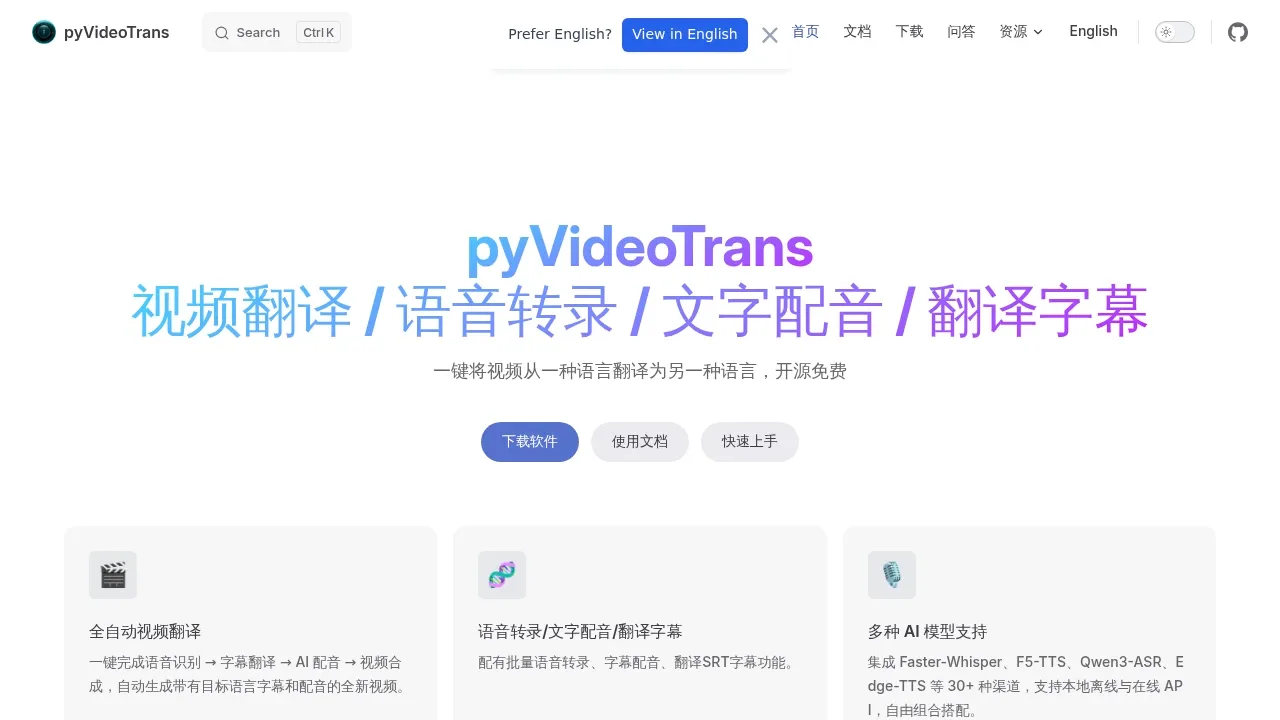
pyVideoTrans replaces AI dubbing. It transcribes a video, translates it and produces a dubbed version with subtitles, pausing for you to proofread at each stage. Speaker separation gives each person in a conversation their own voice, and voice cloning works with F5-TTS, CosyVoice or GPT-SoVITS.
With local models such as Faster-Whisper and Ollama, the whole pipeline can run offline.
A local text-to-speech extension for ComfyUI that combines voice cloning, voice conversion, character dialogue and subtitle-timed audio.
TTS-Audio-Suite builds speech workflows in ComfyUI for character dialogue and subtitle-timed narration. Generate speech against SRT timings, switch voices within a script and regenerate only the segments you change, using the selected speech engines.

Free, open-source AI voice conversion software runs on Windows, macOS and Linux, with live voice changes and local model training.

A self-hosted text-to-speech API runs Kokoro-82M on CPU or GPU, with OpenAI-compatible requests, multiple speakers and caption timestamps.

A ChatTTS-based text-to-speech app that runs locally on Windows and macOS or in Google Colab, with saved voices, character reading and streaming playback.

A local text-to-speech system supports multilingual voice cloning and streaming audio, with open-source code under Apache 2.0.

A local text-to-speech model that clones voices from short recordings and generates multilingual speech through Coqui TTS.

A local audiobook converter creates chaptered audio with OCR and optional voice cloning on Windows, macOS and Linux under Apache 2.0.
ebook2audiobook covers audiobook narration. It turns non-DRM EPUB, MOBI, PDF and Word files into audiobooks with chapters and metadata, and can narrate in a voice cloned from your own recording.
It runs locally with a browser interface and outputs M4B, MP3 or other formats. Languages depend on the speech engine you pick.

Local text-to-speech software turns books and documents into audio with synced captions, using Kokoro-82M in a desktop or self-hosted web interface.

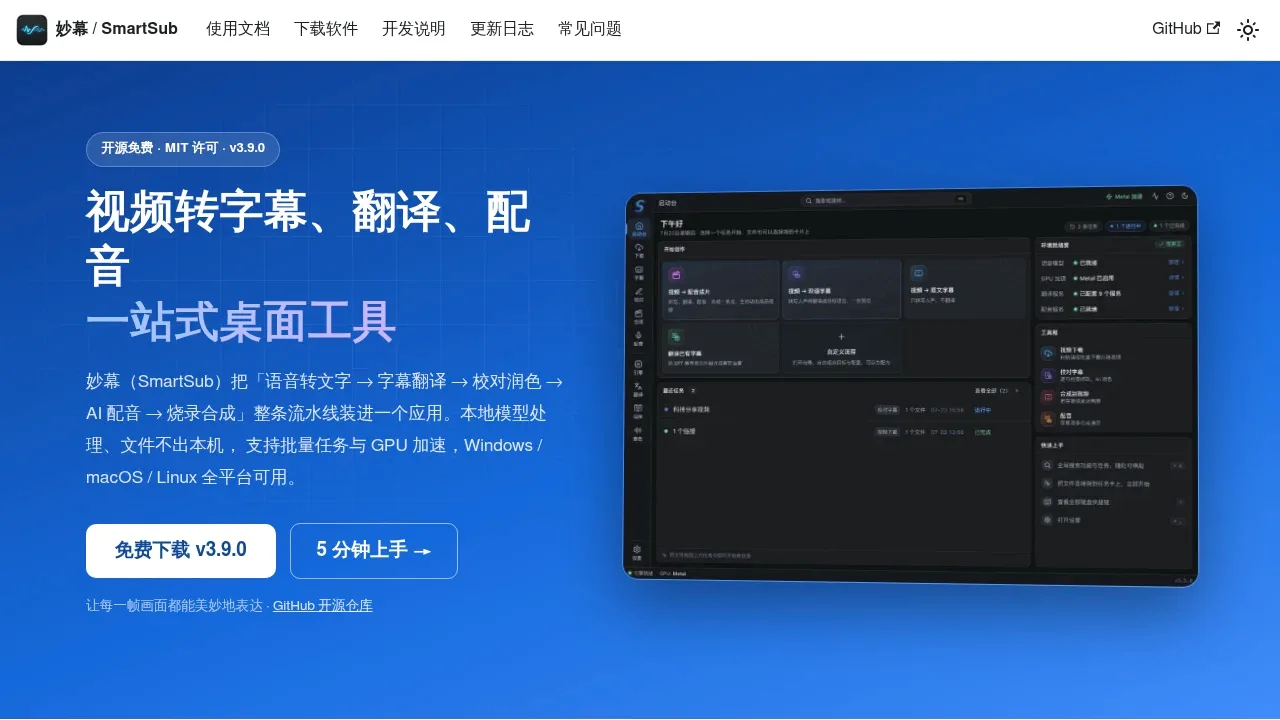
A subtitle and AI dubbing desktop app for Windows, macOS and Linux, with offline transcription, local speech synthesis and optional cloud services.
A local AI audiobook converter turns EPUB books into M4B audio with Kokoro voices, chapter selection and optional NVIDIA GPU acceleration.
audiblez is a simple way to turn EPUB books into M4B audiobooks with Kokoro voices on your own computer. Pick a narrator, reading speed and chapters in the graphical app or on the command line.
Voices cover English, Spanish, French, Hindi, Italian, Japanese, Brazilian Portuguese and Mandarin Chinese.
For ElevenLabs, start with Chatterbox TTS Server. Other alternatives include Voice-Clone-Studio, GPT-SoVITS, TTS WebUI and Speech AI Forge.
Most are Text-to-Speech and Audiobooks; others include Voice Cloning and Voice Changers.
People also replace
See all
Speechify alternatives


HeyGen alternatives


VEED alternatives


