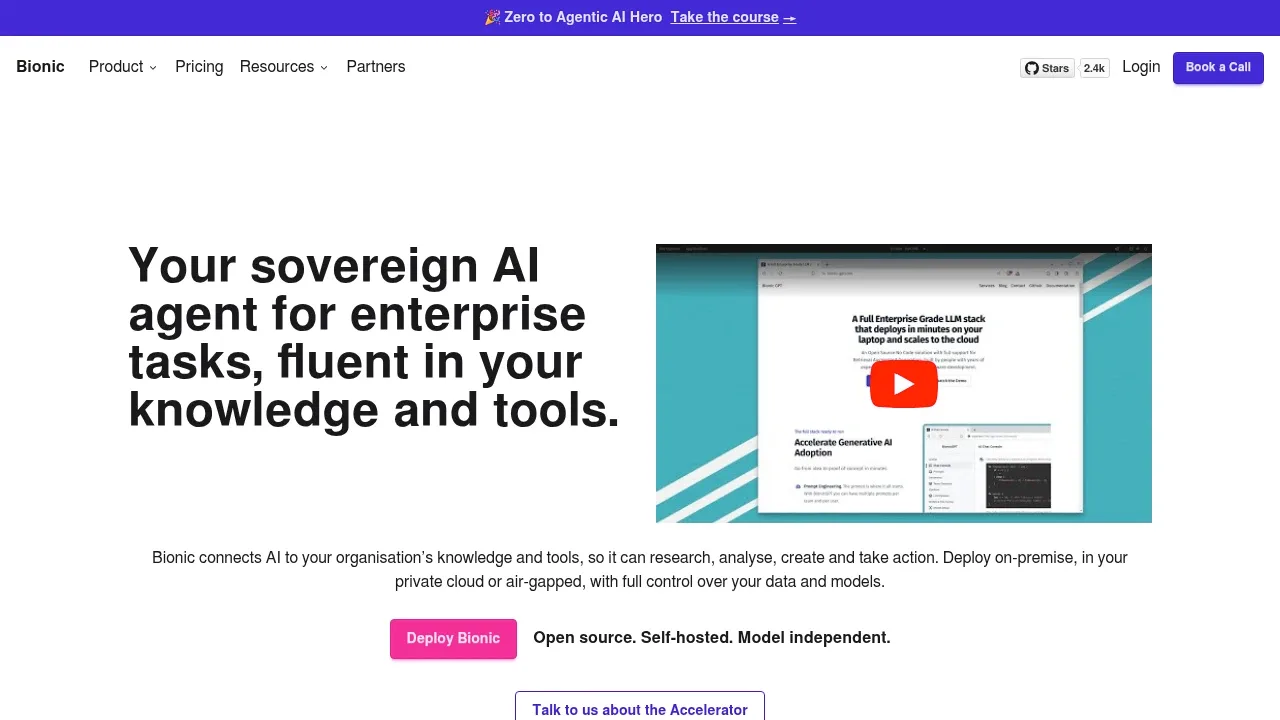
Bionic GPT is a self-hosted AI agent platform for internal AI teams that need control over their models, company data and business systems. It runs on-premise, in a private cloud or in an air-gapped environment. Teams can build company-specific workflows on its existing workspace and agent runtime rather than assemble the underlying platform themselves.
Agents can retrieve information from private datasets, work with uploaded files, call approved tools and execute code in a sandbox. They can carry context through multi-step tasks across business systems and save generated files and other outputs. Reusable skills hold domain instructions and templates for work that needs a repeatable method.
Bionic accepts OpenAPI specifications to connect services such as Gmail, Salesforce and internal applications without a custom agent for each integration. Its chat workspace includes conversation history, while team permissions, identity controls and audit trails support shared use inside an organisation.
The platform works with local models, private inference endpoints and approved hosted models. A deployment using local models and internal systems can stay inside the organisation's perimeter; hosted models and external integrations send requests outside it. Bionic also offers a fully managed cloud deployment.
The open-source foundation uses the Apache 2.0 license and is written in Rust. Docker Compose supports local evaluation and small pilots, while its production infrastructure centres on Kubernetes.
Claim this page with an email at bionic-gpt.com. Bionic GPT gets the verified badge, and you can upgrade the listing to be featured on localhosted. Proud to be listed? Put our badge on your site.
Want more people to find Bionic GPT?Promote it
Something wrong or outdated on this page?
41.3KUpdated 18 hours agoAGPL-3.0
macOS · Docker · Web#Code execution#Hybrid search#LM Studio integration
AstrBot brings AI assistants into messaging apps such as Telegram, Discord, Slack, QQ and WeCom. It's an open source platform under AGPL-3.0 for people building personal companions, customer support bots or team automation. You can run it on your own computer or server, including through Docker, or use its desktop app for browser-style chat.
143Updated 5 months agoMIT
macOS · Windows · Linux · Docker · Web#Agent Skills#Code execution#MCP
7.3KUpdated 3 days agoMIT
Docker · Web#Agent Skills#Human approval#Knowledge graphs
10.5KUpdated 7 months agoApache-2.0
macOS · Windows · Linux · Android · Web#Code execution#MCP#Multimodal input
18.3KUpdated 1 day agoMIT
macOS · Windows · Linux · Docker · Web#Human approval#Hybrid search#llama.cpp backend
12KUpdated 12 months agoApache-2.0
macOS · Windows · Linux · Docker · Web#Code execution#llama.cpp backend#Multi-user access
OpenCrust is a self-hosted AI assistant platform for people who want personal agents available through their chat apps. It runs on Linux, macOS and Windows as a compact Rust application and is open source under the MIT license. A browser interface and terminal chat provide direct access alongside Telegram, Discord, Slack, WhatsApp, LINE, WeChat and macOS iMessage.
Yuxi is a self-hosted knowledge agent platform for teams that want to use their documents in both Q&A and multi-step work. It combines document retrieval, knowledge graphs and agent execution in a browser workspace, with permissions for users and departments. It's open source under MIT.
aichat brings Ollama and cloud AI services into the same terminal interface for developers and people who work at the command line. It runs locally on macOS, Linux and Windows, with Android support through Termux. Model processing happens through the backend you choose: Ollama supports local models, while providers such as OpenAI, Claude and Gemini process requests in the cloud.
DocsGPT is an MIT-licensed, open-source platform for teams that want AI search, assistants and agents over their own documents. It can run on your servers with local models, including fully air-gapped deployments where documents and questions stay inside your network. Answers include the source title and page number so readers can check the evidence.
h2oGPT is a self-hosted ChatGPT alternative for people who want to chat with local models and ask questions about their own documents. The project is archived and no longer maintained. It's open source under Apache 2.0, with support for Linux, macOS, Windows and Docker.