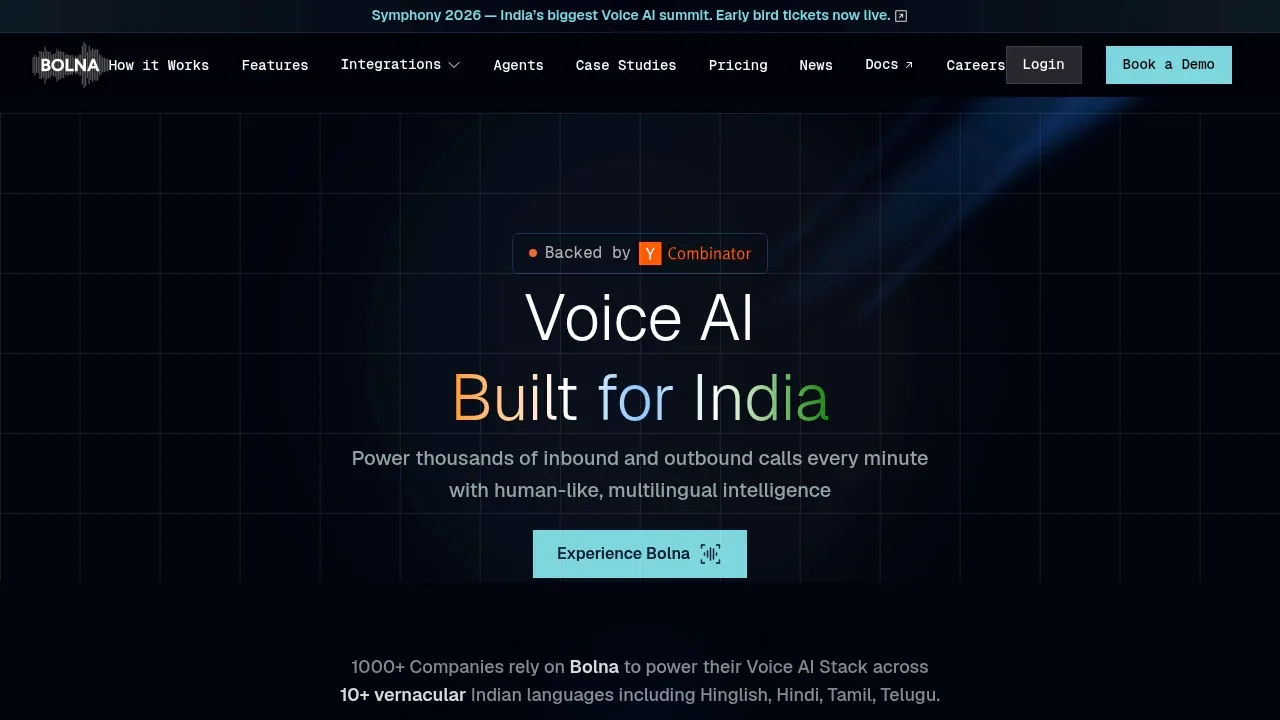
Bolna is a voice AI agent platform for businesses handling customer support, lead qualification, reminders, and recruitment calls. Its focus is Indian languages and accents, including Hindi, Hinglish, Tamil, and Telugu, alongside English. Developers can self-host its MIT-licensed Python orchestration core, while business teams can use a hosted dashboard to build agents without code.
The deployment distinction matters: the open source core can run on your own server through Docker, but Bolna's hosted APIs and dashboard are closed source services. Self-hosting the core doesn't make every part local. Phone calls use providers such as Twilio or Plivo, and connected cloud speech and model services process the audio or text sent to them.
Bolna lets teams choose speech recognition, language models, and speech synthesis separately. It supports Deepgram for transcription, models from OpenAI, DeepSeek, Llama, Cohere, and Mistral, and voices through services including ElevenLabs, AWS Polly, and Cartesia. LiteLLM provides model integrations, and the core can connect to models served through vLLM.
Agents handle inbound and outbound calls, respond to interruptions, and transfer callers to a human. During a conversation, they can call external APIs to take action or retrieve information. The hosted offering also supports bulk calling campaigns and workflow connections with n8n, Make.com, and Zapier. Prebuilt agents cover FAQ answering, customer triage, qualifying leads, and payment or deadline reminders.
Claim this page with an email at bolna.ai. Bolna gets the verified badge, and you can upgrade the listing to be featured on localhosted. Proud to be listed? Put our badge on your site.
Want more people to find Bolna?Promote it
Something wrong or outdated on this page?
3.8KUpdated 2 years agoMIT
Docker#Streaming inference#Tool calling
Vocode is an open source Python library for developers building voice AI agents, with a self-hosted telephony server and support for live conversations through a computer's microphone and speakers. It connects speech recognition, an LLM, and speech synthesis in one library. The code uses the MIT license.
295Updated 2 days agoApache-2.0
Linux · Docker#OpenAI-compatible API#Wake word detection#Works offline
11.1KUpdated 18 hours ago
Docker · Web#Multimodal input#Voice activity detection
TEN Framework is a self-hosted framework for developers building voice AI agents and multimodal conversational apps. It focuses on low-latency, real-time conversations and supports both RTC and WebSocket connections. You can run its agent examples locally with Docker or deploy them on your own server.
29.8KUpdated 23 hours agoMIT
macOS · Windows · Linux#Code execution#Guardrails#Human approval
20.3KUpdated 1 hour agoMIT
#Human approval#LLM tracing#MCP
14.4KUpdated 19 hours agoApache-2.0
#MCP#Multi-agent workflows#Multimodal input
OpenVoiceOS is a free, open-source voice AI platform for people building their own smart speakers or adding voice control to devices. Its core builds on a fork of MycroftAI/mycroft-core, and most classic Mycroft skills also work with it. The project uses the Apache 2.0 license, which permits personal and commercial use.
OpenAI Agents SDK is an open-source Python framework for developers building AI apps that need to use tools, delegate tasks, or work across multiple steps. Its runtime manages agent turns and conversation state while letting developers express workflows in ordinary Python. It uses the MIT license.
Pydantic AI is a Python SDK for developers building AI agents into their own applications. Its main draw is Pydantic validation across agent tools and results, so an agent can return structured data that application code can check and use. The SDK is MIT licensed.
LiveKit Agents is a framework for developers building voice assistants, phone agents, and apps that combine speech with video or text. Agents join LiveKit rooms as participants, so they can interact with people through web and mobile apps or telephone calls. The Apache 2.0 project lets you run the entire stack on your own servers, including the LiveKit media server.