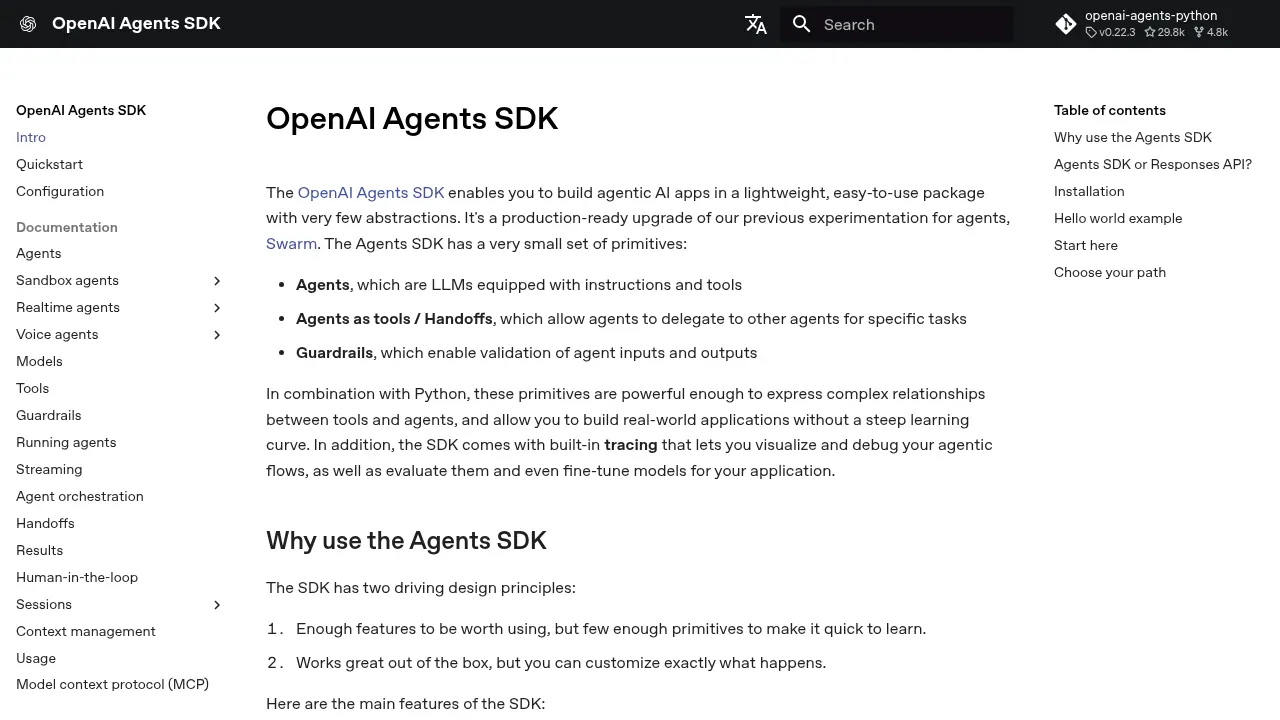
OpenAI Agents SDK is an open-source Python framework for developers building AI apps that need to use tools, delegate tasks, or work across multiple steps. Its runtime manages agent turns and conversation state while letting developers express workflows in ordinary Python. It uses the MIT license.
The runtime runs in your Python environment; model calls use the selected provider. OpenAI models use the cloud Responses API by default and require an API key. The SDK also supports Chat Completions and non-OpenAI providers, so the framework and model service are separate choices.
Agents can call Python functions or remote MCP tools, involve a human during a run, and delegate work through handoffs or by treating another agent as a tool. Input and output guardrails validate what passes through the workflow. Persistent sessions retain conversation context across runs, while built-in tracing helps developers inspect execution and debug tool use or delegation.
Sandbox agents handle tasks that involve files, commands, or code changes in isolated workspaces, with resumable sessions for longer jobs. Local Unix sandboxes work on macOS and Linux. Windows supports Docker sandboxes, and hosted sandbox clients provide a remote alternative.
For voice applications, realtime agents work with gpt-realtime-2.1 and support interruption detection and context management. A separate voice pipeline combines speech recognition, an agent workflow, and streamed speech output.
Claim this page and we'll verify you by hand. OpenAI Agents SDK gets the verified badge, and you can upgrade the listing to be featured on localhosted. Proud to be listed? Put our badge on your site.
Want more people to find OpenAI Agents SDK?Promote it
Something wrong or outdated on this page?
20.3KUpdated 1 hour agoMIT
#Human approval#LLM tracing#MCP
Pydantic AI is a Python SDK for developers building AI agents into their own applications. Its main draw is Pydantic validation across agent tools and results, so an agent can return structured data that application code can check and use. The SDK is MIT licensed.
42.5KUpdated 2 hours agoMIT
#Human approval#Multi-agent workflows#Persistent memory
28.6KUpdated 1 day agoMIT
macOS · Windows · Linux#LM Studio integration#MCP#Multi-agent workflows
9.4KUpdated 1 day agoApache-2.0
macOS · Windows · Linux · iOS · Android · Web#Batch processing#LLM tracing#Structured output
4.7KUpdated 1 month agoMIT
macOS · Windows · Linux#Visual workflows
Rivet is a desktop visual programming environment for developers building AI agents and applications with complex LLM workflows. Its editor runs on macOS, Windows and Linux, and its TypeScript library executes the resulting graphs inside your own application. The project uses the MIT license.
38.4KUpdated 4 days agoMIT
#Code execution#MCP#Multimodal input
LangGraph is a free, MIT-licensed Python framework for developers building AI agents that need to keep state and handle complex tasks. It gives teams control over how an agent moves between steps, where people can intervene, and what happens when a long-running task is interrupted.
Semantic Kernel is an MIT-licensed SDK for developers adding AI agents to their applications. It supports local models through Ollama, LMStudio and ONNX, alongside cloud services such as OpenAI and Azure OpenAI. You choose the model backend. The SDK runs on Windows, macOS and Linux and supports C#, Python and Java.
BAML is a programming language for developers building AI agents, with typed model calls and local tracing built into the language. It runs standalone on macOS, Linux and Windows, or alongside an existing application. The language is open source under Apache 2.0, and works offline.
DSPy is a Python framework for developers building AI applications whose tasks need clear inputs, predictable output types, and measurable results. You define what a language model should produce, then compose those tasks into a larger program. It's open source under the MIT license.