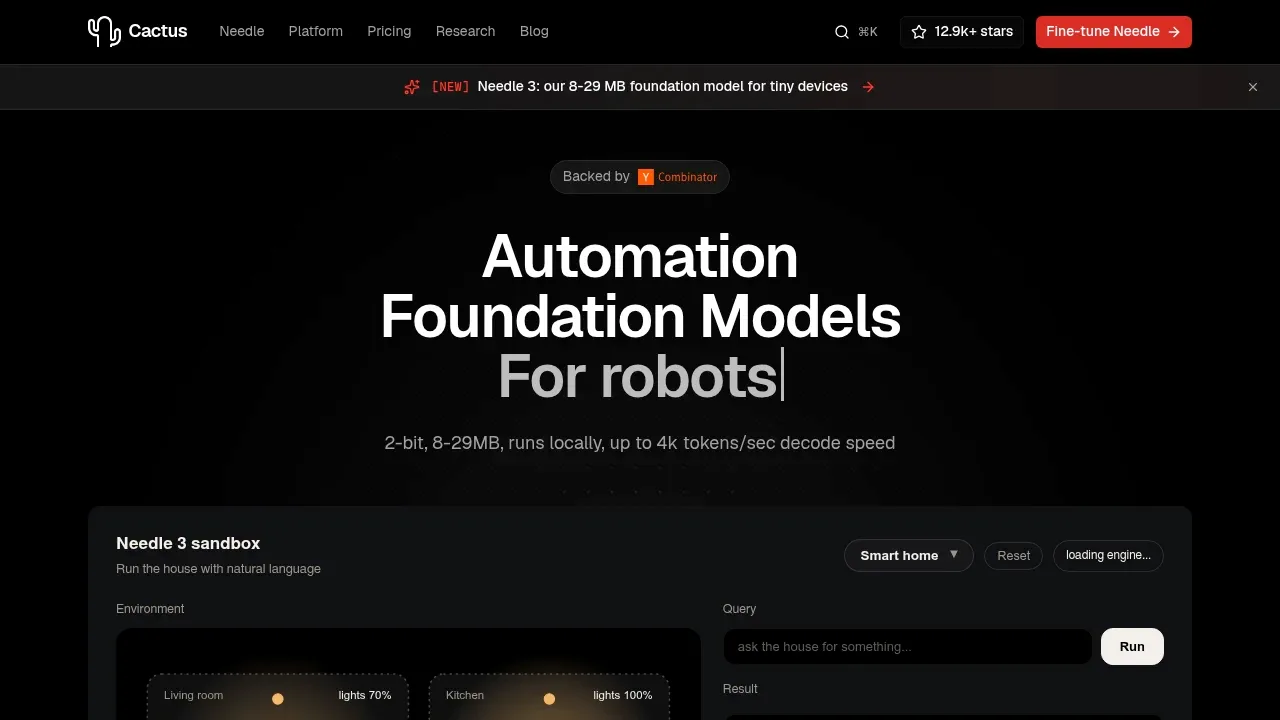
Cactus is an on-device AI engine for developers building automation into mobile apps, wearables and embedded devices. Its Needle model handles tool calling locally, so a device can turn a request into an action without an internet connection. The focus is small devices, including smart home hardware, robots and microcontrollers.
Needle uses compact, 2-bit models to fit automation into hardware with limited memory. The broader engine also handles chat, image input and speech transcription. It supports streaming responses, embeddings and retrieval over local data, with a vector index for search.
Model families tested with the engine include Gemma, Qwen and Liquid, plus Whisper and Parakeet for speech. Cactus runs on iOS, Android and Mac, with bindings for Swift, Kotlin, Flutter and React Native. Python and Rust bindings support other application integrations.
Local inference runs on the user's hardware. An optional hybrid mode routes difficult requests to a cloud service based on the local model's confidence, so requests sent through that path leave the device. Developers can choose local execution for offline automation or use cloud handoff for queries the local model struggles with.
The C++ engine includes its own quantization and ARM-optimized kernels, aimed at reducing the memory and processing demands of inference. Its API covers tool calling alongside speech and vision, allowing an app to use those capabilities through the same engine.
Claim this page with an email at cactuscompute.com. Cactus gets the verified badge, and you can upgrade the listing to be featured on localhosted. Proud to be listed? Put our badge on your site.
Want more people to find Cactus?Promote it
Something wrong or outdated on this page?
5.1KUpdated 20 hours ago
macOS · Windows · Linux · iOS · Android · Web#MLX#Multimodal input#OpenAI-compatible API
ExecuTorch is PyTorch's runtime for developers building AI into mobile apps, desktop software and embedded devices. It runs models on the user's hardware, with support for Android, iOS, Linux, macOS and Windows, as well as microcontrollers. Developers can reuse a PyTorch model across targets, though hardware-specific deployments need their own exported model files.
3.5KUpdated 19 hours agoApache-2.0
macOS · Windows · Linux · iOS · Android · Web#Agent Skills#Hugging Face integration#Multimodal input
23.9KUpdated 6 days ago
macOS · Windows · Linux · iOS · Android · Web#ONNX#Quantization
ncnn is a C++ framework for developers building on-device AI into mobile, desktop and embedded applications. Its focus is running neural networks with a small memory footprint and no third-party runtime dependencies. Models run on the target device's CPU or a supported Vulkan GPU.
16.2KUpdated 1 day agoApache-2.0
Windows · iOS · Android#Image-to-image#Multimodal input#ONNX
10.9KUpdated 23 hours agoApache-2.0
macOS · Windows · Linux#Hugging Face integration#Multimodal input#ONNX
1.7KUpdated 2 days ago
Linux#Multimodal input#Quantization
RKLLM is a software stack for developers building local AI applications on Rockchip hardware. It uses the chip's neural processing unit (NPU) to run language and multimodal models on development boards, with support for the RK3588, RK3576, RK3562 and RV1126B series.
LiteRT is Google's open-source framework for developers building AI into apps that run on users' own devices. It succeeds TensorFlow Lite and covers model conversion, optimization and local inference. It's licensed under Apache 2.0.
MNN is a lightweight C++ framework for developers who want AI models to run on phones, PCs and embedded devices. It handles inference and training on the device, with a focus on small application footprints and hardware acceleration. The project is open source under Apache 2.0, and Alibaba uses it in apps including Taobao, Youku and DingTalk.
OpenVINO is an Apache 2.0 licensed toolkit for developers who want to run AI models locally or serve them on their own infrastructure. It converts and optimizes models for inference, with support for x86 and ARM CPUs, Intel integrated and discrete GPUs, and Intel NPUs. Its runtime works on Linux, Windows and macOS.