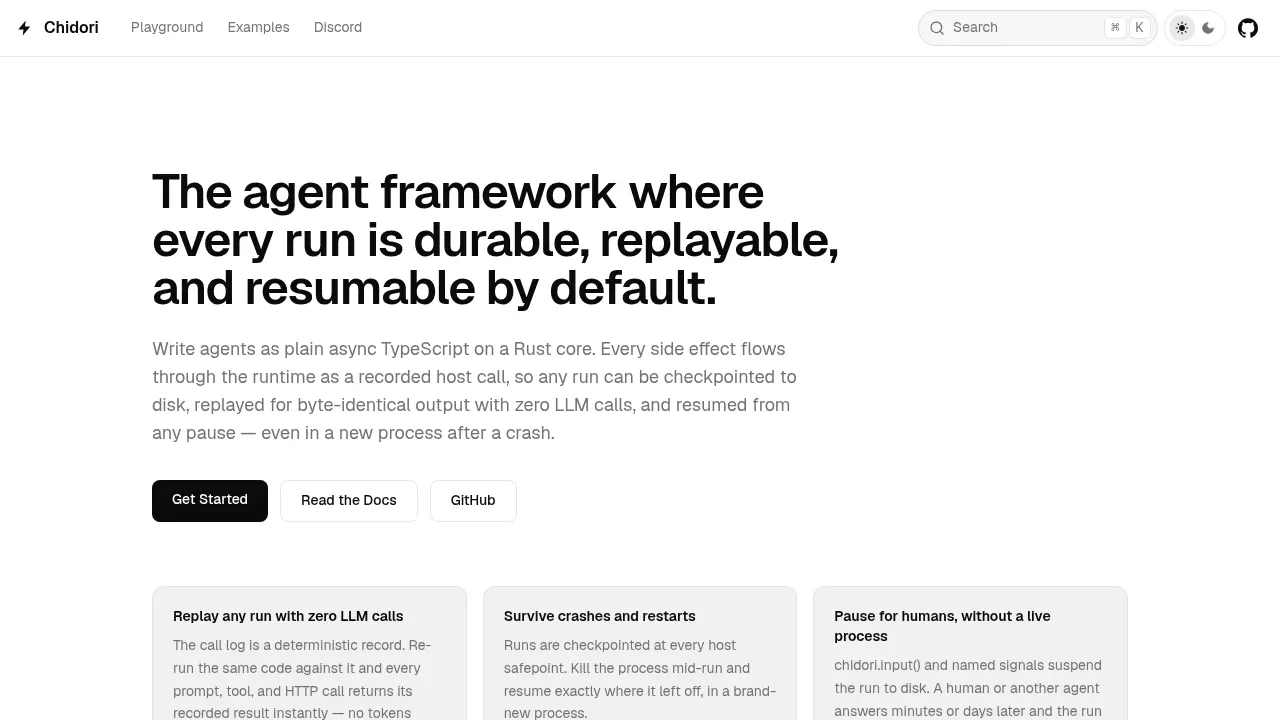
Chidori is an open-source AI agent framework for developers building long-running workflows that need to survive crashes or wait for human approval. It runs on your own machine or server, with binaries for macOS on Apple Silicon and Intel, and for Linux. The project uses the Apache 2.0 license.
Its main distinction is how it preserves a run. Chidori records model responses, tool results, and HTTP calls, then uses those records to reproduce the same output without calling the model again. Developers can revisit a failed run without paying for repeat model requests, or keep a checkpoint in Git as an integration test for changes in agent behavior. Exact replay requires the same code.
Runs save checkpoints to disk and can continue in a fresh process after a crash. An agent can also suspend while it waits for a person or another agent to respond, without keeping a process alive during the wait. Agents use ordinary async TypeScript rather than a graph editor or a separate workflow language.
The runtime is a single Rust binary with an embedded JavaScript engine, so it doesn't require Node, Deno, or V8. TypeScript and Python SDKs communicate with it over HTTP. It supports OpenAI-compatible backends, including Ollama, vLLM, LiteLLM, DeepSeek, and Groq. The runtime and checkpoints stay local; model requests go to the selected backend, which can run locally or use a cloud service. Built-in prompt caching marks stable prompt prefixes for provider caching.
Claim this page and we'll verify you by hand. Chidori gets the verified badge, and you can upgrade the listing to be featured on localhosted. Proud to be listed? Put our badge on your site.
Want more people to find Chidori?Promote it
Something wrong or outdated on this page?
2.4KUpdated 1 day agoApache-2.0
macOS · Windows · Linux · Docker · Web#Agent Skills#Human approval#LLM tracing
PenguinHarness runs on your computer or server and uses AI agents to build runnable agent applications from plain-language requirements. It's for people developing AI apps who want the same tool to handle creation, evaluation, tuning and deployment. The project is open source under Apache 2.0.
9.4KUpdated 2 hours agoApache-2.0
macOS · Windows · Linux · iOS · Android · Web#Batch processing#LLM tracing#Structured output
3.1KUpdated 3 days agoApache-2.0
macOS · Windows · Linux · Web#Code execution#MCP#Multi-agent workflows
294Updated 4 hours ago
macOS · Windows · Linux · Web#Agent Skills#Batch processing#Code execution
Ringer runs parallel AI coding agents on your machine and checks their output by executing tests or other validation commands. It's for developers who want to delegate implementation while keeping planning and review with a stronger model. The aim is to reduce model spending on routine coding work without relying on workers' claims that they're finished.
483Updated 2 months agoMIT
macOS · Web#Guardrails#LLM tracing#Multi-agent workflows
42.5KUpdated 12 hours agoApache-2.0
Docker · Web#Guardrails#Human approval#LLM tracing
BAML is a programming language for developers building AI agents, with typed model calls and local tracing built into the language. It runs standalone on macOS, Linux and Windows, or alongside an existing application. The language is open source under Apache 2.0, and works offline.
BotSharp is a self-hosted framework for .NET developers building AI agents into business applications. Written in C#, it runs on Windows, Linux and macOS and is open source software under Apache 2.0. Its plugin design lets teams choose their model provider, storage and interface while keeping agent coordination in the same framework.
HarnessX is a self-hosted Python framework for developers and researchers building AI agents for coding, research, or assistant tasks. It separates model selection from agent behavior, so you can change memory, tools, or safety checks without rewriting the agent. It's open source under MIT.
Agno is a Python framework and runtime for developers building customer-facing or internal AI agents. You can run its agent platform locally with Docker, on your own servers or in your cloud. The open-source framework uses the Apache 2.0 license, and the platform keeps sessions, memory, knowledge and traces in your database.