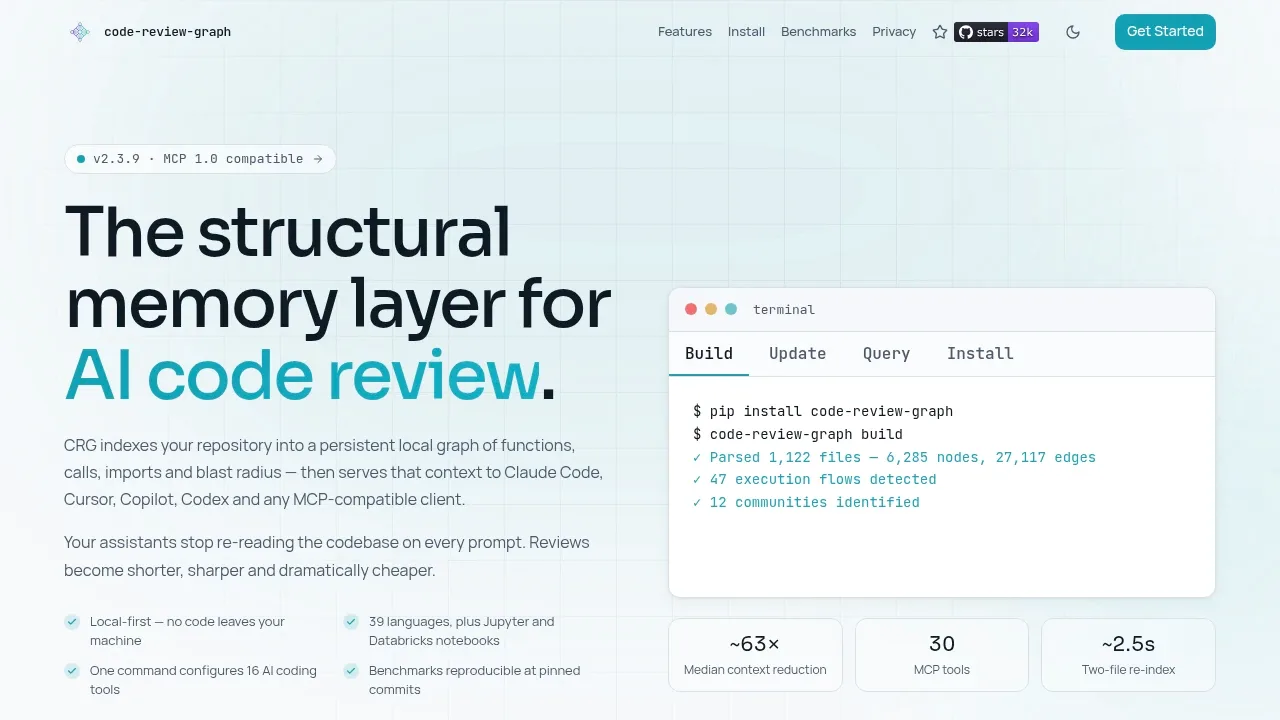
Code Review Graph builds a persistent map of your repository so AI coding assistants can review a change without repeatedly reading the whole codebase. It's an open source, MIT-licensed tool for developers and teams using Claude Code, Cursor, Codex, Copilot or other MCP clients. The graph and core analysis run on your machine.
It maps functions, classes, imports and their relationships, then traces the callers, dependencies and tests a change could affect. That gives an assistant a smaller set of relevant files to inspect. Tree-sitter parsing and a local SQLite database keep the map available between reviews; incremental updates process changed files rather than rebuilding everything.
Beyond affected files, the analysis identifies risky functions, execution flows and gaps in test coverage. It can also find unexpected coupling and code that connects otherwise separate parts of a project. An interactive graph lets you explore those relationships visually, while a GitHub Action runs the analysis on your CI runner and posts risk findings on pull requests without sending source code to an external analysis service.
Language support includes Python, TypeScript, Rust, Swift and Java, alongside Jupyter and Databricks notebooks. Framework-specific analysis follows Laravel relationships and Spring application flows.
Optional semantic search can use local sentence-transformers embeddings or cloud providers such as Google Gemini and Voyage AI. OpenAI-compatible endpoints include vLLM and LocalAI. Cloud embedding choices send data to the selected provider, and connected AI assistants handle supplied review context under their own data policies.
Claim this page with an email at code-review-graph.com. Code Review Graph gets the verified badge, and you can upgrade the listing to be featured on localhosted. Proud to be listed? Put our badge on your site.
Want more people to find Code Review Graph?Promote it
Something wrong or outdated on this page?
2.4KUpdated 19 hours agoApache-2.0
macOS · Windows · Linux#Agent Skills#Git integration#MCP
ripwire helps AI coding agents find relevant code and assess changes without filling their context with whole files. It runs offline on your machine as a self-contained binary, with a CLI and an optional MCP server. It's for developers who want their agents to spend less context on repository research and check the effects of their edits.
270.3KUpdated 2 days agoMIT
Windows#Guardrails#MCP#Multi-agent workflows
190Updated 2 weeks agoMIT
macOS · Web · VS Code#Agent Skills#Git integration#Human approval
29.1KUpdated 10 hours agoApache-2.0
macOS · Windows · Linux · Docker · Web#Agent Skills#Git integration#Hybrid search
1.1KUpdated 20 hours agoAGPL-3.0
macOS · Web#Agent Client Protocol#Agent Skills#Git integration
8.7KUpdated 20 hours agoMIT
macOS · Windows · Linux · Docker · Web#Git integration#Hybrid search#Knowledge graphs
ECC is a free, MIT-licensed open source toolkit that adds repeatable engineering workflows to coding assistants. It runs alongside your chosen agent and works with self-hosted models or cloud providers through that agent's supported endpoints. It's for developers who want planning, testing and review to follow a consistent process across coding sessions.
Link is an open-source memory layer for people who use AI agents across sessions or switch between coding tools. It keeps preferences, project decisions and other saved context in local Markdown files that connected agents can share. The MIT-licensed Python tool works with Claude Code, Codex, Cursor, GitHub Copilot and other agents through MCP and editor integrations.
agentmemory is a self-hosted memory server for developers who want their coding agents to retain project decisions, past fixes and preferences across sessions. It captures activity through agent hooks and retrieves relevant context for later work. Multiple agents can share the same memory, so switching between Claude Code, Cursor and Codex CLI doesn't mean starting with an empty history.
AgentRQ is a self-hosted task manager for people supervising AI agents on their own computers. Agents can ask for decisions, report progress, and receive tasks while you follow their work and reply from a browser, phone, or desktop app. It also offers a hosted service; agents run on your machines, while the task dashboard runs on your own server or the hosted service.
ai-memory keeps project knowledge on a server you control so developers can switch coding assistants or machines without losing context. It connects Claude Code, Codex, Cursor, Gemini CLI and OpenCode to shared memory, including unfinished work, failed approaches and open questions.