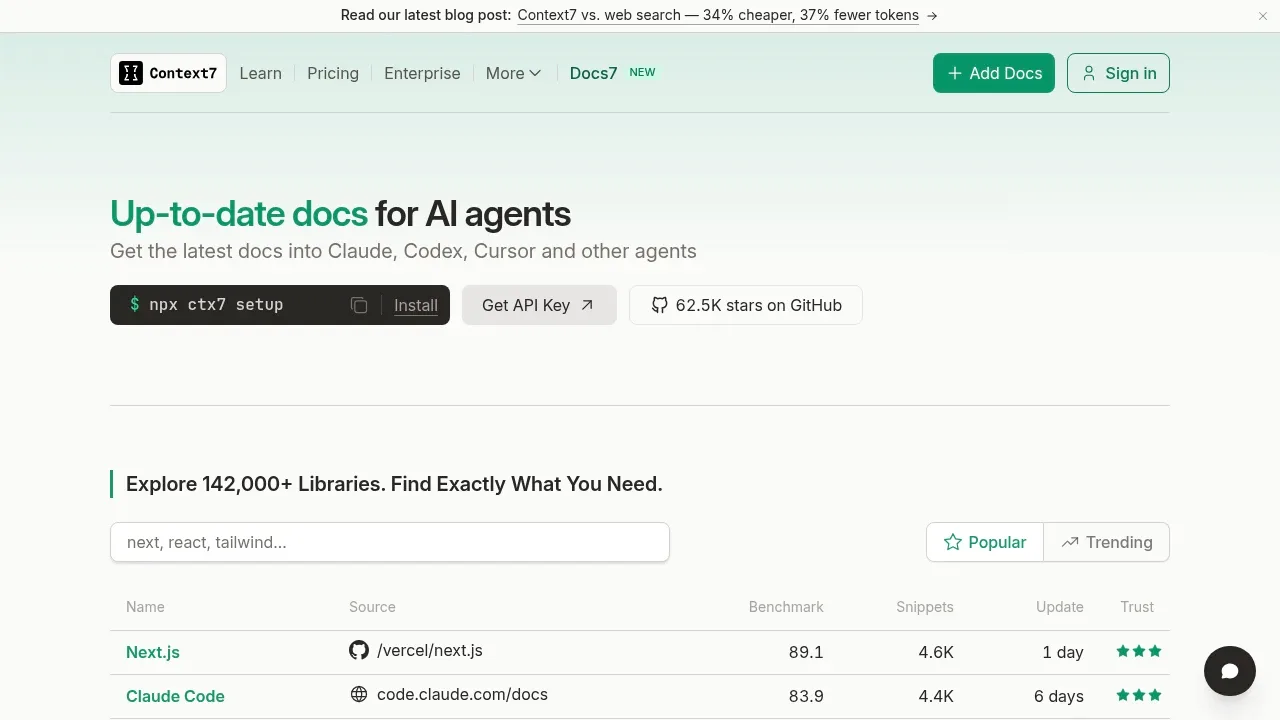
Context7 brings current library documentation and code examples into an AI coding assistant's context. It's for developers who want answers grounded in the libraries and versions they're actually using, rather than an assistant's older training data. It works with Claude Code, Codex, Cursor, Devin Desktop and Antigravity.
You can request documentation for a particular library version and retrieve material relevant to your coding question. Context7 searches its library index to find the right project, then supplies documentation for the task. The index includes Next.js, React, Playwright, Stripe, Supabase and Prisma. This gives an assistant source material to consult when suggesting APIs or writing code, though it doesn't guarantee that the resulting code is correct.
There are two ways to connect it to an agent: a CLI with skills that guide documentation retrieval, or an MCP server that exposes documentation tools directly. The MCP server can run locally, but documentation retrieval uses Context7's online service. It's a documentation connection for your coding assistant, rather than a runtime for running models on your hardware.
The public MCP client is MIT-licensed TypeScript software. For developers building their own AI tools, it also provides a REST API, a TypeScript SDK and tools for the Vercel AI SDK. Library entries include community contributions, and Context7 doesn't guarantee their accuracy or completeness.
A separate licensed on-premises stack includes parsing, indexing, local vector storage, a web UI and an MCP server. Deploy it in Docker or Kubernetes and configure the AI provider; local OpenAI-compatible models are supported. Self-hosting the public MCP client alone still uses the online service.
Claim this page with an email at context7.com. Context7 gets the verified badge, and you can upgrade the listing to be featured on localhosted. Proud to be listed? Put our badge on your site.
Want more people to find Context7?Promote it
Something wrong or outdated on this page?
29.9KUpdated 1 day ago
Docker · JetBrains#Code execution#MCP#Persistent memory
Serena is a locally run MCP toolkit that gives AI coding agents access to code structure: functions, classes and the references between them. It's for developers who want their agent to find and change specific parts of a codebase without reading whole files or relying on text matching. It requires an LLM client and works with Claude Code, Codex, OpenCode, Cursor and OpenWebUI.
33.3KUpdated 2 weeks agoMIT
Docker#Git integration#MCP#Tool calling
13KUpdated 21 hours agoApache-2.0
Docker#Agent Skills#Hugging Face integration#Knowledge graphs
470Updated 1 month agoMIT
macOS#MCP#Tool calling
8.5KUpdated 23 hours agoApache-2.0
Web#LLM tracing#MCP#Multimodal input
30.4KUpdated 17 hours agoMIT
#MCP#Tool calling
Composio connects AI assistants and custom agents to apps such as Gmail, Slack, GitHub, and Linear. It's for people who want their assistant to act on requests across apps, and developers who don't want to maintain each integration themselves. Its CLI gives coding agents a local interface; the standard setup uses Composio's hosted authentication and execution service. It requires an account and internet access.
GitHub MCP Server is GitHub's official connector for developers who want their AI assistant to work with repositories and project activity. It gives compatible coding assistants access to GitHub through the Model Context Protocol (MCP), so they can retrieve context and take actions requested in natural language. The code is open source under the MIT license.
txtai is a Python framework for developers building search applications, chat with their data, and AI agents on their own hardware or servers. Its embeddings database combines sparse and dense vector search with graphs and relational data, so the same system can find related content and supply context to language models. It's open source under Apache 2.0.
ast-grep MCP is a locally run server that lets AI coding assistants search code by its syntax structure. It connects ast-grep to Cursor, Claude Desktop and other clients that support the Model Context Protocol (MCP). It's for developers who need an assistant to find specific code constructs when matching words alone is too broad.
Bifrost is a self-hosted AI gateway for developers and teams whose applications use multiple model providers. It puts Ollama, custom model deployments, and cloud services behind one OpenAI-compatible API, so applications can switch models without maintaining a separate integration for each provider.