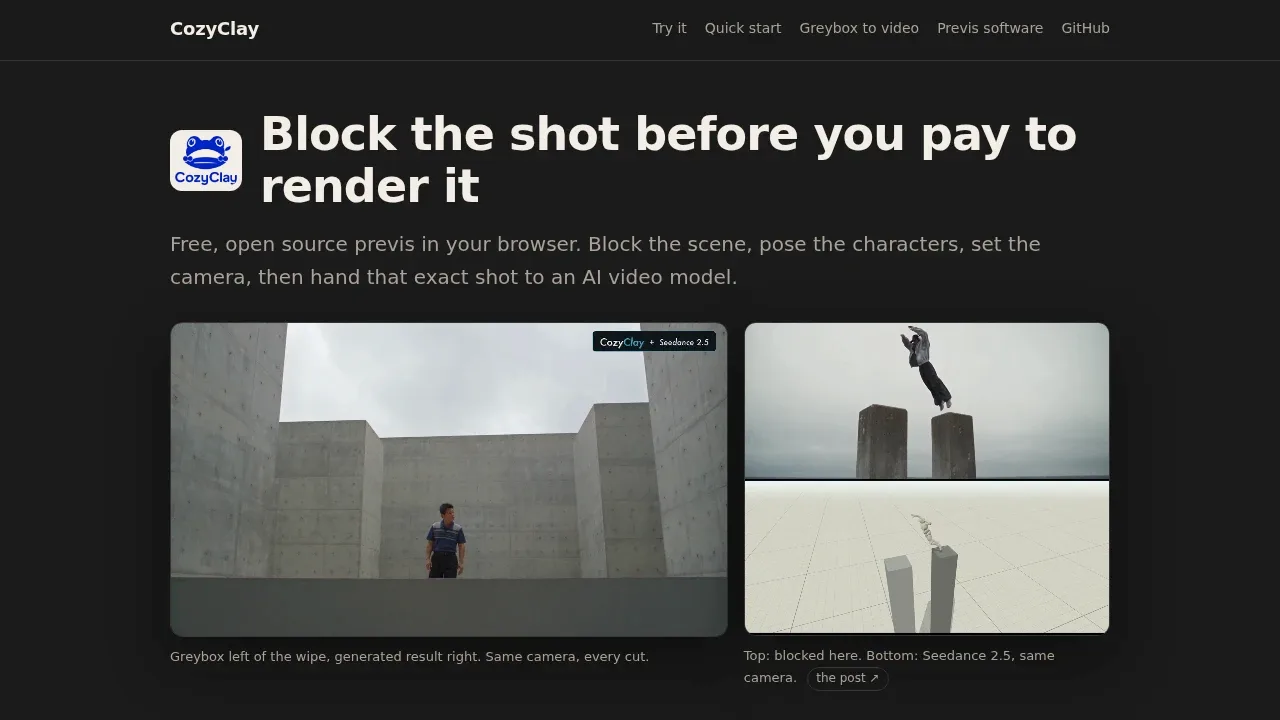
CozyClay is a local 3D previsualization studio for filmmakers and AI video creators who want to plan framing and movement before generating a finished clip. You build a rough scene, pose characters, and edit camera moves and cuts on a timeline. Those shots become visual references for models such as Seedance, Kling and Veo, so you can specify the camera through a clip rather than relying on text alone.
The editor runs in a Chromium browser and follows Unity-style controls. It has primitives and set pieces for scene blocking, a plan view for character paths, and camera tools for lens choice, dolly rails and crane moves. Exports include shot videos, first and last frames, depth and normal passes, storyboard sheets and an OTIO cut list. A keyframe pack combines reference images and a clip with camera data and a model-specific prompt.
Character motion is optional. You can sequence motion prompts through Kimodo, preview the generated result, correct joint motion and regenerate part of a take. For work with AI assistants, an MCP server exposes the scene to external clients. The built-in chat agent uses a ChatGPT account and can arrange characters or edit shots; its changes support undo.
The studio is free and open source under AGPL-3.0. Local editing works offline, and project content isn't uploaded automatically. Account-connected AI features use external services. The hosted demo lets you try the editor and save a project, while video export requires the local Studio. The hosted site and official npm package collect anonymous usage metrics; you can disable collection in the local app.
Claim this page with an email at cozyclay.org. CozyClay gets the verified badge, and you can upgrade the listing to be featured on localhosted. Proud to be listed? Put our badge on your site.
Want more people to find CozyClay?Promote it
Something wrong or outdated on this page?
2.1KUpdated 6 hours agoAGPL-3.0
macOS · Windows · Linux#Agent Skills#MCP#Multilingual
OpenChatCut is a local-first AI video editor for creators who want conversational editing with control over the finished cut. AI changes become editable clips, captions, effects and audio tracks in the same project you can adjust manually. It's a free, open-source ChatCut alternative under AGPL-3.0, with a desktop app for macOS, Windows and Linux.
17.8KUpdated 1 day ago
Web#Git integration#Guardrails#LLM tracing
Wren AI is a self-hosted data agent for teams and agent builders who need answers based on agreed business definitions. It turns plain-language questions into SQL and interactive dashboards, using the same definitions when someone asks directly or through Claude, ChatGPT or Gemini over MCP.
24.8KUpdated 1 day ago
Docker · Web#Code execution#Human approval#MCP
42.4KUpdated 1 day agoApache-2.0
Docker · Web#Guardrails#Human approval#LLM tracing
8.5KUpdated 23 hours agoApache-2.0
Web#LLM tracing#MCP#Multimodal input
29.8KUpdated 4 days agoApache-2.0
Docker · Web#MCP#Multi-agent workflows#Ollama integration
Activepieces brings AI agents and workflow automation into one workspace for teams that need to connect their apps and internal data. It runs on your own servers with Docker or Kubernetes, or as a managed cloud service. An isolated deployment can keep platform data on its own infrastructure; connected apps and model providers may still require external access. Its core and app integration pieces are MIT-licensed.
Agno is a Python framework and runtime for developers building customer-facing or internal AI agents. You can run its agent platform locally with Docker, on your own servers or in your cloud. The open-source framework uses the Apache 2.0 license, and the platform keeps sessions, memory, knowledge and traces in your database.
Bifrost is a self-hosted AI gateway for developers and teams whose applications use multiple model providers. It puts Ollama, custom model deployments, and cloud services behind one OpenAI-compatible API, so applications can switch models without maintaining a separate integration for each provider.
GPT Researcher is a self-hosted AI research agent for people who need detailed, cited reports drawn from the web, their own documents, or both. You choose the language model and search provider, and can run the software on your own server or through Docker. It's open source under Apache 2.0.