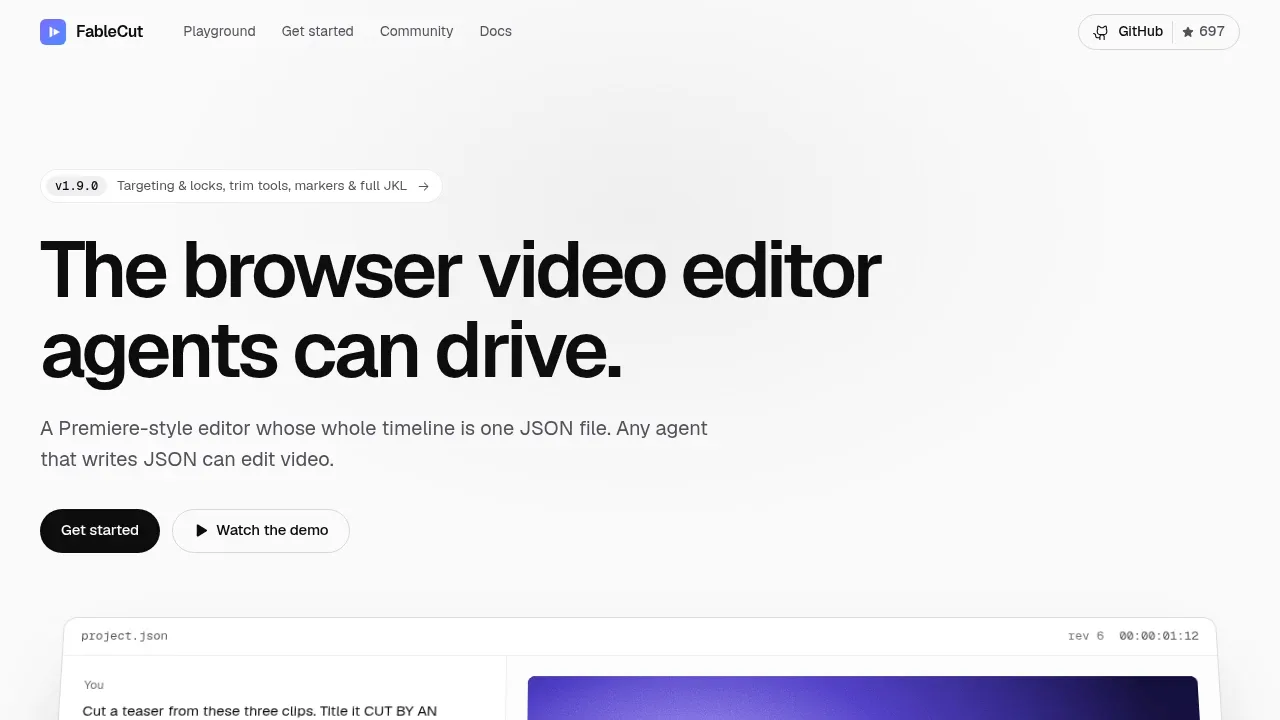
FableCut is a local video editor for people who want to edit footage themselves and let an AI agent work on the same project. It runs in a Chromium browser with a local Node server, and its entire timeline lives in an editable JSON file. Footage stays on your machine; the editor doesn't upload it.
An agent can arrange clips, add titles, change effects and adjust keyframes while the browser shows the edits live. You can work alongside it. The shared project file gives both the visual editor and external tools access to the same clips, tracks and transitions.
FableCut supports MCP and REST control, with connections to Claude Code, Claude Desktop, Codex, Gemini CLI, Cursor, opencode and Amp. Its agent interface isn't tied to a particular model provider, though those clients determine where the AI itself runs.
For manual editing, it has multiple video and audio tracks, trimming, splitting, snapping and undo/redo. Track and clip locks protect parts of a cut, while linked video and audio can move together or separately. You can move, resize and rotate clips or titles directly in the preview. Titles, animated SVG overlays, filter presets and keyframes cover visual styling and motion.
It's open source under the MIT license, with no npm dependencies. Export can run in the browser, with optional ffmpeg for faster rendering. AI background removal downloads its model from a CDN on first use.
Claim this page with an email at fablecut.space. FableCut gets the verified badge, and you can upgrade the listing to be featured on localhosted. Proud to be listed? Put our badge on your site.
Want more people to find FableCut?Promote it
Something wrong or outdated on this page?
745Updated 22 hours agoAGPL-3.0
Web#MCP#Tool calling#Works offline
CozyClay is a local 3D previsualization studio for filmmakers and AI video creators who want to plan framing and movement before generating a finished clip. You build a rough scene, pose characters, and edit camera moves and cuts on a timeline. Those shots become visual references for models such as Seedance, Kling and Veo, so you can specify the camera through a clip rather than relying on text alone.
454Updated 2 weeks agoMIT
Web#MCP#Resumable workflows#Tool calling
2.1KUpdated 1 day agoAGPL-3.0
macOS · Windows · Linux#Agent Skills#MCP#Multilingual
893Updated 6 days agoMIT
Docker · Web#Agent Skills#Guardrails#Human approval
95.1KUpdated 16 hours agoApache-2.0
macOS · Windows · Web#Agent Skills#Hybrid search#MCP
3.2KUpdated 13 hours agoApache-2.0
macOS · Linux · Web#Agent Skills#MCP#Multi-agent workflows
Velocut is a local-first video editor and 3D scene studio for people who want to edit by hand or delegate work to an AI agent. It runs in Chrome or Edge and is open source under the MIT license. Media storage and rendering stay in your browser; AI observations and optional cloud features send relevant data to your chosen model or provider.
OpenChatCut is a local-first AI video editor for creators who want conversational editing with control over the finished cut. AI changes become editable clips, captions, effects and audio tracks in the same project you can adjust manually. It's a free, open-source ChatCut alternative under AGPL-3.0, with a desktop app for macOS, Windows and Linux.
Auto Browser lets AI agents and human operators share a live Chromium browser, with a person able to take over when a login or fragile page needs attention. It's a self-hosted tool for internal dashboards, account workflows, and browser QA. The full stack runs on your own hardware through Docker Compose; Codespaces provides a hosted demo. It's open source under the MIT license.
Claude Mem gives coding assistants persistent project memory, so developers don't have to explain earlier decisions each time a session starts. It records agent activity, turns it into structured observations and summaries, and brings relevant context into later sessions. The free, open source engine runs on your machine under the Apache 2.0 license and doesn't require an account.
OpenRig is a self-hosted coordinator for coding agent teams that keep their responsibilities and context across projects lasting weeks or months. It's for developers who want Claude Code, Codex and Pi to work together, with a lead agent handling requests and feedback while specialists carry out assigned work.