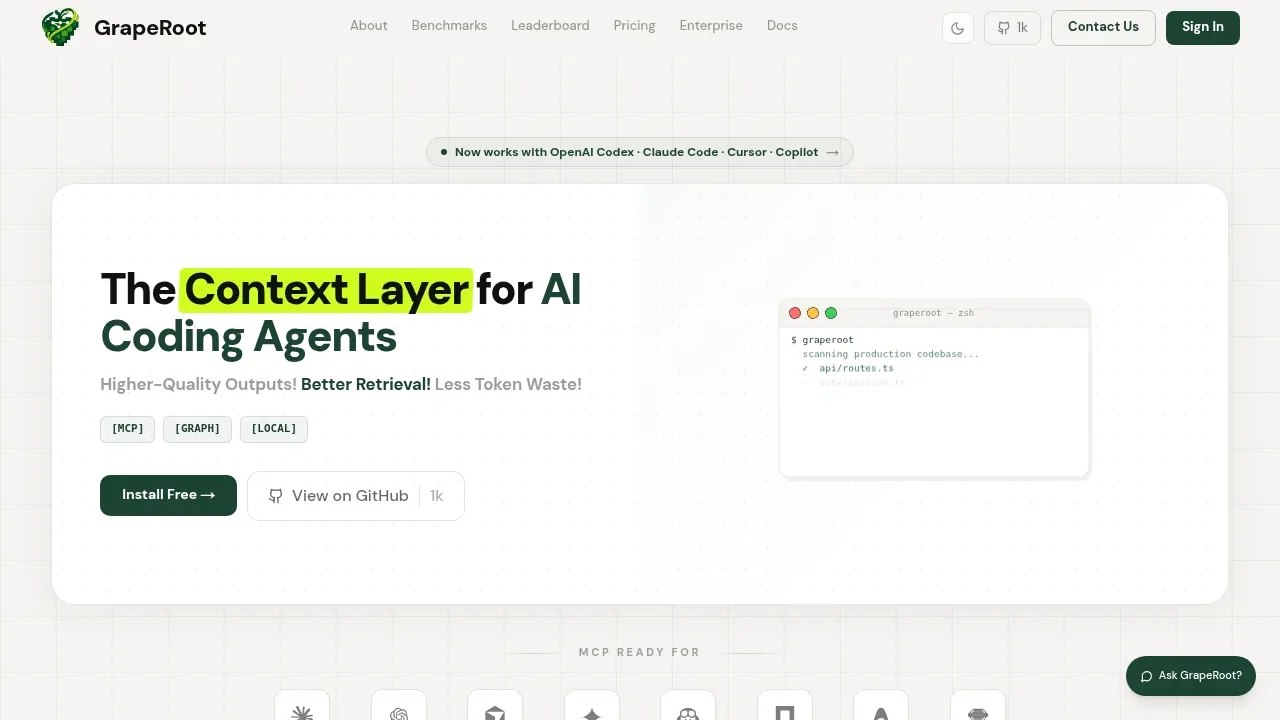
GrapeRoot is a local MCP tool for developers who want their AI coding assistant to understand a project's structure without repeatedly searching through files. It builds a graph of the codebase and supplies relevant code before each prompt reaches the assistant. It runs on macOS, Linux and Windows.
The graph connects files and symbols with imports and call chains, so context selection can follow relationships in the code rather than rely only on text matches. GrapeRoot remembers which files the assistant has read, edited or queried and uses that history to select context for later turns. It also stores decisions, tasks and facts across sessions. Per-turn context limits help control how much code enters a prompt, while graph-aware MCP tools let the assistant inspect related code when it needs more detail.
It works with Claude Code, OpenAI Codex CLI, Cursor, Gemini CLI, GitHub Copilot and OpenCode, among other assistants. Its main distinction is automatic context delivery before each turn, paired with memory of earlier work. That approach targets repeated file exploration and the tokens it consumes, particularly during work that spans several parts of a project.
GrapeRoot processes the codebase and stores its graph locally. The launcher scripts are open source under Apache 2.0; the graph engine is proprietary.
Claim this page with an email at graperoot.dev. GrapeRoot gets the verified badge, and you can upgrade the listing to be featured on localhosted. Proud to be listed? Put our badge on your site.
Want more people to find GrapeRoot?Promote it
Something wrong or outdated on this page?
45.6KUpdated 3 hours agoMIT
macOS · Windows · Linux · Web#Git integration#Knowledge graphs#MCP
Codebase Memory MCP gives AI coding agents a persistent map of a repository's structure, so they can answer questions about dependencies and call chains without repeatedly reading whole files. It's for developers using Claude Code, Codex CLI, Cursor or other MCP-compatible clients who want their agents to spend less context on code exploration.
2KUpdated 3 months agoMIT
Windows#Code execution#Knowledge graphs#MCP
2.6KUpdated 15 hours agoApache-2.0
macOS · Windows · Linux#Hybrid search#Knowledge graphs#MCP
XERJ is a local search engine for AI agents that retrieves relevant code and documents instead of making an agent read whole files into its context. It's for developers building coding assistants, codebase Q&A or agents that need persistent memory. The open-source Rust engine runs on Linux, macOS and Windows, on a laptop or self-hosted server, under the Apache 2.0 license.
1.4KUpdated 14 hours agoMIT
macOS · Windows · Linux#Agent Skills#MCP#Multilingual
270.3KUpdated 2 days agoMIT
Windows#Guardrails#MCP#Multi-agent workflows
13.3KUpdated 1 day agoApache-2.0
Docker#Agent Skills#Hybrid search#MCP
Context+ is a local MCP server that helps coding assistants understand large codebases through code structure, semantic search and linked project knowledge. It's for developers using Claude Code, Cursor, VS Code, Windsurf or OpenCode who need their assistant to find relevant code and assess what a change could affect.
Wake is a native macOS app for developers whose coding conversations are spread across different AI agents. It brings those histories into a searchable library, grouped by project and agent. Built with Rust and GPUI, it's open source under the MIT license and runs on Apple Silicon and Intel Macs. Linux and Windows support is experimental.
ECC is a free, MIT-licensed open source toolkit that adds repeatable engineering workflows to coding assistants. It runs alongside your chosen agent and works with self-hosted models or cloud providers through that agent's supported endpoints. It's for developers who want planning, testing and review to follow a consistent process across coding sessions.
EverOS is a self-hosted memory runtime and Python library for developers building AI agents that need to remember across sessions and applications. It stores conversations, files, and task histories as readable Markdown, with local SQLite and LanceDB indexes for retrieval. The code uses the Apache 2.0 license; a managed cloud service is also available.