
Palace
A local memory layer for AI coding agents that recalls past work through MCP, with a free MIT core and a paid self-hosted team server.
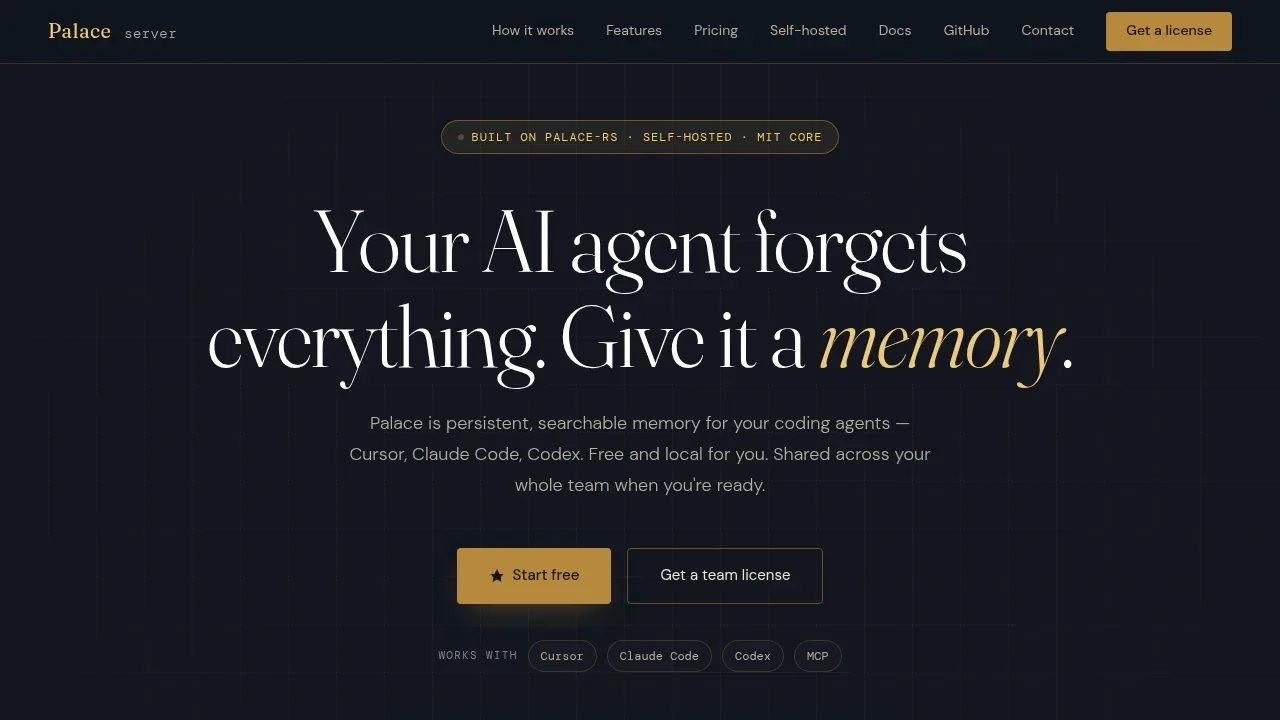
Palace gives AI coding agents persistent memory of project decisions, conventions and fixes. Developers can carry that context between sessions in Cursor, Claude Code, Codex and Claude Desktop.
- Automatic recall: Supported coding clients receive relevant history during work, scoped to the current project; Claude Desktop accesses memory through MCP without automatic hooks.
- Search with sources: Keyword and semantic search retrieve original text with nearby context and source references, including dedicated matching for preferences.
- Decisions and session history: A knowledge graph tracks facts and relationships over time, while session diaries let agents pick up earlier work.
- Shared team memory: The paid Palace Server lets teammates recall shared knowledge on their own infrastructure, with workspace read/write permissions, tenant isolation and audit logs; diaries stay private unless shared.
The free, open-source palace-rs core uses the MIT license and stores memory in a local SQLite file. It needs no account. Embeddings run on your CPU through ONNX Runtime using all-MiniLM-L6-v2, and the memory layer can work offline without telemetry. These local processing facts apply to Palace, independently of the connected coding assistant.
Palace Server is the commercial layer. It runs as a Docker image or Rust binary on Linux and macOS, including ARM64, and stores shared data in PostgreSQL with pgvector. Local embeddings and offline license verification support air-gapped deployments. Stored memories and knowledge graph entries can be exported as JSON.


