
Captain Memo
Local AI memory shares context across coding agents, with synchronized skills, multilingual search and fully offline operation through local models.
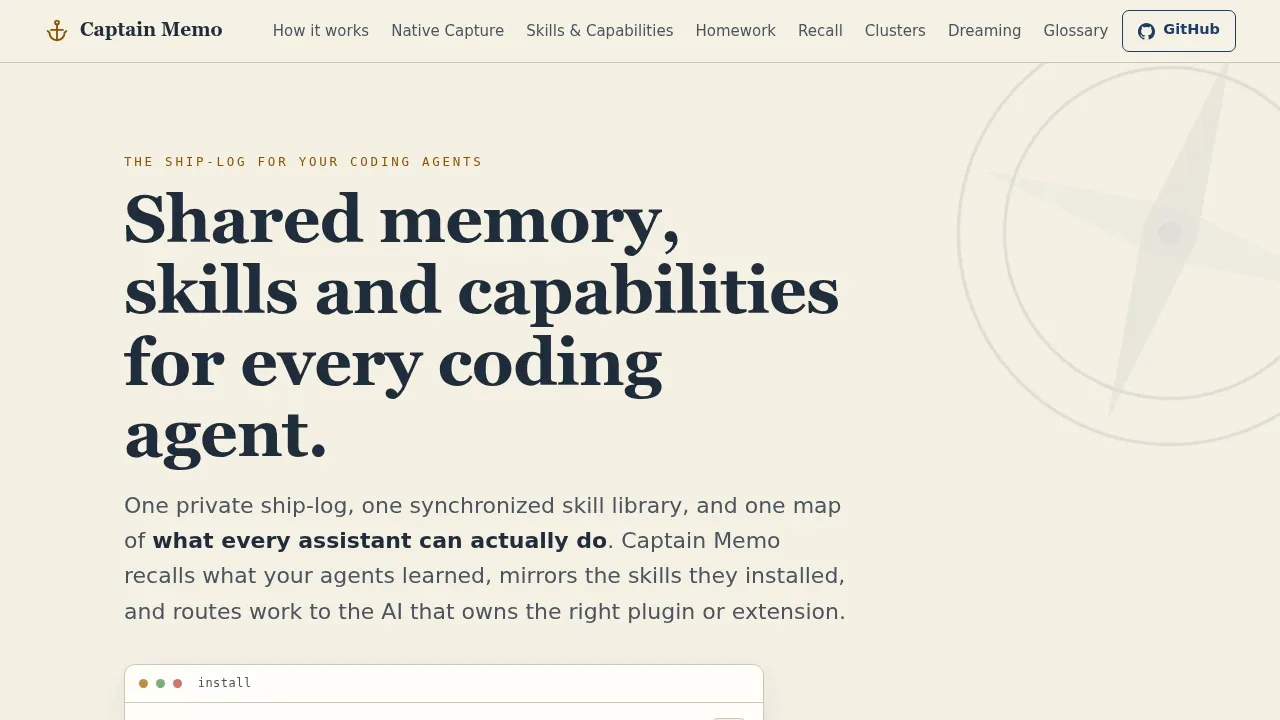
Captain Memo gives developers a shared memory across coding assistants, so project decisions and lessons remain available between sessions and tools. Claude Code, Codex, Gemini CLI, Cursor and other MCP-compatible assistants can access the same corpus.
- Session memory: Searches captured observations and notes by meaning and keywords, including multilingual text; Claude Code gets automatic recall, while Codex and Gemini CLI get it where native hooks are installed.
- Shared skills and capabilities: Synchronizes installed skill instructions as their originals change and maps plugins to the assistant that can execute them, without copying credentials or executable configuration.
- Work coordination: Tracks overlapping files and tasks and can block conflicting edits and uploads in guarded sessions; Claude Code supports enforcement, while Codex and Gemini enforcement requires Linux, and other assistants' claims only warn.
- Ideas for later: Keeps a shared task list where assistants can save ideas, claim work and record completion.
- Memory consolidation: Groups related observations into themes during idle time, archives the originals and lets you reverse the changes.
It's free and open source under Apache 2.0, and runs on Linux, macOS and Windows x64. Capture varies by assistant: Cursor, goose, VS Code, JetBrains and Claude Desktop access memory without automatic session recording.
Storage stays on your disk. Optional hosted summarizers and embedders receive data for processing. Local models through Ollama, LM Studio or compatible endpoints let it work fully offline without an account or API key. The bundled local embedder runs on Linux and Windows; macOS needs an external local embedding backend.


