
GROBID
Self-hosted document extraction software turns scholarly PDFs into TEI XML. Runs on Linux and macOS, supports Docker, and uses the Apache 2.0 license.
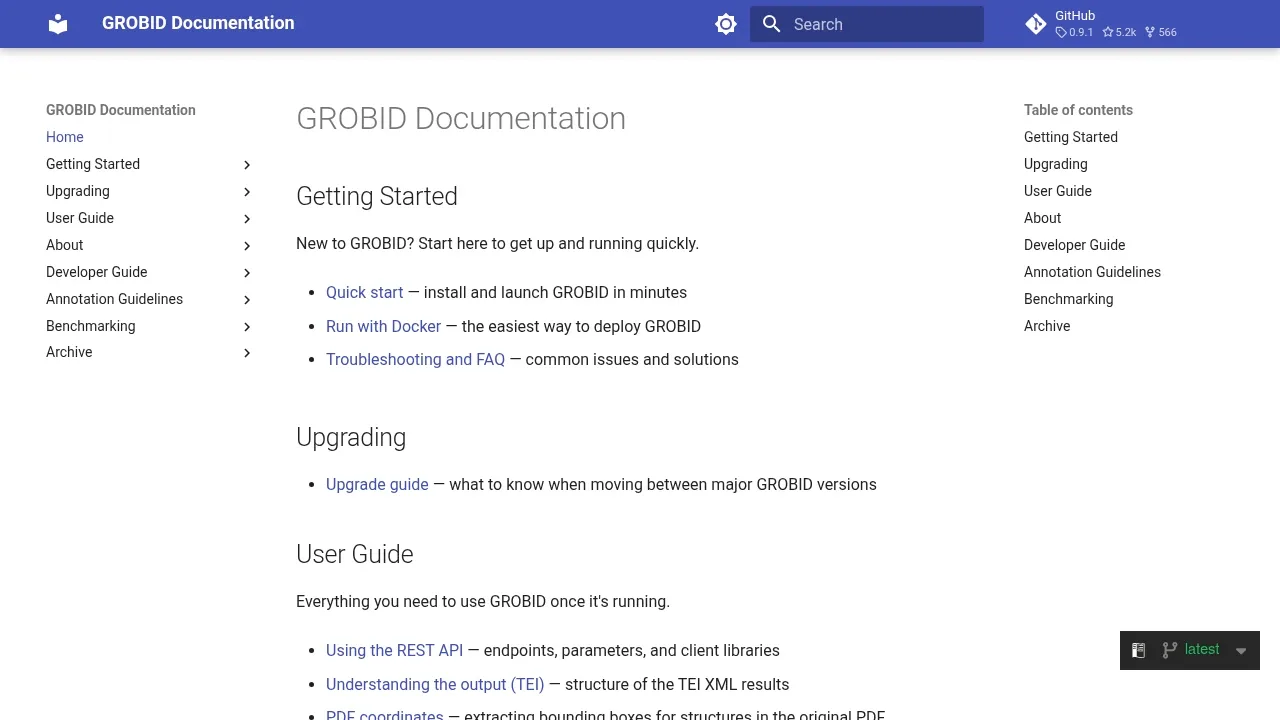
GROBID turns scientific and technical PDFs into structured TEI XML on your own machine or server. It's for researchers and developers who need article metadata, full text and bibliographical references for search, analysis or document collections. The software is open source under Apache 2.0.
It extracts titles, abstracts, authors, affiliations and keywords, and parses the structure of articles and their references. PDF coordinates connect extracted structures to their positions on the original page. An optional consolidation service links references to external metadata.
GROBID uses both text and page layout to recognize document structure. Its default CRF models run on ordinary hardware, while optional deep learning models use RNNs or transformers through DeLFT after explicit selection in the configuration. Some of these models improve reference parsing accuracy. CPU processing is supported; an NVIDIA GPU with CUDA can speed up deep learning workloads.
Native builds support 64-bit Linux and macOS on Intel or Apple Silicon. Docker deployment is also available. A REST API and Python, Java and Node.js clients support parallel processing of PDF collections, with a separate Go client available.
Self-hosted deployments process documents on your hardware. Public demos run on Hugging Face Spaces, where submitted PDFs go to the hosted service. Developers can retrain or fine-tune the extraction models, and separate modules identify software mentions, datasets and physical measurements in scientific papers.


