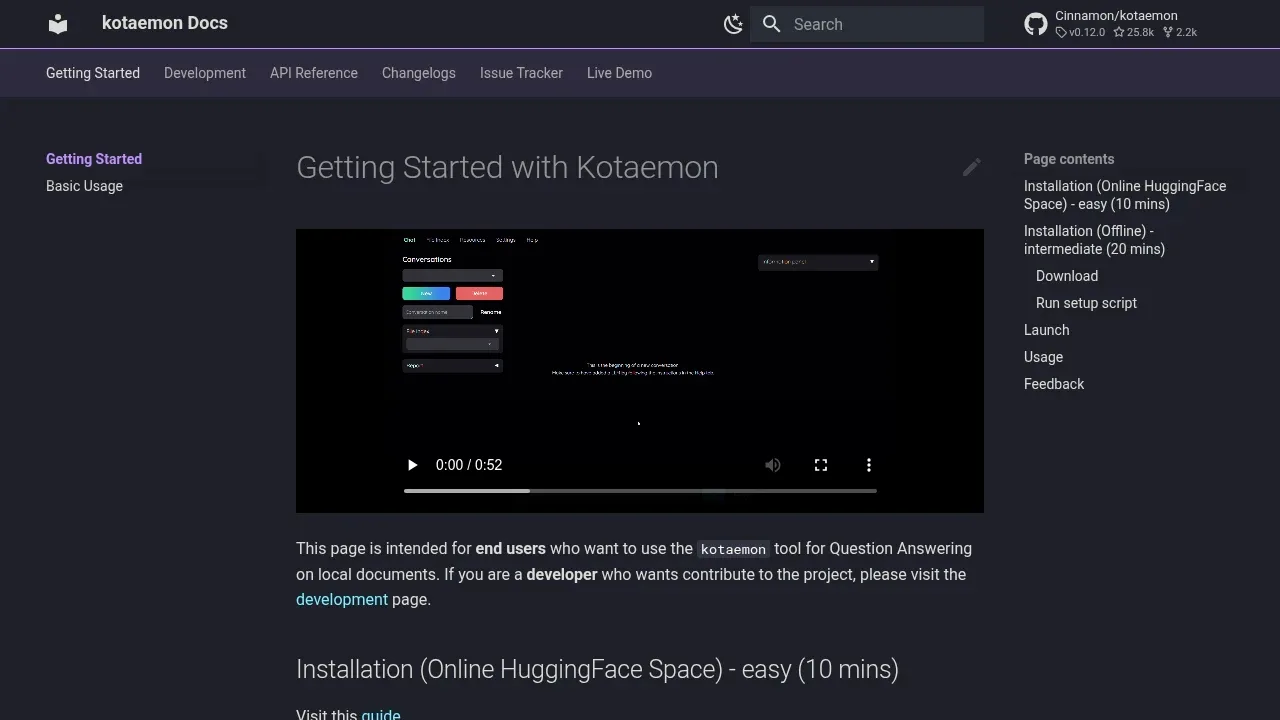
kotaemon is a self-hosted document chat app for people who want to ask questions across their files and check where the answers came from. It runs in a browser on Windows, macOS or Linux, with Docker also supported. The project uses the Apache 2.0 license.
You can use local LLMs through Ollama or llama-cpp-python, or connect services such as OpenAI, Azure OpenAI, Cohere and Groq. Local models and local document parsers support private processing on your own hardware. Choosing cloud models or parsing APIs sends the corresponding work to those services. A Hugging Face Space provides an online option, separate from running the app yourself.
Answers include citations that you can inspect in an in-browser PDF viewer, with highlights and relevance scores. The app also warns when retrieved material has low relevance. Its document search combines full-text and vector retrieval with re-ranking, and questions can span multiple documents, including figures and tables.
For shared use, kotaemon has multi-user login, private and public file collections, and chat sharing. Document parsing options include local Docling and PaddleOCR, alongside Azure Document Intelligence and Adobe PDF Extract APIs.
Developers can extend the Python app's Gradio interface and supply their own document indexing or reasoning pipelines. It supports question decomposition for multi-step questions, agent reasoning through ReAct and ReWOO, and GraphRAG indexing.
Claim this page and we'll verify you by hand. kotaemon gets the verified badge, and you can upgrade the listing to be featured on localhosted. Proud to be listed? Put our badge on your site.
Want more people to find kotaemon?Promote it
Something wrong or outdated on this page?
10.5KUpdated 7 months agoApache-2.0
macOS · Windows · Linux · Android · Web#Code execution#MCP#Multimodal input
aichat brings Ollama and cloud AI services into the same terminal interface for developers and people who work at the command line. It runs locally on macOS, Linux and Windows, with Android support through Termux. Model processing happens through the backend you choose: Ollama supports local models, while providers such as OpenAI, Claude and Gemini process requests in the cloud.
41.2KUpdated 1 day agoAGPL-3.0
macOS · Docker · Web#Code execution#Hybrid search#LM Studio integration
18.3KUpdated 24 hours agoMIT
macOS · Windows · Linux · Docker · Web#Human approval#Hybrid search#llama.cpp backend
12KUpdated 12 months agoApache-2.0
macOS · Windows · Linux · Docker · Web#Code execution#llama.cpp backend#Multi-user access
38.7KUpdated 11 months agoApache-2.0
macOS · Windows · Linux · Docker · Web#Multimodal input#Ollama integration#OpenAI-compatible API
39.9KUpdated 4 days agoMIT
macOS · Windows · Linux · Docker · Web#Knowledge graphs#LLM tracing#Multimodal input
AstrBot brings AI assistants into messaging apps such as Telegram, Discord, Slack, QQ and WeCom. It's an open source platform under AGPL-3.0 for people building personal companions, customer support bots or team automation. You can run it on your own computer or server, including through Docker, or use its desktop app for browser-style chat.
DocsGPT is an MIT-licensed, open-source platform for teams that want AI search, assistants and agents over their own documents. It can run on your servers with local models, including fully air-gapped deployments where documents and questions stay inside your network. Answers include the source title and page number so readers can check the evidence.
h2oGPT is a self-hosted ChatGPT alternative for people who want to chat with local models and ask questions about their own documents. The project is archived and no longer maintained. It's open source under Apache 2.0, with support for Linux, macOS, Windows and Docker.
Langchain-Chatchat is a self-hosted application for asking questions about your own documents and using AI agents. It focuses on Chinese-language use and open models, with a fully offline setup that can keep documents and model processing on your hardware. Its code is open source under Apache 2.0.
LightRAG combines knowledge graphs with vector search to answer questions across a document collection. It's a self-hosted Python framework for developers building document assistants, particularly where answers depend on relationships between facts in different files, such as legal or financial material.