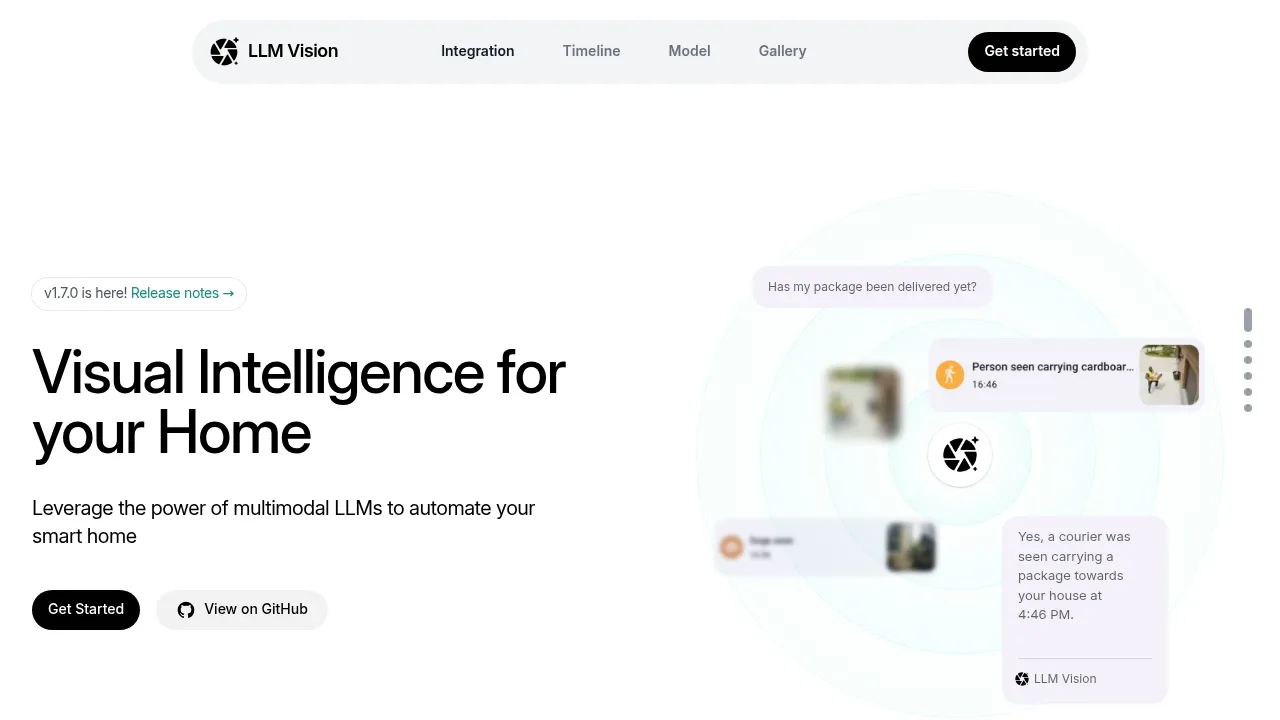
LLM Vision is a free, open-source Home Assistant integration for people who want their smart home to interpret what cameras see. It uses multimodal LLMs to describe images, video files, live feeds and Frigate events, then uses those results in notifications and automations.
You choose where analysis runs. Ollama and LocalAI let you use models on your own hardware; hosted providers such as OpenAI, Anthropic and Google process inputs through their cloud services. It also supports Open WebUI and providers with an OpenAI-compatible API. The integration uses the Apache 2.0 license.
Camera events can become a searchable history of activity around your home. Event storage is optional, and analyzed events stay in your Home Assistant instance. You can retain only events the model classifies as important, view them in a dashboard timeline, or ask about past activity through Assist with a conversation agent such as Extended OpenAI Conversation. Events also appear as calendar entities for automations.
For live feeds and video, the image pipeline selects relevant frames and a key image for notifications. It supports hardware acceleration and reduces image resolution to limit latency and token use. Any camera stream viewable in Home Assistant can serve as an input.
Image analysis can also extract values and update Home Assistant entities, including numbers, text, selections and booleans. This data extraction accepts cameras, image entities and local image files; it doesn't accept video.
Claim this page with an email at llmvision.org. LLM Vision gets the verified badge, and you can upgrade the listing to be featured on localhosted. Proud to be listed? Put our badge on your site.
Want more people to find LLM Vision?Promote it
Something wrong or outdated on this page?
818Updated 4 years agoApache-2.0
macOS · Windows · Linux · Docker#Home Assistant integration#Works offline
DeepStack is a self-hosted computer vision API for developers adding image analysis to camera systems, home automation or other applications. It runs prebuilt and custom models on your own hardware and works fully offline. Image processing stays on the device or server where you host it, with no cloud service required.
1.4KUpdated 1 year agoMIT
Docker · Web#Home Assistant integration
Double Take connects Frigate camera images to facial recognition services through a shared web interface and API. It's for people running camera systems and Home Assistant who want to identify familiar faces and use the results in home automations. The app runs on your own server in Docker and is open source under the MIT license.
36.2KUpdated 7 hours agoMIT
#Home Assistant integration#Works offline
6KUpdated 2 days ago
#Home Assistant integration
Scrypted is a server-based video integration platform for people who want to view their home cameras through their existing smart home apps and displays. It supports most cameras and focuses on low latency streaming. Its NVR plugin adds continuous recording and smart detections for people who also need a record of what happened.
5.7KUpdated 2 weeks agoMIT
macOS · Windows · Linux · Docker#Home Assistant integration#MCP#Multi-agent workflows
1.4KUpdated 3 days ago
#GGUF#Home Assistant integration#Hugging Face integration
Home-LLM connects Home Assistant to language models running on your own hardware, so you can control smart devices through voice or chat. It's for Home Assistant users who want natural language control without relying on a cloud service or subscription. The project pairs a custom integration with small models trained specifically for smart home commands.
Frigate is an open source NVR for IP cameras that detects people, cars, and other objects on your own hardware. Camera feeds stay at home. It's built for people who want a locally controlled security camera system, particularly those using Home Assistant.
GLaDOS is a local AI voice assistant modeled on the sarcastic character from Valve's Portal games. It's for people who want a conversational companion on their own hardware, with camera awareness and connections to home automation. The Python project is open source under the MIT license and runs on Linux and Windows. macOS support is experimental.