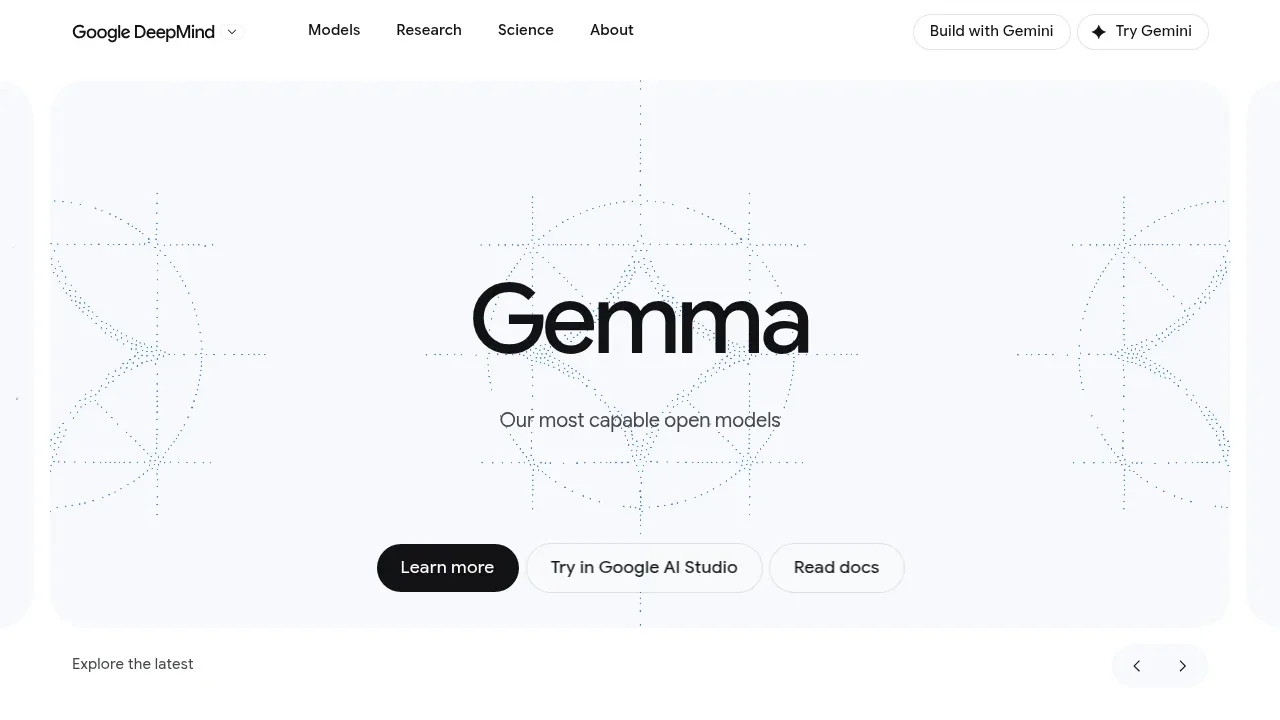
Gemma is Google DeepMind’s family of open-weight AI models for developers building applications that can run on their own hardware. Its range covers compact models for phones and IoT devices alongside larger Gemma 4 models for reasoning on personal computers and servers. Some applications can work offline, keeping model inference on the device. Google AI Studio and Google Cloud are also available for hosted use.
The models cover different jobs. Gemma 4 supports reasoning and multimodal applications, while specialized variants include MedGemma for medical text and images, TranslateGemma for translation, EmbeddingGemma for on-device embeddings, and ShieldGemma 2 for content classification. DiffusionGemma is designed for fast text generation. This gives developers a choice of model suited to the task and the hardware where it will run.
For local use, Gemma works with Ollama, LM Studio, Gemma.cpp and Google AI Edge. The accompanying JAX library supports conversations, multimodal use and fine-tuning, including LoRA. That library is open source under Apache License 2.0 and can use a CPU, GPU or TPU. Gemma models also have integrations with PyTorch and Keras.
Claim this page with an email at ai.google.dev. Gemma gets the verified badge, and you can upgrade the listing to be featured on localhosted. Proud to be listed? Put our badge on your site.
Want more people to find Gemma?Promote it
Something wrong or outdated on this page?
2.1KUpdated 3 weeks agoApache-2.0
Linux#GGUF#Guardrails#Hugging Face integration
Nemotron is NVIDIA's family of AI models for developers building agents that reason, write code and call tools. You can run models locally for private, offline work or deploy them on your own servers. NVIDIA publishes model weights, training data and recipes so teams can inspect and adapt the models for their applications.
273Updated 2 years agoApache-2.0
Linux#Guardrails#Hugging Face integration#LM Studio integration
25KUpdated 2 years agoApache-2.0
macOS · Web#LoRA#Multimodal input#Quantization
10.1KUpdated 5 months agoApache-2.0
macOS · Windows · Linux#Hugging Face integration#Multimodal input#Works offline
34.4KUpdated 6 months agoMIT
#Batch processing#Multimodal input
CLIP is an open-source image and text model that lets developers and researchers classify images using labels written in natural language, without collecting training examples for each task. It runs locally through PyTorch on a CPU or CUDA GPU. The code and model weights use the MIT license.
7.7KUpdated 12 months ago
#Hugging Face integration#Multimodal input#Quantization
Llama is Meta's family of large language models for developers, researchers and businesses that want to run models on their own hardware or servers. Its downloadable weights let you build generative AI applications with local inference. Access requires license acceptance and approval, and the weights use custom licensing for research and commercial use.
Granite is IBM's family of open-source AI models for developers and businesses that want to run and customize AI on their own hardware or servers. The language-model repository listed here is archived and no longer maintained. The broader family includes models for language, speech, document understanding and forecasting, released under Apache 2.0 for research and commercial use.
LLaVA is a family of vision-language models for researchers and developers who want to ask questions about images on their own hardware. It pairs a CLIP vision encoder with a language model to support image descriptions, visual reasoning and reading text in pictures. Its Python code is open source under Apache 2.0; the project places research-use restrictions on its data and checkpoints, with additional terms from the underlying models.
Moondream is a vision model for developers building software that needs to understand images. It can answer questions about a picture, write captions, locate objects, identify points and segment regions. The open-weight models can run on your own hardware, including in an air-gapped environment. The repository code is licensed under Apache 2.0; check each model checkpoint’s own terms for use.