
MCPHub
A self-hosted MCP gateway connects local and remote servers to AI clients, with per-user credentials, access controls and semantic tool discovery.
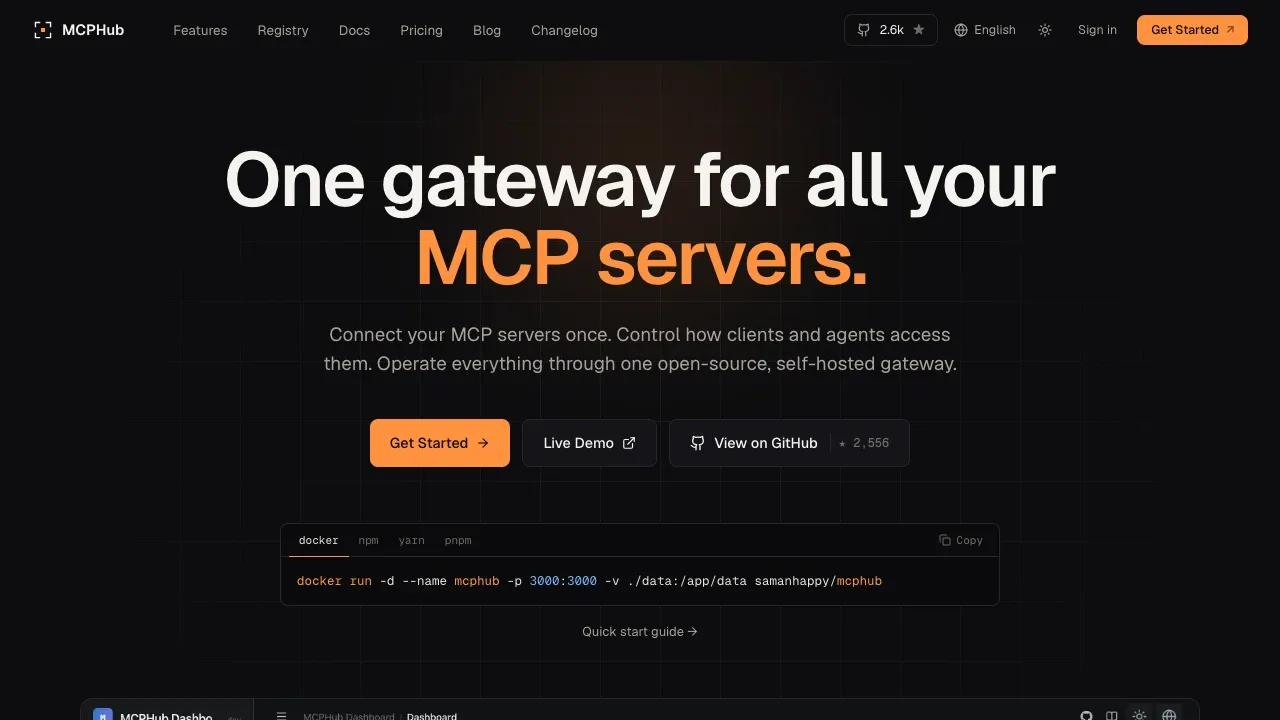
MCPHub is a self-hosted gateway for developers and teams connecting AI clients to multiple MCP servers. It gives them one place to manage shared tools and decide what each user or project can access.
- Shared connections: Connect local and remote MCP servers through unified endpoints, with separate routes for all servers, selected groups or a single server.
- Access and credentials: Restrict access to servers, tools, prompts and resources with authentication, scoped keys and visibility controls. Users can attach their own upstream credentials to a shared server, with encrypted storage and isolated local server processes per user.
- Semantic tool discovery: Smart Routing selects a smaller set of tools by matching their descriptions to a requested capability. It requires a configured vector store and embedding model.
- APIs and interactive apps: Expose OpenAPI services as MCP tools and pass interactive MCP Apps through to compatible clients. Smart Routing doesn't pass Apps through.
- Monitoring and management: Use the browser dashboard to inspect tool calls, request status, latency, server logs and connection health. Server configuration can change without downtime.
MCPHub is open source under Apache 2.0 and runs on your own hardware or server through Docker or Node.js. It works with Claude Desktop, Claude Code, Cursor, OpenWebUI and other MCP clients. The gateway stores settings and credential bindings locally by default, with PostgreSQL as an alternative. Connected remote services receive requests sent to them.
 Logotyper


