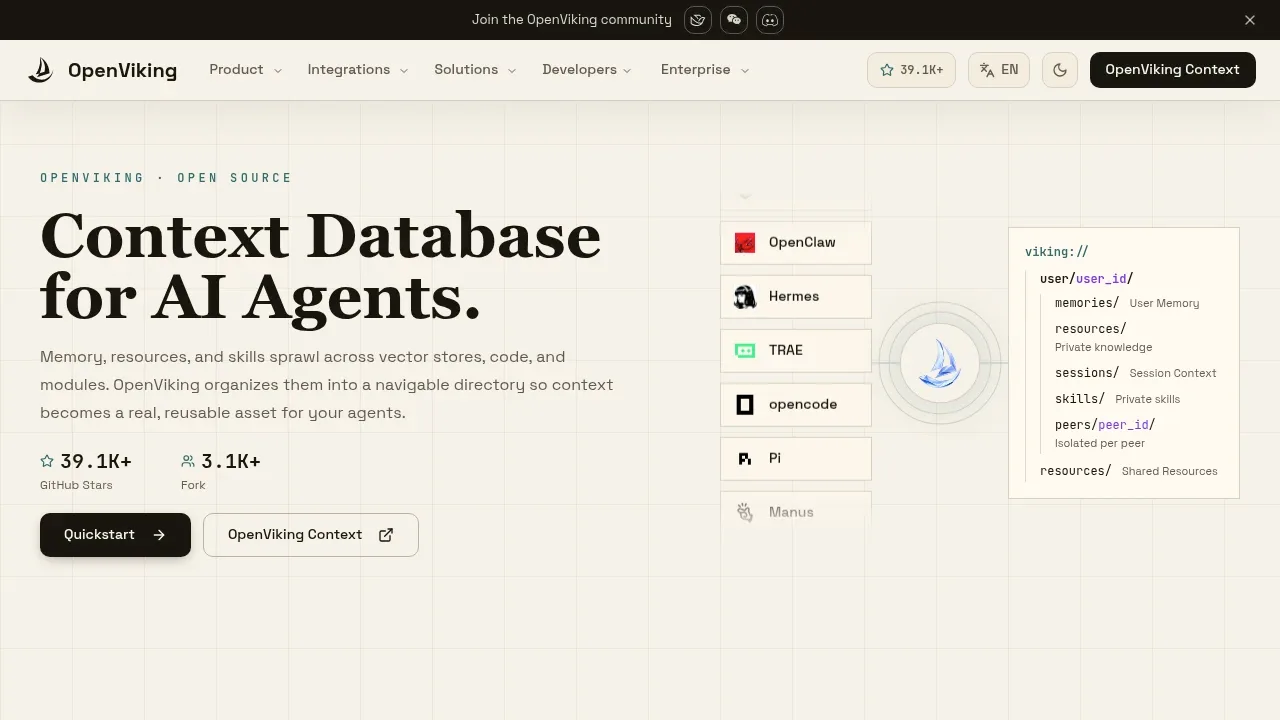
OpenViking is a self-hosted context database for developers who want agents to retain knowledge across sessions and inspect what they remember. It puts documents, memories and skills in a browsable directory structure, with editable content instead of an opaque collection of embeddings.
Agents can search within a specific project or memory directory. Generated summaries help them judge relevance before reading full documents, so retrieval can use less context. Web pages, repositories and project docs become resources alongside user preferences and task experience. Session capture archives conversations and extracts memories into Markdown that you can inspect, edit and merge.
OpenViking connects to Claude Code, Codex, Cursor, OpenClaw and Hermes, among other agent tools. Native integrations provide automatic recall and session capture; MCP clients can access memory and context tools. A browser-based Studio lets you inspect the database, and you can self-host that interface too. The server supports separate user accounts and optional access controls for resources.
The open source server uses the AGPL-3.0 license and runs in your own environment, including through Docker, without an activation key. It needs an embedding model and a vision-language model, which can run locally or through cloud services. Supported providers include Ollama, OpenAI and Volcengine. Your model choice determines whether processing stays local or uses a cloud provider. Volcengine also offers managed hosting, while a commercial self-managed edition supports deployment in your own cloud account or an offline environment.
Claim this page with an email at openviking.ai. OpenViking gets the verified badge, and you can upgrade the listing to be featured on localhosted. Proud to be listed? Put our badge on your site.
Want more people to find OpenViking?Promote it
Something wrong or outdated on this page?
3.8KUpdated 2 months agoMIT
Linux · Docker · Web#Hybrid search#Knowledge graphs#LM Studio integration
SimpleMem is a Python memory system for developers building AI agents that need to recall earlier conversations and stored media. You can self-host it with Docker or use its hosted text-memory service. The code is open source under the MIT license.
31.3KUpdated 2 days agoApache-2.0
Docker · Web#Knowledge graphs#MCP#Multi-user access
4.5KUpdated 2 months agoApache-2.0
Docker · Web#Hybrid search#Knowledge graphs#MCP
705Updated 3 months agoMIT
Web#Human approval#Hybrid search#Knowledge graphs
SwarmVault is a self-hosted knowledge base for people who want research, notes, or code documentation to become a persistent wiki that AI agents can use. It stores original sources, Markdown pages, and a knowledge graph as local files you can inspect. The project is open source under the MIT license.
29.1KUpdated 7 hours agoApache-2.0
macOS · Windows · Linux · Docker · Web#Agent Skills#Git integration#Hybrid search
8.7KUpdated 18 hours agoMIT
macOS · Windows · Linux · Docker · Web#Git integration#Hybrid search#Knowledge graphs
Cognee gives AI agents persistent memory across sessions, connecting documents, code, and conversations in a searchable knowledge graph. It's for developers who want agents to retain project context and teams whose knowledge sits across tickets, discussions, and repositories. The Python package is open source under Apache 2.0.
M Flow is a self-hosted memory engine for developers building AI agents and applications that need to recall earlier conversations, facts, and workflows. Its distinguishing feature is how it selects context: vector search finds possible matches, then a knowledge graph ranks them by the evidence connecting them to the query. It's open source under Apache 2.0 and runs as a Python library or a Docker service.
agentmemory is a self-hosted memory server for developers who want their coding agents to retain project decisions, past fixes and preferences across sessions. It captures activity through agent hooks and retrieves relevant context for later work. Multiple agents can share the same memory, so switching between Claude Code, Cursor and Codex CLI doesn't mean starting with an empty history.
ai-memory keeps project knowledge on a server you control so developers can switch coding assistants or machines without losing context. It connects Claude Code, Codex, Cursor, Gemini CLI and OpenCode to shared memory, including unfinished work, failed approaches and open questions.