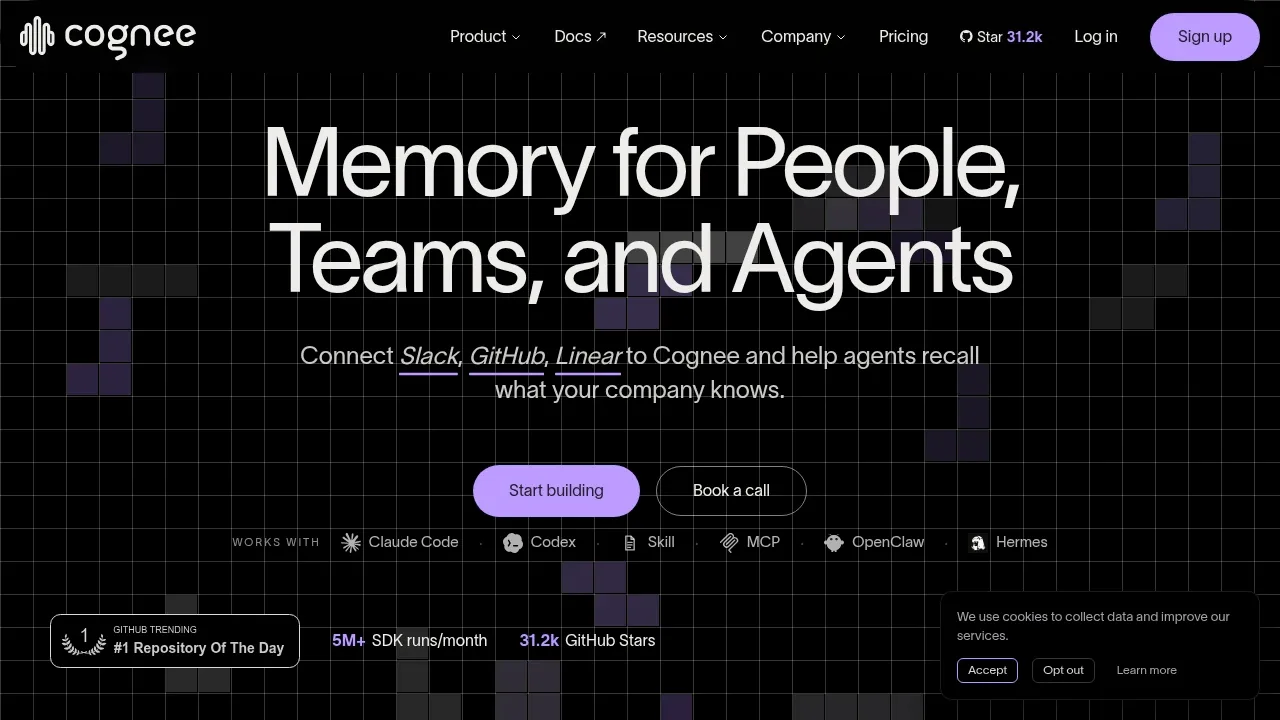
Cognee gives AI agents persistent memory across sessions, connecting documents, code, and conversations in a searchable knowledge graph. It's for developers who want agents to retain project context and teams whose knowledge sits across tickets, discussions, and repositories. The Python package is open source under Apache 2.0.
Memory can run locally on your CPU without an API key. Cognee uses GLiNER to extract entities and relationships, plus a local embedding model; both download on first use. This path processes content on your machine. Optional OpenAI models and embeddings send processing and answer-generation requests to that provider. You can self-host in Docker, on-premises, or in your own cloud, while Cognee Cloud provides managed hosting.
Cognee combines graph, vector, and relational retrieval so agents can find related facts as well as relevant text. Code memory captures symbols and dependencies. Agents can retrieve passages or use an optional local or hosted LLM to generate answers, with citations attached to supporting facts.
Claude Code and Codex plugins preserve context across agent runs. Cursor and other MCP clients can read and write memory through its MCP server, and LangGraph and OpenClaw have integrations. Slack, GitHub, and Linear connectors bring team knowledge into shared memory.
Custom data models and ontologies describe domain entities, relationships, and rules. Session distillation saves accepted lessons as durable knowledge, feedback adjusts later recall, and deletion controls let you remove individual items or datasets.
Claim this page with an email at cognee.ai. Cognee gets the verified badge, and you can upgrade the listing to be featured on localhosted. Proud to be listed? Put our badge on your site.
Want more people to find Cognee?Promote it
Something wrong or outdated on this page?
pieces.appAgent Memory
#MCP#Persistent memory#RAG
Pieces runs in the background on your computer and builds a searchable history of your work across apps. It's for people who need to recover a decision, find earlier research or resume a task after switching between tools. Memories stay on your machine by default.
29.4KUpdated 4 days agoAGPL-3.0
iOS · Android · Docker · Web · Browser Extension#MCP#Multi-user access#Ollama integration
3.7KUpdated 5 days ago
Docker · Web#MCP#Multi-user access#Multimodal input
Morphik Core is a self-hosted multimodal retrieval engine for developers building AI applications around visually rich documents. It searches diagrams, schematics, charts, and datasheets alongside text, so applications can retrieve information that text extraction alone can miss. You can run it on your own server, including through Docker, or use Morphik's hosted service.
2.8KUpdated 2 weeks agoApache-2.0
macOS · Windows · Linux · Docker · Web#Code execution#Git integration#Human approval
155.4KUpdated 1 day agoMIT
macOS · Windows · Docker · Web#LLM tracing#MCP#Multi-agent workflows
31.3KUpdated 1 day agoApache-2.0
Docker#Hybrid search#Knowledge graphs#llama.cpp backend
Karakeep is a bookmark manager for people who collect links, notes, images and PDFs in one place. You can run the open source app on your own server with Docker under the AGPL-3.0 license, or use the managed Karakeep Cloud service. It has a web app, iOS and Android apps, and extensions for Chrome, Firefox and Safari.
Vexa is a meeting bot and transcription API for developers building meeting features and teams feeding calls into AI agents. Bots join Google Meet, Microsoft Teams and Zoom, then send live transcripts with speaker labels to your application or agent. You can host the full platform on your own infrastructure or use Vexa's cloud service.
Langflow is a visual builder for developers creating AI agents and retrieval-augmented generation (RAG) applications. You can run it locally or on your own server, with Docker support and desktop apps for Windows and macOS. The open-source software uses the MIT license. A hosted cloud offering provides a separate deployment option.
Graphiti is a self-hosted Python framework for developers building AI agents that need to remember changing facts. It builds knowledge graphs from conversations, structured records and unstructured text, so an agent can query current information or recover what was true earlier. It's open source under Apache 2.0.