
ReMe
A local AI agent memory toolkit stores knowledge in Markdown, recalls relevant passages, and shares a workspace across coding agents and assistants.
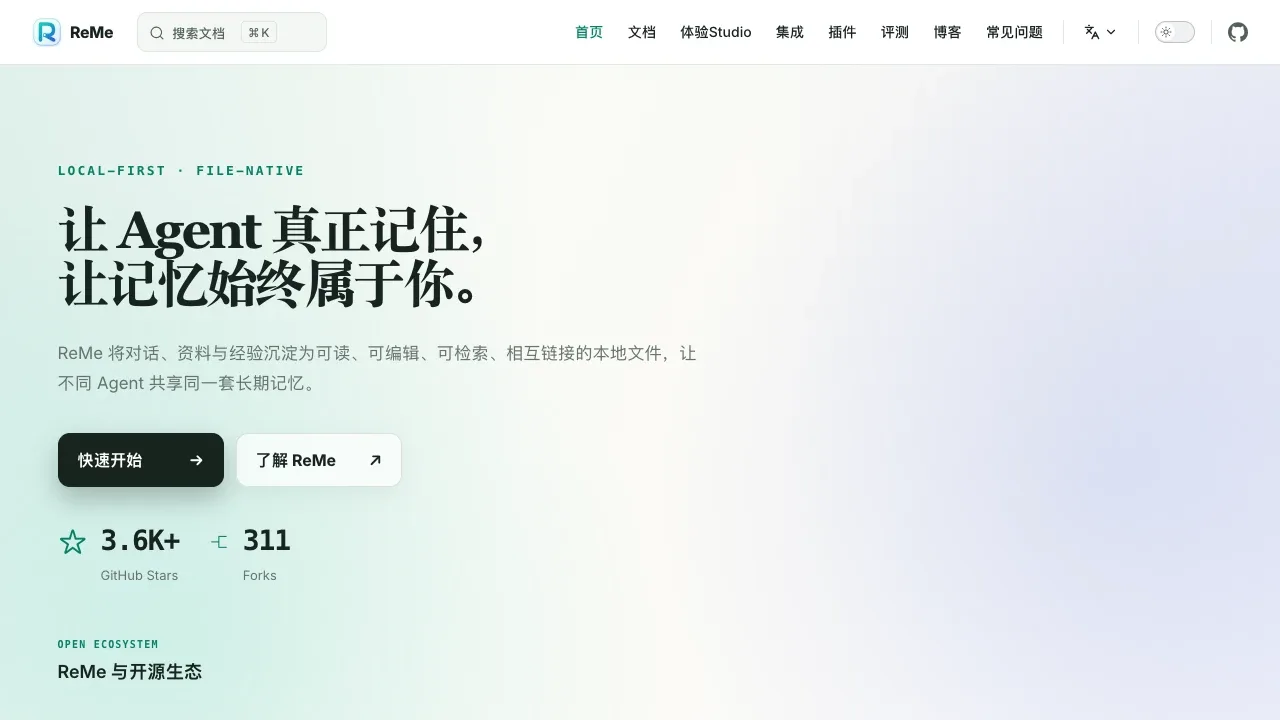
ReMe gives AI agents lasting memory across conversations. It's for developers who want coding assistants or personal agents to retain useful facts, preferences, and procedures in files they can inspect and edit.
- Editable memory: Keep knowledge in ordinary Markdown files with links between notes, so you can edit, move, sync, and back up the memory independently of an agent.
- Conversation and resource capture: Turn conversations, text resources, and images into daily notes that retain links to their sources.
- Long-term knowledge: Consolidate daily notes into lasting records, refining or correcting facts and reusable procedures over time.
- Targeted recall: Retrieve relevant passages and related notes through keyword search, linked-note traversal, and optional semantic search without sending the whole knowledge base into the agent's context.
- Shared agent workspace: Connect Claude Code, Codex, OpenClaw, Hermes, QwenPaw, or DeepSeek Harness to the same memory files; integrations support recall and conversation capture according to the host's capabilities.
ReMe is open source under Apache 2.0. It runs as a local service, including through Docker, or within a Python application. Its Studio browser interface lets you browse, edit, and search the local workspace.
Memory files stay in a user-controlled workspace. Basic file operations and keyword search don't need LLM credentials. Automatic memory creation, resource processing, consolidation, and proactive refresh require an LLM API connection; if you use a cloud provider, those operations send content to that provider. Semantic search is optional and disabled by default.
 Logotyper


