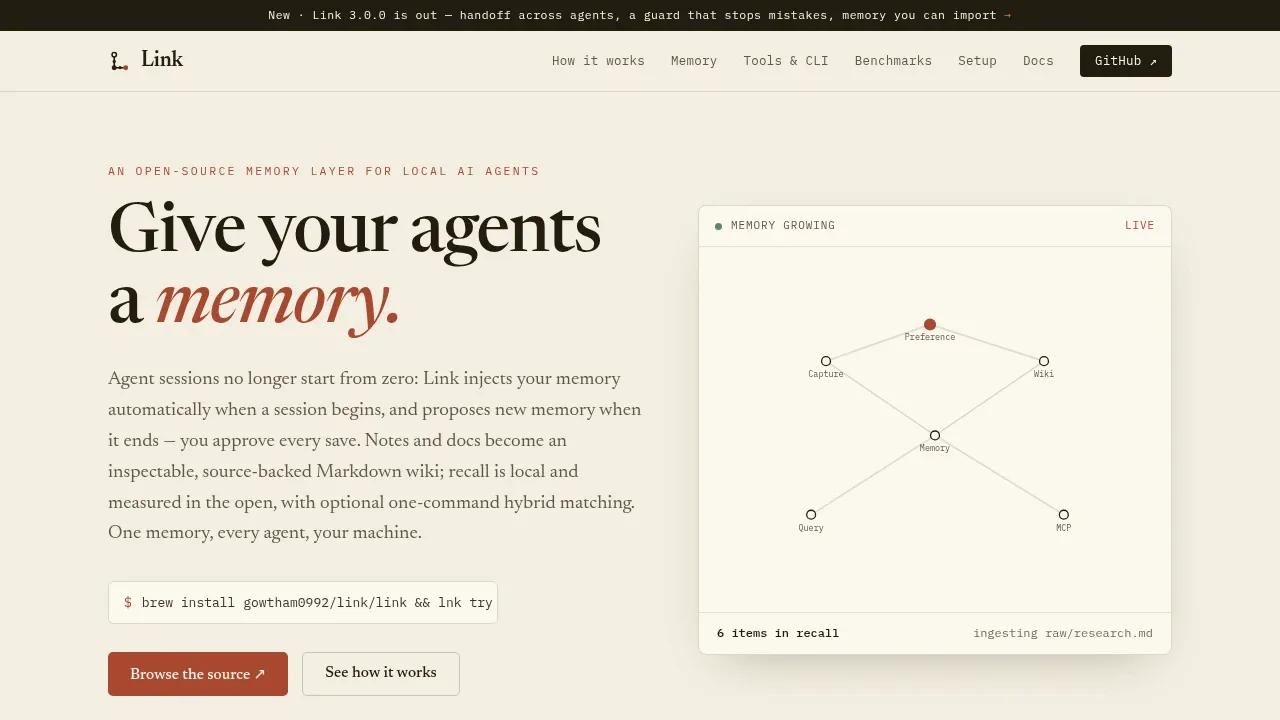
Link is an open-source memory layer for people who use AI agents across sessions or switch between coding tools. It keeps preferences, project decisions and other saved context in local Markdown files that connected agents can share. The MIT-licensed Python tool works with Claude Code, Codex, Cursor, GitHub Copilot and other agents through MCP and editor integrations.
Agents turn notes, transcripts, PDFs and screenshots into a wiki with links back to the original sources. Durable memories require your approval. Session hooks supply context when an agent starts and propose memories when it finishes, so an automatic capture doesn't become an accepted fact. You can inspect the files in any editor or open the wiki in Obsidian.
Recall returns compact context with source references and confidence labels. The default memory layer doesn't need an LLM, API or vector database. Optional semantic matching uses a local embedding model and works offline after initial setup. Review dates bring stale memories back for checking, expiry dates remove them from default recall, and historical queries retrieve what was recorded as true at an earlier date.
Memory stays on your machine unless you choose to sync reviewed files through a Git remote you control. Sync checks for secrets and excludes private captures; teams can share approved memory through the same approach. A local viewer lets you browse the workspace, while LinkBar on macOS adds recall and memory review from the menu bar. Local retrieval records show which memories agents read and when, without recording your questions.
Claim this page and we'll verify you by hand. Link gets the verified badge, and you can upgrade the listing to be featured on localhosted. Proud to be listed? Put our badge on your site.
Want more people to find Link?Promote it
Something wrong or outdated on this page?
8.7KUpdated 19 hours agoMIT
macOS · Windows · Linux · Docker · Web#Git integration#Hybrid search#Knowledge graphs
ai-memory keeps project knowledge on a server you control so developers can switch coding assistants or machines without losing context. It connects Claude Code, Codex, Cursor, Gemini CLI and OpenCode to shared memory, including unfinished work, failed approaches and open questions.
31.3KUpdated 2 days agoApache-2.0
Docker · Web#Knowledge graphs#MCP#Multi-user access
619Updated 5 days agoMIT
Docker · Web#Agent Skills#Hybrid search#Knowledge graphs
705Updated 3 months agoMIT
Web#Human approval#Hybrid search#Knowledge graphs
SwarmVault is a self-hosted knowledge base for people who want research, notes, or code documentation to become a persistent wiki that AI agents can use. It stores original sources, Markdown pages, and a knowledge graph as local files you can inspect. The project is open source under the MIT license.
1.6KUpdated 3 months agoApache-2.0
#Git integration#Human approval#Hybrid search
pieces.appAgent Memory
#MCP#Persistent memory#RAG
Cognee gives AI agents persistent memory across sessions, connecting documents, code, and conversations in a searchable knowledge graph. It's for developers who want agents to retain project context and teams whose knowledge sits across tickets, discussions, and repositories. The Python package is open source under Apache 2.0.
sage-wiki turns documents into linked articles and a knowledge graph that both people and AI agents can query. It's for personal research collections, shared team knowledge, and agents that need a lasting memory of what they've learned. The software is open source under the MIT license and runs as a Go binary or in Docker on your own machine or server. It supports local models through Ollama.
ktx gives data agents a shared set of approved metrics and business context before they query a warehouse. It's for analytics teams whose agents otherwise keep rediscovering schemas or producing numbers with inconsistent definitions. The context lives in a local project as Markdown and YAML files that teams can review and version in Git.
Pieces runs in the background on your computer and builds a searchable history of your work across apps. It's for people who need to recover a decision, find earlier research or resume a task after switching between tools. Memories stay on your machine by default.