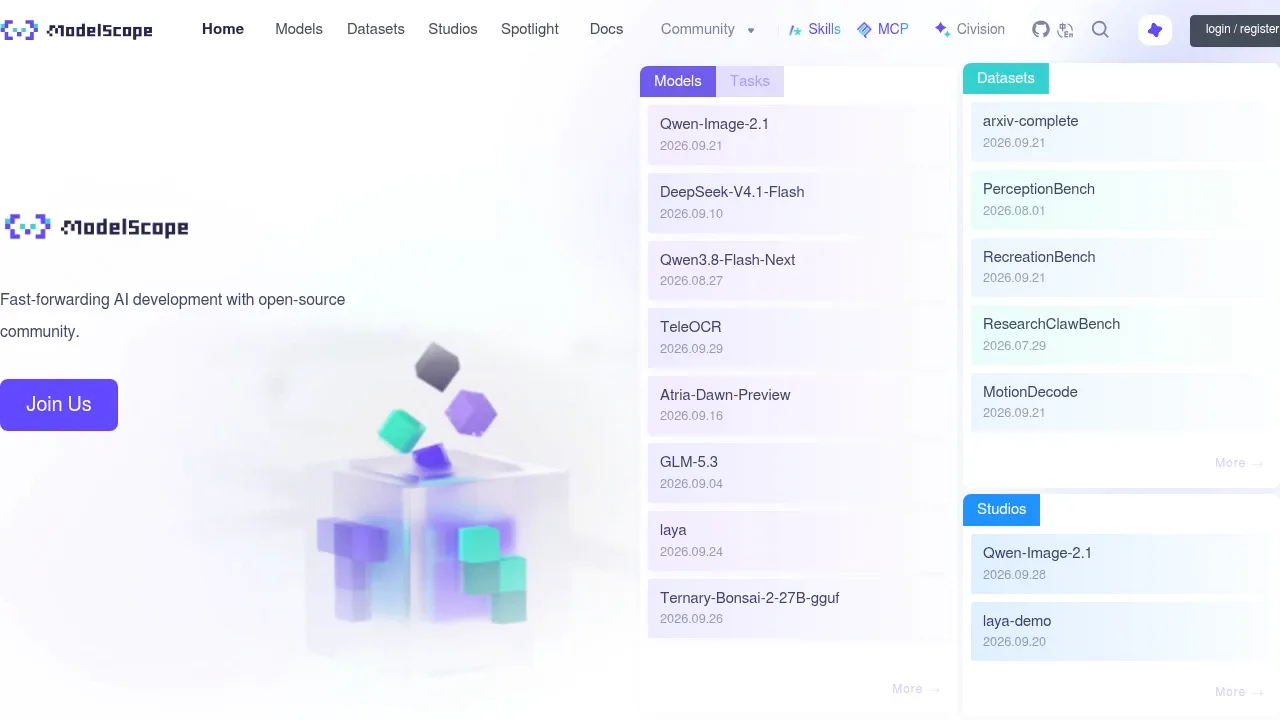
ModelScope combines a hosted model and dataset hub with a Python library you can run locally. It's for developers and researchers who want to use AI models in their own applications, fine-tune them on their own data, or compare their performance. The library is open source under Apache 2.0.
Its scope extends beyond local LLM work. Models cover computer vision, speech, multimodal tasks and scientific computing, including text generation, image editing, speech recognition and protein structure prediction. The hub includes Qwen and DeepSeek models, along with projects such as Meta-Llama-3-8B-Instruct and LaMa image inpainting.
The library provides a shared interface for inference, training and evaluation across these different tasks. It supports PyTorch, TensorFlow and ONNX, with modular components that developers can customize for their applications. Support also covers model export, deployment and distributed training, including data and model parallel approaches.
The local library and hosted services have distinct roles. You can download public models for use in a local Python environment; the website provides online demos, Studios for displaying AI applications, and cloud notebooks backed by CPU or GPU environments. Those browser experiences run on hosted infrastructure.
The library connects to the model and dataset hubs for discovery, version management and caching. Most models on the hub are public and available for direct download.
Claim this page with an email at modelscope.cn. ModelScope gets the verified badge, and you can upgrade the listing to be featured on localhosted. Proud to be listed? Put our badge on your site.
Want more people to find ModelScope?Promote it
Something wrong or outdated on this page?
13.7KUpdated 3 weeks agoApache-2.0
#Hugging Face integration#LoRA#Quantization
LitGPT is a Python toolkit for developers and researchers who want to train, adapt and serve language models on their own hardware or servers. Its model implementations are written directly, with little abstraction between you and the code, so you can inspect model behavior and modify it for research or custom applications. It's open source under Apache 2.0.
9.4KUpdated 2 days agoApache-2.0
Docker#Distributed execution#LoRA#Multimodal input
2.3KUpdated 4 months agoMPL-2.0
macOS · Windows · Linux · Docker#Multilingual#Streaming inference#Voice cloning
21.1KUpdated 2 days agoApache-2.0
macOS · Web#GGUF#Hugging Face integration#Multilingual
19.1KUpdated 1 week agoApache-2.0
#Hugging Face integration#Multilingual#Multimodal input
12.2KUpdated 1 month agoMIT
#Multilingual#Multimodal input#Semantic search
Oumi builds specialized AI models for teams that want control over their training data, model weights, and deployment. Its Apache 2.0 open-source stack runs on laptops, clusters, and your own servers, while its hosted service automates model development from a plain-English task description. You own the resulting weights, data, and training recipes.
Coqui TTS (idiap fork) is a local text-to-speech library for developers and speech researchers who want pretrained voices or tools to train their own models. It builds on coqui-ai/TTS, continuing the original unmaintained project. The Python toolkit is open source under the Mozilla Public License 2.0 (MPL-2.0).
Candle is a Rust machine learning framework for developers who want to embed local AI in applications or deploy models on their own servers. It produces lightweight binaries that don't need Python in production, making it a candidate for serverless inference where a large runtime can slow startup. Its API uses tensor operations familiar to PyTorch developers.
Sentence Transformers is an open-source Python library for developers building semantic search and document retrieval on their own hardware. It runs embedding and reranker models locally, turning content into numerical representations for similarity comparisons and scoring results against a query. The library uses the Apache 2.0 license.
FlagEmbedding is an open-source Python toolkit for developers building semantic search or retrieval-augmented generation (RAG) into their own applications. It runs BGE embedding and reranking models, with tools to fine-tune both and evaluate retrieval results. The library uses the MIT license.