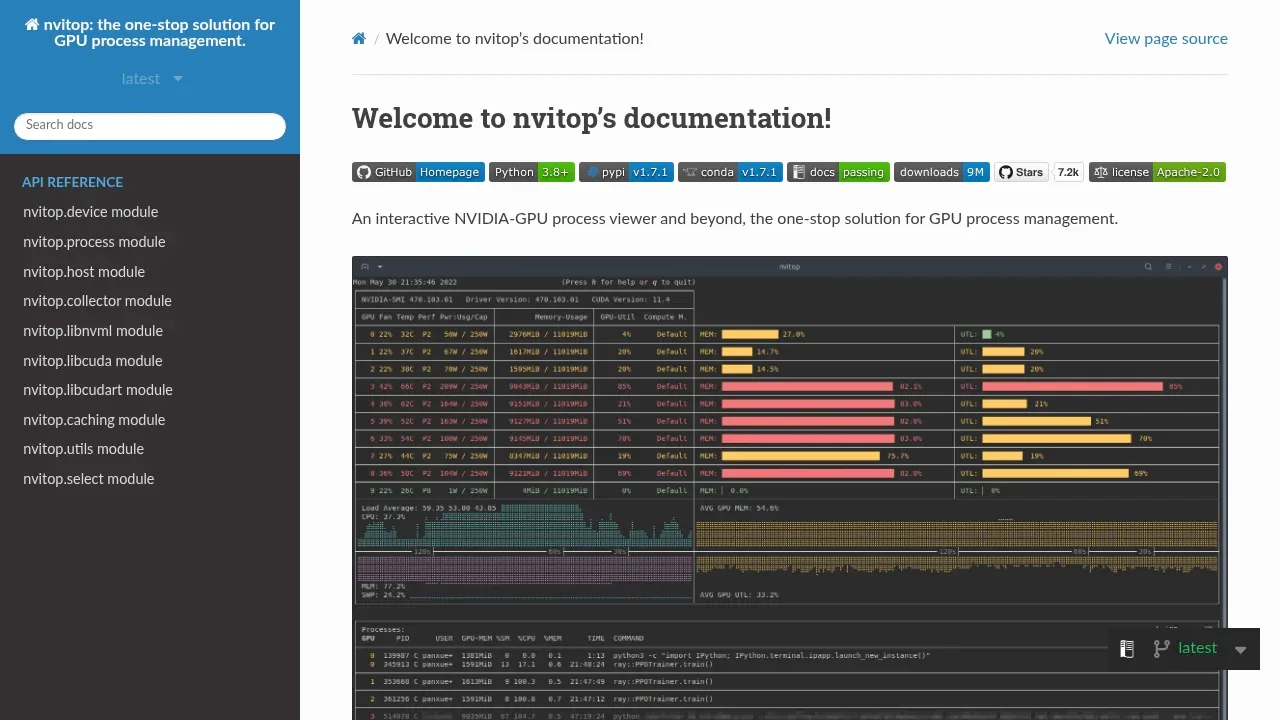
nvitop is an interactive terminal monitor for NVIDIA GPUs and the processes using them. It runs locally on Linux and Windows and suits people running AI workloads who need to see device usage alongside host process information. The project is open source under Apache 2.0.
Its live view includes bar charts and history graphs, with sorting and filtering to help you find the processes you're interested in. You can inspect a GPU process's parent and child processes in a tree view, check its environment variables, or send it a signal from the monitor. Keyboard and mouse controls support interaction, though mouse support can vary between Windows terminals. A one-time status view is also available.
nvitop queries NVIDIA's NVML interface directly rather than reading the text output of nvidia-smi. It requires NVIDIA hardware supported by NVML and access to that library, which ships with NVIDIA drivers. The Python implementation gathers information asynchronously and caches queries to keep the monitor responsive. It also works over SSH and can run in Docker with NVIDIA container support.
For custom monitoring, its Python APIs collect host, GPU and process metrics and capture device and process status together. nvitop-exporter supports Prometheus and Grafana dashboards, giving server operators a browser view of GPU activity. The included nvisel tool selects GPUs according to supplied criteria and can feed that selection into a training script.
Claim this page and we'll verify you by hand. nvitop gets the verified badge, and you can upgrade the listing to be featured on localhosted. Proud to be listed? Put our badge on your site.
Want more people to find nvitop?Promote it
Something wrong or outdated on this page?
2.3KUpdated 1 day agoMPL-2.0
macOS · Windows · Linux · Docker#Agent Skills#Batch processing#Multi-user access
dstack is a self-hosted orchestration tool for AI teams managing compute across GPU clouds and their own servers. It puts cluster management, training jobs and model inference behind one interface, so teams can use different providers and accelerators without maintaining a separate workflow for each environment. It's open source under the Mozilla Public License 2.0.
11KUpdated 3 days ago
macOS · Windows · Linux · Docker
nvtop is a terminal monitor that shows activity across multiple GPUs and accelerators in an interface familiar to htop users. It's useful for people running local LLM workloads or managing compute servers who want to see which processes are using their hardware and how much GPU memory they consume. It runs locally on Linux and is open source under GPLv3 or later.
2.8KUpdated 1 day agoApache-2.0
Windows · Linux · Docker · Web#LLM tracing#Ollama integration#Prompt versioning
6.9KUpdated 2 days agoApache-2.0
Docker · Web#Code execution#Git integration#Multi-user access
2.6KUpdated 1 week agoAGPL-3.0
Linux · Docker
jetson-stats monitors NVIDIA Jetson hardware and gives you control over its power and cooling settings. It runs locally on the board, with a terminal interface called jtop for people developing or running workloads on Jetson devices, including local AI applications.
6.8KUpdated 4 weeks agoMIT
Windows · Linux
ROCm is AMD's open-source GPU computing platform for developers running AI training, inference and scientific workloads on their own hardware or servers. It supports selected Linux and Windows configurations on AMD Instinct, Radeon and Ryzen AI devices. Check the version-specific GPU, operating-system, driver and firmware compatibility matrix before installing. It's the software foundation for applications that need AMD GPU acceleration, including local LLM workloads.
OpenLIT is a self-hosted platform for developers who need to understand how their LLM applications and AI agents behave. It connects model calls with tool activity, retrieval and agent steps, so teams can investigate errors and compare cost, latency and output quality across a workflow.
ClearML is an MLOps suite for recording experiments, managing datasets and running ML workloads. Its Apache 2.0 Python SDK connects to a ClearML Server, available as a hosted service or open-source software you deploy yourself. ClearML Agent handles job orchestration and reproducibility.