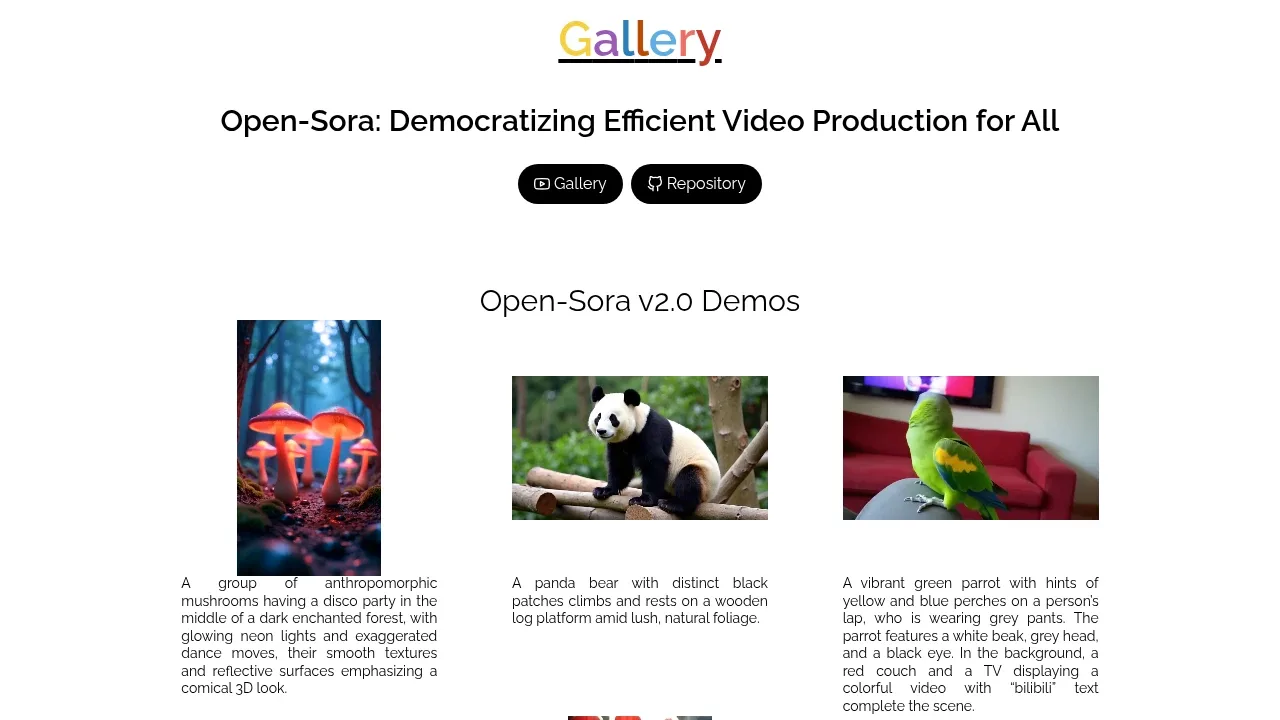
Open-Sora is an open source AI video generation project for developers, researchers, and creators who want to run and adapt a model on their own hardware. Its model focuses on turning reference images into video, with text prompts guiding the result. It also generates video directly from text. The code and Open-Sora 2.0 weights use Apache 2.0.
The same model handles both input types. For text prompts, a separate pipeline uses Flux to create an image before Open-Sora animates it. The default image stage uses FLUX.1-dev weights with their own license; Open-Sora's Apache license does not cover that component. The gallery includes realistic scenes and stylized animation, with examples of moving subjects and camera motion.
Users can influence movement through a motion score, and the project includes an evaluator for measuring motion in generated clips. Seed controls support reproducible results, while multiple samples let users compare different outputs from one prompt. Optional prompt refinement uses ChatGPT, so that feature sends prompts to an external service.
Open-Sora also provides tools and technical reports for training or fine-tuning a video model and training and evaluating its video autoencoder. Its Python code uses ColossalAI for work across multiple GPUs and supports offloading to reduce GPU memory pressure. Published performance tests use NVIDIA H100 and H800 GPUs, so the documented hardware context is server-class GPU computing.
Claim this page and we'll verify you by hand. Open-Sora gets the verified badge, and you can upgrade the listing to be featured on localhosted. Proud to be listed? Put our badge on your site.
Want more people to find Open-Sora?Promote it
Something wrong or outdated on this page?
3.2KUpdated 2 years agoMIT
macOS · Web#Hugging Face integration#Multimodal input
Pyramid Flow is an open-source AI video generator for people who want to create clips on their own hardware, and for researchers working on video models. It turns text prompts into video or animates a supplied image with guidance from text. The Python code uses PyTorch and carries MIT. Model licenses are separate: the SD3-derived weights use the Stability AI Community License. Check the chosen checkpoint before deployment.
12.3KUpdated 2 years agoApache-2.0
Web#Hugging Face integration#LoRA#Multimodal input
13KUpdated 11 months agoApache-2.0
Windows · Web#Hugging Face integration#LoRA#Multimodal input
17.3KUpdated 11 months agoApache-2.0
Windows · Linux · Web#Hugging Face integration#Multimodal input
8.7KUpdated 2 years agoMIT
Linux#Hugging Face integration#Multimodal input#ONNX
6.1KUpdated 1 year agoApache-2.0
Web#Batch processing#Hugging Face integration#Multimodal input
AnimateDiff adds text-driven animation to personalized Stable Diffusion models without requiring separate training for each model. It's for artists and developers who want to generate motion while keeping the visual style of a chosen image model. The Python implementation runs locally and includes a Gradio browser interface.
CogVideoX is a family of downloadable video generation models for developers, researchers and creators who want to generate clips on their own hardware. It turns English text prompts into video, animates a supplied image and can continue an existing video. A local Gradio web interface provides a browser front end for generation.
FramePack is an open source desktop app for making videos from a still image and a written motion prompt. It runs on Windows and Linux, with generation handled by your own NVIDIA GPU. It suits people who want to make AI video locally and see the clip develop as it renders.
Hallo turns a single portrait and a speech recording into an animated talking video on your own hardware. It's a local AI tool for creators working with talking portraits and researchers who want access to both generation and training code. The Python code uses the MIT license; required pretrained models and dependencies have their own terms.
LatentSync is an open-source AI lip-sync tool that edits a video's mouth movements to match supplied audio. It runs on your own GPU and suits video creators working with talking faces or virtual avatars, as well as researchers who want to train their own lip-sync models. The code uses the Apache 2.0 license.