
PandasAI is a Python library for people who want to ask questions about their data in plain language. It works with SQL databases, CSV and parquet data, and can answer questions across multiple pandas DataFrames. Developers can use it in their own applications; analysts can use conversational queries to reduce the code they write for individual questions.
The library generates charts as well as answers, so a question can produce a visual result without a separate charting task. It uses LLMs and retrieval-augmented generation for conversational analysis. A Docker sandbox provides an isolated environment for executing analysis code, which matters when generated code runs against your data.
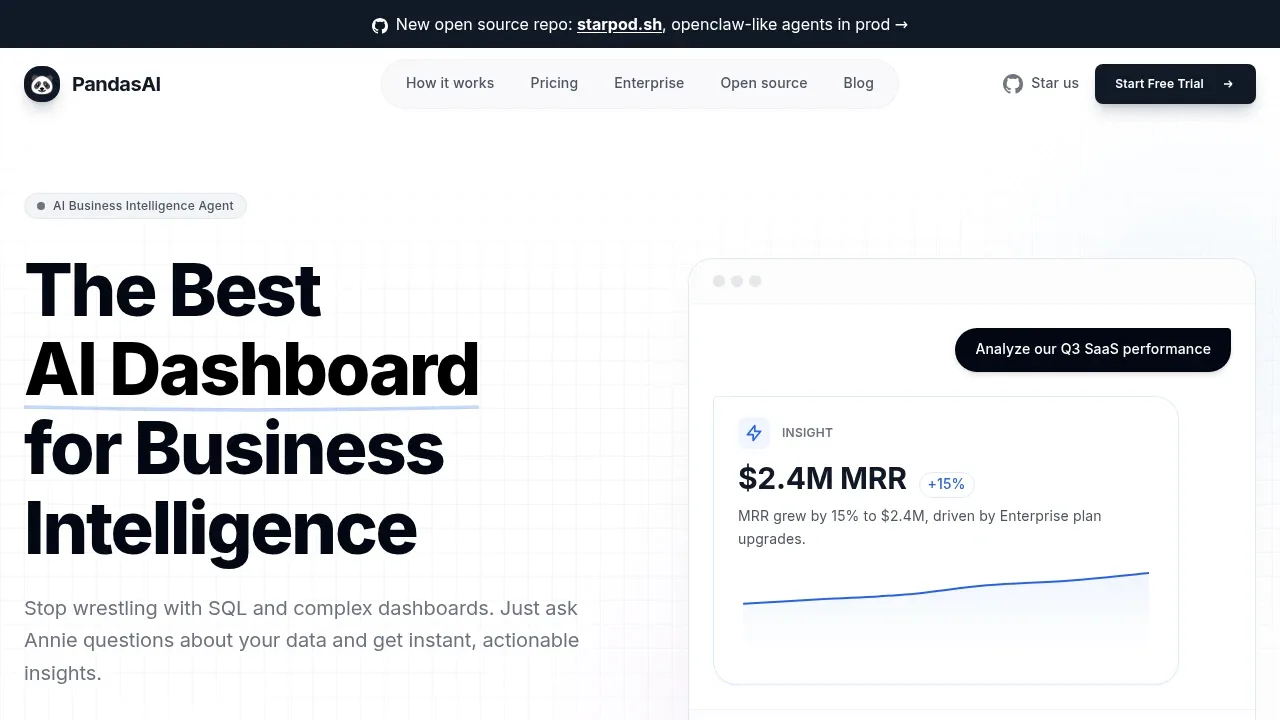
The same team offers Annie, a separate hosted business intelligence app. It targets business users who want analysis without writing SQL or Python. Annie turns questions into charts and shareable dashboards, supports follow-up questions, and produces executive summaries and PDF exports. Its analysis capabilities include trends, forecasting, anomaly detection and root cause analysis.
Deployment differs between the products. The Python library can run in your own environment, while Annie has a hosted offering and deployment options for on-premise systems, private VPCs and air-gapped environments. Annie also supports custom LLM integration.
Claim this page with an email at pandas-ai.com. PandasAI gets the verified badge, and you can upgrade the listing to be featured on localhosted. Proud to be listed? Put our badge on your site.
Want more people to find PandasAI?Promote it
Something wrong or outdated on this page?
20.1KUpdated 2 days agoMIT
macOS · Linux · Docker · Web#Code execution#llama.cpp backend#OpenAI-compatible API
DB-GPT is a self-hosted AI data assistant for teams analyzing business data and developers building data applications. It turns plain-language requests into SQL queries and Python analysis, then produces charts, dashboards, or HTML reports. You can run it on macOS or Linux, with Docker deployment also supported.
57.6KUpdated 1 week agoApache-2.0
Docker · Web#Code execution#llama.cpp backend#MCP
28.3KUpdated 1 day ago
macOS · Windows · Linux · Docker · Web#Code execution#MCP
Chat2DB Community is a database client and AI SQL workspace for developers, database administrators and analysts. It runs on Windows, macOS and Linux, with Docker and browser access also available. Its AI assistant connects to a model you configure to generate, explain and optimize SQL. Where AI requests are processed depends on that model connection.
26.6KUpdated 1 day agoApache-2.0
Docker#Guardrails#Hugging Face integration#Hybrid search
38.7KUpdated 11 months agoApache-2.0
macOS · Windows · Linux · Docker · Web#Multimodal input#Ollama integration#OpenAI-compatible API
5.8KUpdated 4 months agoPostgreSQL
Docker#Batch processing#Ollama integration#RAG
PrivateGPT is a self-hosted API layer for developers building AI applications around local models. It adds document retrieval, database access and agent tools to an existing model server. Local workflows can work offline and keep data within your environment; web search and connections to online providers need internet access.
Haystack is a Python framework for developers building self-hosted AI agents, document search, and apps that answer questions using their own data. Its modular pipelines let teams control which information reaches a model and inspect how retrieval, memory, tools, and generation contribute to an answer. It's open source under Apache 2.0.
Langchain-Chatchat is a self-hosted application for asking questions about your own documents and using AI agents. It focuses on Chinese-language use and open models, with a fully offline setup that can keep documents and model processing on your hardware. Its code is open source under Apache 2.0.
pgai keeps search embeddings in sync with PostgreSQL data for developers building RAG applications and AI agents. It's a Python library with database components and workers you can self-host, including in Docker. The project is archived and no longer maintained or supported. Its code is open source under the PostgreSQL License.