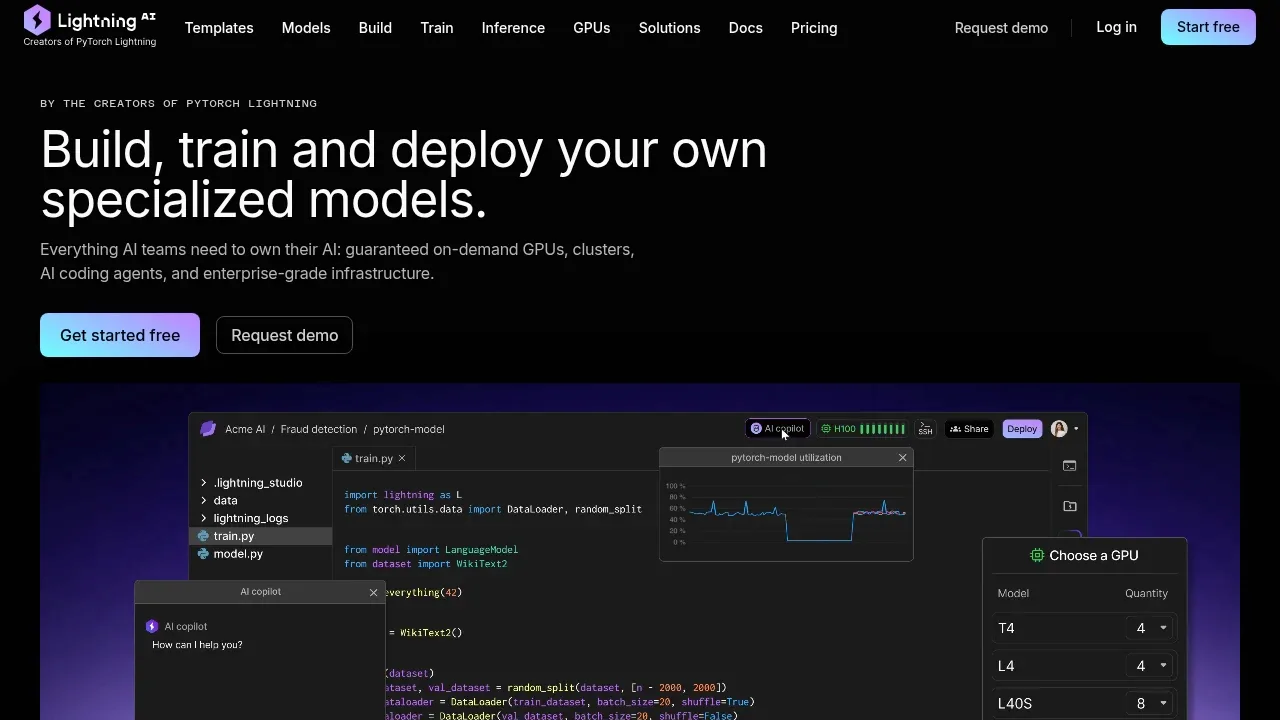
PyTorch Lightning is a Python framework for researchers and developers who want to pretrain or fine-tune models on their own hardware or in the cloud. It handles repetitive training code while leaving model logic under your control. The framework is open source under Apache 2.0.
Its main value is keeping a PyTorch project usable as training grows from a CPU to multiple GPUs or machines. Lightning automates backpropagation, mixed precision and distributed training without requiring changes to your core model code. Your models remain PyTorch modules, so you can keep working with PyTorch rather than adopt a separate model format.
Training features include checkpointing, early stopping and experiment manager integrations. It also supports exporting models to ONNX and TorchScript for production use. The framework covers tasks such as classification, segmentation and summarization, rather than focusing only on language models.
For teams that need more control over training loops, the companion Lightning Fabric package provides lower-level tools. Fabric supports Apple Silicon and CUDA GPUs, CPUs and TPUs, plus distributed training strategies such as DDP, FSDP and DeepSpeed.
You can run the framework on your own hardware without choosing Lightning's hosted service. Lightning Cloud is a separate offering that runs workloads on cloud GPUs and provides infrastructure management, autoscaling and monitoring. The hosted platform also supports private cloud and VPC deployments, Kubernetes and Slurm.
Claim this page with an email at lightning.ai. PyTorch Lightning gets the verified badge, and you can upgrade the listing to be featured on localhosted. Proud to be listed? Put our badge on your site.
Want more people to find PyTorch Lightning?Promote it
Something wrong or outdated on this page?
21.9KUpdated 1 day agoMIT
macOS · Windows · Linux · iOS · Android · Web#Distributed execution#ONNX
ONNX Runtime is an open source inference and training engine for developers building AI into apps and services. It runs ONNX models across desktop systems, mobile devices, web browsers and servers. It's a fit when you need the same model format to work in several places, including on a user's device.
21.1KUpdated 2 days agoApache-2.0
macOS · Web#GGUF#Hugging Face integration#Multilingual
28.6KUpdated 23 hours agoMIT
macOS · Linux#Distributed execution#LoRA
21.7KUpdated 1 day agoApache-2.0
macOS#Distributed execution#Hugging Face integration#LoRA
2.9KUpdated 19 hours agoAGPL-3.0
macOS · Docker · Web#ControlNet#Distributed execution#Human approval
12.2KUpdated 3 days agoMIT
macOS · Windows · Linux · Web#Hugging Face integration#Image-to-image#LoRA
Candle is a Rust machine learning framework for developers who want to embed local AI in applications or deploy models on their own servers. It produces lightweight binaries that don't need Python in production, making it a candidate for serverless inference where a large runtime can slow startup. Its API uses tensor operations familiar to PyTorch developers.
MLX is a machine learning array framework for researchers and developers building models on their own hardware. Its distinctive feature on Apple silicon is shared CPU and GPU memory: both processors can work on the same arrays without copying data between them. It's open source under the MIT license.
PEFT is an open-source Python library for developers who want to adapt pretrained models on their own hardware with less compute and storage than full fine-tuning requires. It trains a small subset of parameters, often through adapters, while leaving the base model intact. It's licensed under Apache 2.0.
SimpleTuner is an open-source toolkit for fine-tuning image, video and audio generation models on your own hardware or GPU servers. It's for creators and researchers adapting models to their datasets, and teams sharing training infrastructure. A web dashboard manages training jobs.
AI Toolkit (ostris) is an MIT-licensed training suite for people who want to fine-tune image and video models on their own hardware or a self-hosted server. It targets consumer NVIDIA GPUs and runs on Linux and Windows, including ARM64 Linux systems such as DGX Spark. An experimental installer also supports Apple Silicon Macs. GPU memory needs depend on the model and training task.