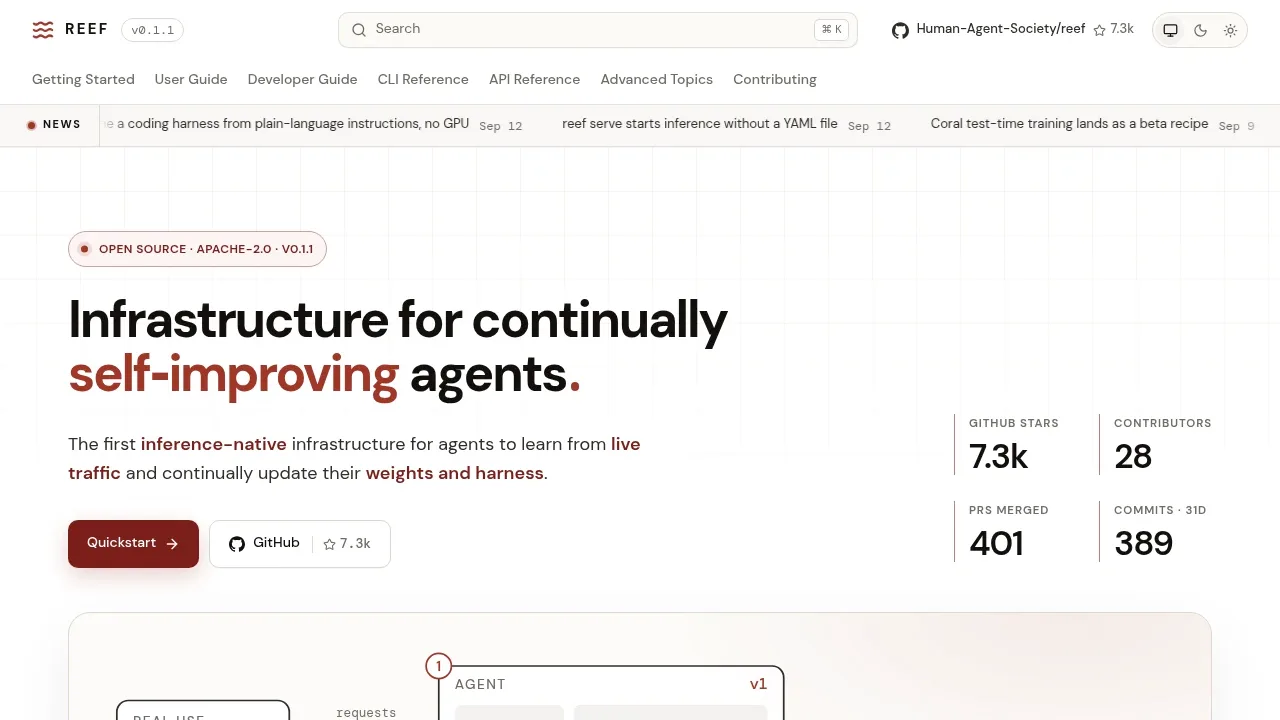
Reef is self-hosted infrastructure for developers who want AI agents to improve through feedback on actual interactions. It connects inference and learning with versioned deployment, so an agent can update its model weights or its prompts, rules, and skills while continuing to serve requests. It's open source under Apache 2.0.
The two approaches have different hardware needs. Weight training uses Slime and SGLang and requires a trainable model with a supported GPU stack. Harness optimization, which changes the instructions and tools around a model, works with any model endpoint and doesn't need local training GPUs. Reef runs the service and keeps harness state locally; if you connect an external model API, inference requests go to that provider.
Reef accepts OpenAI- and Anthropic-compatible requests and associates feedback with the interactions it evaluates. That feedback can include scores, written explanations, or structured data. Candidate updates pass through evaluation and selection before Reef publishes them, and version history tracks the resulting artifacts. Updated weights reach the serving runtime without a restart.
Its recipes cover different kinds of agent improvement. Reefine refines a coding harness from plain-language requests, while SkillClaw develops skills from failures. GEPA evolves prompts through reflection, and Meta-Harness searches across full harness designs. For model training, SAO learns from a single rollout and OpenClaw-RL learns from personalized chat.
Claim this page with an email at reefinfra.ai. Reef gets the verified badge, and you can upgrade the listing to be featured on localhosted. Proud to be listed? Put our badge on your site.
Want more people to find Reef?Promote it
Something wrong or outdated on this page?
15.8KUpdated 2 days agoApache-2.0
Web#Distributed execution#Hugging Face integration#LoRA
ms-swift is a Python framework for developers and researchers who want to train and deploy language or multimodal models on their own hardware. It brings fine-tuning, evaluation and model serving into one project, with support for Qwen3, DeepSeek-R1, Llama4 and Mistral, plus multimodal models such as Qwen3-VL and InternVL3.5. It's open source under Apache 2.0.
38.4KUpdated 4 days agoMIT
#Code execution#MCP#Multimodal input
13.7KUpdated 3 weeks agoApache-2.0
#Hugging Face integration#LoRA#Quantization
20.1KUpdated 2 days agoMIT
macOS · Linux · Docker · Web#Code execution#llama.cpp backend#OpenAI-compatible API
5.1KUpdated 21 hours ago
macOS · Windows · Linux#Git integration#MCP#Multi-agent workflows
Kiln is a desktop workbench for teams building AI applications on macOS, Windows and Linux. It keeps a task and its dataset together across evaluation, prompt optimization, RAG and fine-tuning, so teams can compare changes against the same examples. Engineers, data scientists, QA staff and subject matter experts can contribute through the app.
7.7KUpdated 5 days agoMIT
macOS · Windows · Linux · Docker · Web#Code execution#GGUF#Hugging Face integration
DSPy is a Python framework for developers building AI applications whose tasks need clear inputs, predictable output types, and measurable results. You define what a language model should produce, then compose those tasks into a larger program. It's open source under the MIT license.
LitGPT is a Python toolkit for developers and researchers who want to train, adapt and serve language models on their own hardware or servers. Its model implementations are written directly, with little abstraction between you and the code, so you can inspect model behavior and modify it for research or custom applications. It's open source under Apache 2.0.
DB-GPT is a self-hosted AI data assistant for teams analyzing business data and developers building data applications. It turns plain-language requests into SQL queries and Python analysis, then produces charts, dashboards, or HTML reports. You can run it on macOS or Linux, with Docker deployment also supported.
mistral.rs is an open source inference engine for running models on your own computer or self-hosted server. It's for developers building AI applications and people who want local chat, multimodal models and agent tools in the same runtime. The Rust project uses the MIT license.