
Reticle
A local app testing tool lets MCP coding agents check runtime behavior, inspect supporting evidence and replay saved flows without an AI model.
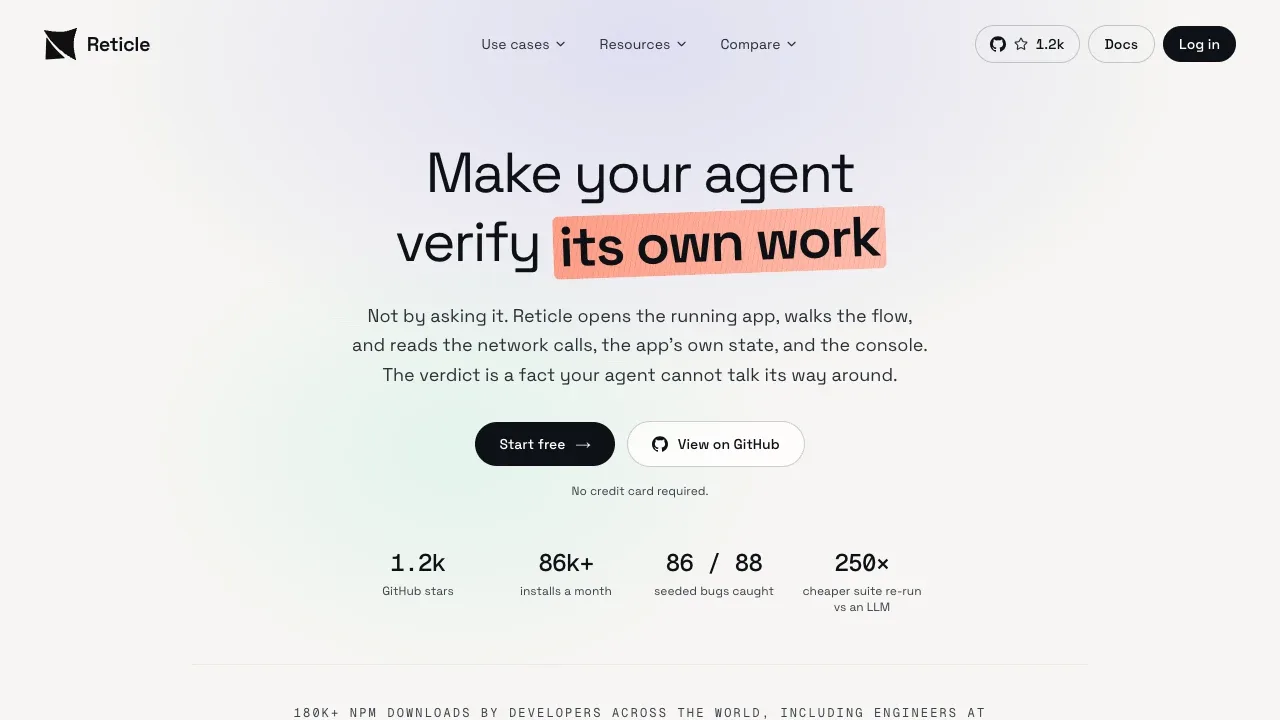
Reticle lets AI coding agents check changes against a running web or desktop app. It's for developers who need to catch failed requests, duplicate submissions and application state that disagrees with what the screen shows.
- Runtime evidence: Checks read network responses, application state and console output, then return a verdict with evidence and source locations; inconclusive checks don't count as passes.
- Saved flows: Agents can save a tested journey for repeat checks without an AI model, while a CI gate requires passing verification for flows affected by code changes.
- Behavior checks: Reticle can check access control, keyboard interactions, request counts and performance signals such as React renders, layout shifts and long tasks.
- Agent visibility: An in-page display shows agent actions, verdicts and saved flows, and lets developers pin notes for the agent.
Reticle works with MCP clients including Claude Code, Cursor, Codex and Gemini CLI. Supported app environments include React with Vite, Next.js, Remix, Astro, Electron and Tauri. State inspection includes zustand, Redux and TanStack Query. It uses a development-only SDK that is removed from production builds.
The local bridge listens only on the machine's loopback address. App data stays on your machine unless you link a project. The optional Harness runs on the platform and can drive a journey described in plain language, verify its steps and save successful flows.
Reticle can't inspect IndexedDB, Web Workers, closed shadow roots or cross-origin iframes. Cross-browser checks, pixel comparisons, full WCAG audits and vulnerability discovery need companion tools such as Playwright, visual testing software, axe or a security scanner.
 Logotyper


